The Jessica Dall Blog

Musings of a Book Reviewer, Editor, and Writer

Month: April, 2012

I am woman, hear me roar

Recently, an article (“The five most pathetic female film characters of all time” by Lindy West) popped up on my Facebook feed, outlining West’s choice of ”most-standy-there female movie characters.”

West goes on to point out female characters in movies who are “boring, old-timey, textbook damsel[s]-in-distress” with entries like:

-Valerie (Amanda Seyfried) in Red Riding Hood (described as “nubility personified/human Keane painting/tube of lip gloss made flesh…[whose role is to] Stand there. Wait to be rescued. Weep. Stand there some more. Quiver under the male gaze. Reapply lip gloss.”)

-Buttercup (Robin Wright) in The Princess Bride (“could Buttercup maybe DO something once in a while besides brush her hair and contemplate suicide because she and her boyfriend broke up? The woman is a blue silk sausage casing stuffed with whines.”)

and, of course:

-Bella (Kristen Stewart) in the Twilight Series (“Limp bag of tears waits for marriage to have sex with her undead boyfriend; is paralysed by grief every time he goes in the other room.”)

Ok, now even I can’t support a character that falls apart as soon as their man leaves (“You’re just… lifeless, Bella.”) but does that mean that you can never have a “weak” female character?

Now, having previously gone to a very liberal, very politically active university (we were in DC after all…) I have known my share of feminists, from radical to lipstick. I’ve also known a couple of people on the “feminism is subjugating men” side of the equation. Likewise, I would define myself as a feminist, by the fact that I support “equal political, economic, and social rights for women” What I have a problem with, however, is the idea I have found circulated in some groups that the only way to be a feminist is to rebel against what society has decided are “traditional” female roles. While I do fully support equal rights for women (which I don’t believe should shock many people reading this) I also like makeup, am currently wearing a dress, like to cook, and plan on taking my fiance’s last name once we get married (for at least social situations). Does the fact that I genuinely enjoy “traditionally feminine” things mean that I can’t be a feminist? If anything, how is telling women they have to like ”traditionally masculine” activities to be acceptable any different from telling them they have to like “traditionally feminine” activities?

Now, there are so many different arguments you can go off of from there (“traditional” roles are really fairly modern, men and women are different, but equal in their different ways, feminism is losing site of its original goal, what have you) but my point through all of that is: How is forcing a character to be strong just because she’s a woman any different from forcing a character to be weak?

I fully understand not wanting weeping, standy-there female characters. But I don’t think that, over all, is a problem with the characters being female. It’s a problem with the fact that standy-there characters, in general, are boring (and many times annoying). A protagonist that doesn’t make any decisions and lets the rest of the story carry them along isn’t much of a protagonist at all. Male or Female.  The “damsel in distress” (or her male equivalent) is not often cast as the main character of interesting books. Why? Because she doesn’t do anything. There isn’t much of a plot to be written when your main character is sitting up in a tower waiting to be rescued (at least not if you aren’t planning on doing some psychological drama about the effects of isolation, which I could actually see being pretty interesting).

Day 1: Sitting in tower. God I wish I weren’t in this tower.
Day 2: Still sitting here, you’d really think someone would come help me. Oh well, still hate it here.
Day 3: Sitting against the opposite wall now. I passingly considered trying to make a ladder out of sheets, but I think I’d rather keep sitting here and whining about being stuck in a tower with no one to save me.

Male or Female, I don’t care, I would get fed up with that character (and that book) very quickly.

To be clear, I’m not suggesting people rely on stereotypes for any of their characters. A female character shouldn’t be weak and emotional just because she’s a woman any more than a Latino character should eat nothing but tacos just because they’re Latino. But there are people in the world that can be weepy messes. As an author, you are perfectly allowed to have one in your story.

But I can also promise you, at least 99% of the time, being a weepy emotional mess is not all that real person is. Perhaps they’re battling depression. Perhaps they cry at the drop of a hat, but they are a genuinely good, happy person. Perhaps they used to be more balanced, but something happened to make them think that’s how they should act to be accepted. Don’t feel the need to make your character something they’re not just because it’s something that could be seen as a stereotype, but don’t make that trait their entire personality either. If you dig a little deeper, you will find so much more to them that will keep them who they are (weepy) but make them so much more than a one-note stereotype.

Some people fall into “traditional” stereotypes, there’s a reason they’re stereotypes after all, but people are complex. If you can capture that complexity in your character, you don’t have to make them something they’re not to not be “insulting” Let’s face it, making a character “un-stereotypical” but, again, just that one simple trait, it isn’t any better.

Googled Questions

One of the things I have to say I love about WordPress (the host for this blog, if you missed that in the URL) is that they give you a stats page about your blog. It might be a little more addicting than it should be (I really want someone from Russia to read this blog one of these days to get that country filled in on the “where your readers are” map) but it’s very handy when it comes to seeing how you’re reaching your readers, and what posts are the most popular.

What can be interesting about the stat page, though, is that it will sometimes show you search terms that brought people to your page. For example, if someone searched “Jessica Dall” and then clicked over here from Bing or Google or another search engine, it might show “Jessica Dall” as a search term on my stats page. Of course the page isn’t going to let me know who’s doing the searching (or even what country they’re in) since I’m sure that’s some sort of privacy violation, but it is interesting to see what people are trying to find out when they make it to this blog.

So, for anyone who’s Googled something and haven’t found the answer they wanted here, I’ll do my best at answering some of those questions. (Questions edited for spelling mistakes/coherency)

Q. Is 300,000 words a long book?
A. Yes, it is, but hardly the longest out there.
- Likely article(s) they were interested in: Why it’s harder to get longer books published , or tips on cutting down word count.

Q. When writing in third person, can you say what several characters are feeling?
A. It depends. There are two different ways of writing third person: Third Person Limited and Third Person Omniscient. In the first (currently more popular) narrative, you are telling a story through the point of view (POV) of a character, just describing them as he/she/it rather than I. In third Person Limited you should stay in the head of your POV character (thus you can only say what they feel/what they observe. If they don’t know Character B is upset because she had a little sister POV Character’s age, the narrative can’t explain that while still in POV Character’s head). In Third Person Omniscient, the story is being told by an all-knowing narrator. It is generally uncommon to find true Third Person Omniscient stories at the moment (the style seems to have been most popular in the 19th century) but if the story is being told by a narrator who knows everything it is possible for that narrator to say how all the characters a feeling (just make sure you aren’t writing in Third Person Limited and then decided you’re going to call it Third Person Omniscient randomly just so you can jump back and forth with how characters are feeling).
-
Likely article(s) they were interested in: Head Jumping

Q. Should you use contractions in query letter?
A. Sure. I’m not sure there is a set protocol for it (I never knew one when I worked in submissions) but I don’t believe there’s any reason to sound overly formal in a query letter and (at least to me) you sound more natural as a writer if you use contractions, which is a good thing in my humble opinion.
- Likely article(s) they were interested in: I don’t think there’s one directly related, but I do touch on why you should use contractions in creative writing here.

Q. How much narration do I need in a novel?
A. Depends on your novel. There are reasons to use narration some places and dialogue others. It’s about weighing the pros and cons to each. The big thing is not to worry too much about having a perfect ratio of narration to dialogue in your novel, it’s to make sure you’re telling the story the best way it can be told.
- Likely article(s) they were interested in: Pros and Cons to dialogue and narrative in Too Much Dialogue

Q. What’s the poison thing vampires have?
A. I don’t know, Googler, I don’t know… Apparently rather than turning someone into a vampire by feeding them your vampire blood (a la Anne Rice) in some books it’s “vampire poison” ( though I suppose it would be “vampire venom” if you’re going to be technical on the poison vs. venom thing) that turns a human into a vampire (the bite infects them or what not and if they don’t die the poison/venom changes them into vampires). Of course, it’s fantasy, so your guess is as good as mine.
- Likely article(s) they were interested in: One of the many where I talk about writing problems where Twilight just happens to pop up…

Q. Is it ok to use song lyrics for writing prompts?
A. Absolutely. I’ve used a couple of different songs as the original inspiration for characters, plots, or even entire stories that have now been published. What you don’t want to do, however, is quote the song lyrics in your story (you can get into a whole host of problems with copyright infringement then).
- Likely article(s) they were interested in: Writing Prompts

Q. What’s the shortest word count a publisher will accept?
A. It depends on the publisher (look at their submission guidelines as to what they accept before sending a query). It also will depend on if the publisher only publishes novels (generally considered to be over 50,000 words, but many publishers put novels in the 70,000+ words range) or if they also publish novellas and short stories. Of course, word counts are generally guidelines. One novel I have coming out this summer is around 51,000 words and the publisher generally doesn’t publish things that short, they just liked mine and made an exception. If nothing else, and you have an awkward word count, try searching for a publisher on a site like Duotrope which will let you search based one word counts accepted rather than just “novel/novella/short story”
- Likely article(s) they were interested in: Word Limits

Q. Why do people say “dahlin’”?
A. Regional accents (in this case Southern US more than likely). If I remember my history of language class, that exact morphing of “darling” come from the fact that a US ”Southern” accent is actually closer to an old English accent than many other US accents (supposedly Shakespeare would have sounded sort of Southern to us?) and thus it shares the same ‘h’ sounding ‘r’ as a British accent today (“dahling”). As to spelling it like that in a novel, “dahlin’” might be one you can get away with for phonetic spelling of accents (people generally will know what the word is without struggling) but as always, I’d be wary of trying to go overboard with “fonetik” spellings.
- Likely article(s) they were interested in: Wy I Hayt Fonetik Axsents

Q. When are info dumps necessary?
A. Never. Ok, ok, probably not never, there’s always an exception to all writing advice and times you can do things that aren’t suggested amazingly, but as a general rule? Stay away from info dumps unless you’re parodying a Bond villain. There are almost always better ways to get information into a story than info dumping.
- Likely articles(s) they were interested in: Tips on how to get information in without info dumps in Info Dumps

Q. Is J. K. Rowling a bad writer/J. K. Rowling bad writing examples/examples of awful writing in Harry Potter/[and the list goes on]?
A. It’s interesting to see just how many different people are looking for examples of what makes J. K. Rowling a bad writer. Honestly, I enjoyed the Harry Potter series as some light reading as a teen, but no writer is faultless, so for those looking for some of J.K.’s weaknesses:
- Over uses adverbs
- Clichéd plots/characters/etc
- Flat Prose
- Contrived Plot Points
And I’m sure there are more that people will point out (believe me, if you were a best seller, people would be picking apart every little problem you have in your novel too) but those are some major ones. Just remember, no author is infallible.
- Likely article(s) they were interested in: But They Did It… about why best sellers aren’t always the best role models.

Q. Some real stories on why you shouldn’t use i cant believe it’s not butter?
A. All right, not really a question, and I don’t have an answer for it, but some how it linked someone to my blog. I really have no clue how. Still amuses me enough I felt the need to end with it. If someone has some sites with stories on why you shouldn’t use “I Can’t Believe It’s Not Butter” (other than that meaningless “margarine’s a molecule away from being plastic” myth) please let me know, since obviously a search engine thinks I can help people with that.
- Likely article(s) they were interested in: …um…I really have no clue…

“Craigslist Agents”

Note: Another short story of mine has been published, for those interested in reading it. You can find it online at http://20minutetales.com/ , or, if you happen to live in the DC Metro area, you can look for a paper copy of the new, local lit paper.

Note 2: Thank you Thomas Halvë (Writing with Water blogger) for the link on your site as a favorite blog (and thank you to all my new followers as a whole).

Now, on to the actual blog!

**************************************************************************

Every once in a while I come across ads on Craigslist similar to this one today:

I’m looking for a reputable book/literary agent. I have two book manuscripts that I believe are gold (but I’m also the writer). I need an agent who has experience working with the top publishing companies in the country and knows how to pitch and markert it well.”

Now, the first thing I always want to say to these posters is, “A reputable agent isn’t going to be looking for clients on Craigslist” let alone one who has experience working with top publishing companies (especially the big six: Hachette, HaperCollins, Macmillan, Penguin, Random House, and Simon & Schuster). In all honesty, any agent worth their salt more than likely isn’t going to be looking/advertising for clients at all.

Having worked as both an author and a publisher (or at least as an employee at a publishers) I can speak first hand as to what a disadvantage authors are at when it comes to getting published traditionally. Part of this comes down to the relatively common complaint I hear from people who work on the editing/publishing side of creative writing, “Everyone thinks they’re a writer.” Now, I talked earlier about my problem with people trying to separate novelists into writers and “real” writers, but I can understand the general sentiment for “Everyone thinks they’re a writer.” It takes a lot of work, but as a whole, it isn’t that hard to write a novel. Most people who have gone through grade school are capable of writing a generally understandable sentence in their native language (and perhaps non-native languages if they took those sorts of classes), so it’s just a matter of coming up with some idea for a plot and writing a bunch of those sentences over and over again, and sticking with it until you have a novel. The trick isn’t being able to write a novel, it’s about being able to write a good novel.

And one big problem in the writing community is the inability for authors to objectively judge their own novels. You put so much work into writing one, it’s your baby. Of course it’s amazing. You can see this in the Craigslist ad: “I have two book manuscripts that I believe are gold (but I’m also the writer).” I don’t blame the author at all for thinking that (lord knows I have some early manuscripts that are awful by my standards now that I thought were brilliant when I wrote them at sixteen), and hey, it’s even possible that they are amazing, even as a first novel (My former editing client, Allyson Marrs [@allymarrs] just recently got her first request for a full manuscript from an agent on her first novel, that’s further than my first novel ever got). It’s just really, really hard to judge your own work.

And so, there is a surplus of novels out there. Even taking out novels that I believe slush pile readers have every right to stop reading after a paragraph (my first novel, cough) authors still put out far more novels a year than even all the big and indie publishers combined could ever print. And thus, as authors, we are on the bum end of a supply vs. demand equation. Working in submissions, you can reject novels for a plot you aren’t interested in, typos, a writing style you don’t like, or even just because the author sounds like a diva in their cover letter. You don’t need more of a reason than any one of those. For every novel you reject there are three more that just landed in your inbox.

Now, that certainly doesn’t mean that you should just not try or bend over backwards for the first publisher or agent that sounds interested in your book. It does, however, mean that it’s important to understand where, as an author, you fall into the publishing hierarchy. You are the one who is going to be shopping your manuscript around. You are the one who is going to have to prove that your novel is better than the other hundred novels the agent/publisher got at the same time as yours. And that’s why you aren’t going to be able to advertise for an agent or publisher–at least not for one that’s any good. Sadly, authors are the ones applying for a job, not the ones hiring.

And so, for anyone just starting to look into trying to find an agent and/or publisher, here are some quick tips.

1. Don’t advertise for an agent/publisher. It might be tempting to save some time and have someone contact you rather than having to go around querying, but as I’ve stated above, reputable publishers and agents can have hundreds (if not thousands) of submissions each month from writers looking to be published/represented. There is no need for one of them to be browsing Craigslist or similar sites looking for clients. Advertising like that simply opens you up to getting contacted by people running vanity presses, people who are running scams, and “agents” with no experience/contacts in publishing.

1b. Not all agents are created equal. Simply having someone representing you isn’t a work around for a good lit agent. Working in submissions, every once in a while I would see a submission made by the author’s friend “working as their lit agent” who obviously had no more idea what they were doing than the author. “Agent” isn’t a magic word to get your submission ranked higher than other author-submitted manuscripts. If you aren’t working with an agent that is at least somewhat established, known to the press, or at least obviously is a professional with some experience in publishing, your submission is going into the slush pile with all the other submissions “agent” or not.

2. Be wary of “top agents” who are looking for clients on sites such as Craigslist. Now, there are some reputable agents/publishers who will let authors know they have an open submission period or are “actively growing their client base” (or something along those line). You don’t have to write someone off just because they have a post up saying they are accepting queries. What you should be wary of is agents who are looking for clients on general classified sites, especially ones that seem willing to accept any client (double points for any client without any sort of querying process).

3. If it sounds too good to be true, it probably is. I’ve said it before, I’ll say it again. If someone’s promising you something that seems too good to be true, be careful. No agent should promise they can get you published. Even top agents who do have a working relationship with the big six publishers can’t promise that those publishers will want your book. Sad fact is, even if you get an agent, it doesn’t necessarily mean your book is going to get published. It just means you have a much better chance than some other people in the slush pile. Pie in the sky promises should be a big red flag.

4. Always do your research. Big, well-established lit agencies are a good place to start when looking for a reputable agent. Also, agents which have a posted client list (especially one that lists books that have sold) are generally better than ones that have no track record of client sales. If something seems fishy about an agent’s website, be cautious. When in doubt, you can always look at sites such as Preditors and Editors which will list if the agent has any verified sales to publishers, if they are a member of a respected organization, and if other authors have not recommended them with a list of reasons (poor contract, unrealistic promises, etc.)

5. NEVER PAY SOMEONE TO REPRESENT/PUBLISH YOU. And, of course, the big one. Remember the general rule in publishing is money flows to the author, not from. Yes, authors are at a disadvantage when it comes to finding an agent/publisher, but that doesn’t mean you’re going to have to start shelling out big money to get one. No reputable agent will ask for money. They make their money by selling your story (generally around 15% of the final amount they get you from the publisher [e.g. $150 of a $1000 advance, etc.]) Likewise, reputable agents and publishers won’t ask for a “reading fee” (money to cover their time considering your query).

As author Holly Lisle puts it:

Here is the unspoken translation to the agent’s reason for requiring a reading fee. ‘I absolutely suck as an agent. I cannot make as much money off of my sales of books for my clients as I can by ripping off naive writers who don’t know that my job as an agent should be to sell books and make money for my clients, and that my search for new clients should be part of my cost for doing business, just as the writer’s investment of time, talent, office supplies and postage is part of his. Furthermore, I have the ethics of the scum you scrape off the underside of a dead tree, and I’ve found that P.T. Barnum was right: There is a sucker born every minute. I’m out to milk my share of them’.”

You Don’t Say…

Note: Inspired by other tax-day give aways, I’ll be offering a free edit of any chapter/short story (up to 4,500 words) you’re interested in having someone look over. No purchase necessary. Email me at jesskdall(a)gmail.com for more information/submissions before midnight tonight whatever your local time is (for anyone it’s already past midnight for [I'm looking at you Australia] You’ll have until midnight the 18th).

************************************************************************

Now, anyone who’s ever read my work knows I’m big fan of dialogue. As I’ve pointed out before, I’ve even gotten letters from my editors claiming some of my short stories to be 95% dialogue. While I’m not sure that’s completely fair, I am completely willing to admit you can often find my short stories in an anthology by flipping through it until you find one that has a huge chunk of dialogue in the middle of a page.

Now, is that a good thing? Maybe, maybe not. Either way, I seem to have made it work for me. And I’d think it’s a good things too since dialogue is what I find easiest to write. My narrative may have been less than stellar with my first couple of novels (Mary Sues, wordiness, and info dumps abound, I promise) but going back now the dialogue’s actually not that bad.

For some people, though, I know dialogue is the hardest part. On the NaNoWriMo Forums we find:

I always have a hard time writting dialogue so If someone could help me It would be appreciated.”

I think good dialogue is very hard to write. So I’ve resigned myself to the fact that it will require extra effort when it’s time to rewrite and revise… “

I’m about 1,000 words into my NaNo and for some reason I”m stuck on dialogue.  When I wrote out the beginning of this conversation it sounded fine in my head, however, on paper/screen, it looks horrendous.”

Struggling with narrative and struggling with dialogue are both bad things (they make for stilted/unnatural reading) but for right now I will focus on some tips for writing better dialogue.

1. Listen. Just like people develop an ear for notes when they’re musicians (my French Horn-playing brother can pick out a flat note from a mile away) writers tend to develop an ear for language. Some people are better at it naturally than others, but if someone writes well, somehow or another they’ve figured out what sounds right.  Developing that ear is part of what makes writing get better over time (practice makes perfect after all) and while reading good writing can definitely help with that, when working on writing better dialogue, simply sitting down and listening can be one of your greatest tools.

In acquisitions, you see people put down all sorts of credits on their query letters (past publications, degrees, having worked as a journalist/technical writer, etc.) and you learn very quickly which credits mean something. The reason spending 20 years as a technical writer for a company doesn’t mean much on a query letter is that creative writing is very different from formal writing. Being a technical writer means that (hopefully) you have good spelling and grammar, but it doesn’t say you can write a good novel. People talk in fragments, they use poor grammar, they use slang. Where you’d never (again hopefully) find a piece of business writing that says, “Me and my guys…” You may very well find a character in a novel saying it, and making it work.

The more you listen to those speaking around you, the more you will be able to write dialogue naturally.

2. Don’t be too formal. As I said up above, people don’t talk in completely proper English (some seem to barely speak it at all). One of the most common problems I see in novels I’m editing with stilted dialogue is that, for some reason, the author has gotten rid of most of their contractions. Perhaps it comes from years of teachers trying to get us not to use contractions in formal essays (I know my teachers did) but creative writing is a completely different animal from formal/technical writing (it’s why writing “This is my first novel, but I’ve been a technical writer for X years” isn’t so helpful on your query letters, FYI). Taking contractions out of your dialogue makes your character sound awkward. It’s actually, I’ve found, one of the best ways to make your character sound like a non-native speaker. People use slang, people use improper grammar, people slur words. Don’t over do it, but embrace it for more natural dialogue.

2b. Don’t use stereotypes/slang you don’t know. Side note to the last two sentences of number 2, people use slang/improper grammar, but they aren’t stereotypes. Don’t try to force in slang you aren’t familiar with to try to make a [enter ethnicity/nationality/age here] character sound “natural” A little might be ok, but making a character say “wicked” or “dawg” every other sentence will sound just as unnatural as overly proper dialogue (and has the added bonus of often coming off rather insulting).

3. Don’t be long-winded. Unless your character is supposed to be a blowhard (or a Bond villain) keep dialogue short and to the point. Contractions, nicknames, abbreviations, people tend take just about any short cut they can use to cut down on the length of what they’re saying. Long monologues with a lot of unnecessary words comes off as unnatural.

4. Use punctuation properly. One of the biggest problems with written dialogue is that you just have the words, not the intonation/cadence you have in actual speech. “Why did you do that” can be said a million different ways, but how it’s read is dependent on your reader. Use commas properly to show small pauses, Periods to show full stops, and if you need to use italics (sparingly) to show emphasis (“Why did you do that?”) Don’t worry if using a period every once in a while ends up with a sentence fragment (re: people don’t speak in proper English). If something is an afterthought, a period might best suit the sentence. For example:

“I really want a dog or a cat.”

reads differently than:

“I really want a dog, or a cat.”

reads differently than:

“I really want a dog. Or a cat.”

4b. Don’t overuse punctuation. My old editor used to joke that every book she edited was only allowed five exclamation marks (well half-joked). Overusing punctuation can be just as bad as under-using it.

“I don’t know!” Works, the person is upset.

“I don’t know!!!!!!!!!!!!!!!!!!!!!!!!!!!!!!!!!!!!!!!!!!!!!!” Makes it look like either the character is crazy or (at least to me) like it should be on a preteen’s MySpace page (do people still use MySpace?)

Punctuation is a fine balance, don’t be afraid to use it, but don’t go crazy with it (and please, please, please, DoN’t WrItE LiKe ThIs to show someone is drunk. Yes, I have seen that in a manuscript before. It was quickly edited out for “he slurred” and actions which showed he was drunk).

Plot Holes (Part III)

With everyone buzzing around Plot Hole articles (Parts I and II) it was pointed out that I missed a comment from Secretly_Samus, author of Shannon on Writing and Rewriting, on Part I. Secretly_Samus writes:

This [Plot Holes Part I] makes me…ponder the question, how do you know when you have a plot hole?”

I apologise for the delay, but to help everyone who wonders if they have a plot hole, “The Pesky Plot Hole Questionnaire” can be a lot of help.

So don’t stress yourself too much over it, but if you’re worried about possibly having a plot hole on your hands, try asking yourself some of these questions (both from the original questionnaire on Freelance and Fiction and some I’ve added myself):

  1. Do your characters overlook obvious solutions to their problems? (e.g. the heroine forgets to use her incredible knowledge of karate when she’s attacked.)
  2. Do your villains conveniently overlook or pooh-pooh the one flaw that could let the hero escape?
  3. Does the cavalry arrive more quickly than is physically possible? (Your character took three days to cross the mountains. She gets thrown in jail. Her sidekick, who didn’t start the journey until learning of her predicament, is there springing her out the next day.)
  4. Are people a little too willing to help the heroes? (Or a little too unwilling?)
  5. Do you tell reader that the hero’s plan was brilliant but refuse to actually reveal how he/she pulled it off? (Skipping past the daring action can be a huge cop-out.)
  6. Do your heroes recover from physical trauma much too quickly? (Recovery times may vary greatly due to fantasy potions and sci-fi gadgets, but those elements need to be set up well in advance.)
  7. Do your heroes recover from emotional trauma too quickly? (We want to empathize with the     protagonists, and that can be hard when we’re still grieving over a killed-off character and the hero is running around like nothing happened.)
  8. Does the hero/heroine go ALONE to the one place where the villain will surely find him/her?
  9. Does a problem arise out of nowhere just to spur the plot along?
  10. Have you broken the rules of your universe to get out of a dead-end/move the plot along? (Ok, so people in your fantasy novel can fly, but not higher than 300 ft….except your Main Character when they need to…)

If anyone can think of others, please feel free to comment below/message me to add them.

Plot Holes (Part II)

Since writing my first blog post about Plot Holes, I have gotten a few requests from people to point out some plot holes in famous stories. As I am not one to disappoint my readers, I have compiled some examples of plot holes I know, and that have been pointed out on other fun sites, for your reading pleasure. (So, while trying to edit out your own plot holes, at least take comfort in the fact you’re not alone).

Note: Should perhaps be obvious but, hey, spoilers ahead.

Harry Potter

1) The first thing people always have to point to when talking about plot holes it seems–the Time-Turner. For those that haven’t read the Harry Potter Series, or anything about them, or seen the movies, etc. “The Time-Turner was a device capable of time travel. The Time-Turner resembled an hourglass on a necklace. The number of times one turns the hourglass corresponds to the number of hours one travels back in time. It is extremely important that the user of a Time-Turner not be seen by past or future versions of themselves unless, of course, said versions are aware of their usage of a Time-Turner. A possible scenario is a wizard or witch killing their past or future selves by mistake” (Harry Potter Wiki). In Prisoner of Azkaban, brainiac Hermione Granger is using a Time-Turner to take several classes that happen at the same time of day, and it comes into play at the climax of the story.

Now time travel is a can of worms for any story, but the main point here is…If the wizards in Harry Potter are able to use time travel, why didn’t they just all go back to before the trouble started and keep it from happening?

There have been several arguments as to how this plot hole could be covered , but still it is a problem. Perhaps they all are destroyed in Book 5, but why didn’t they do it in the first four books (or before the series even started)? Perhaps within the realm of Harry Potter time travel you can only jump back, not move forward (making it so your future self doesn’t want to go too far back and not be able to catch back up to the “present”) but why then not find someone who doesn’t want to be in the present anyway, offer them a lot of money and have them go live a couple decades ago? All in all, it’s a problem J. K. Rowling opened up in Prisoner of Azkaban, and never could fully patch.

2) Wands changing ownership. “According to the seventh book, Harry disarmed Malfoy. Malfoy was the true owner of the Elder Wand, and so Harry became the true owner. If disarming was a suitable method for gaining ownership of a wand, then everyone in the DA would own each other’s wands.”

3) Horcruxes. “In COS [Chamber of Secrets], the horcrux in Harry should have died when the basilisk pierced him? Even though Fawkes healed him a few minutes later, the diary was destroyed in seconds when it was pierced, why should it take longer for the “Harry horcrux” to die.”

Twilight

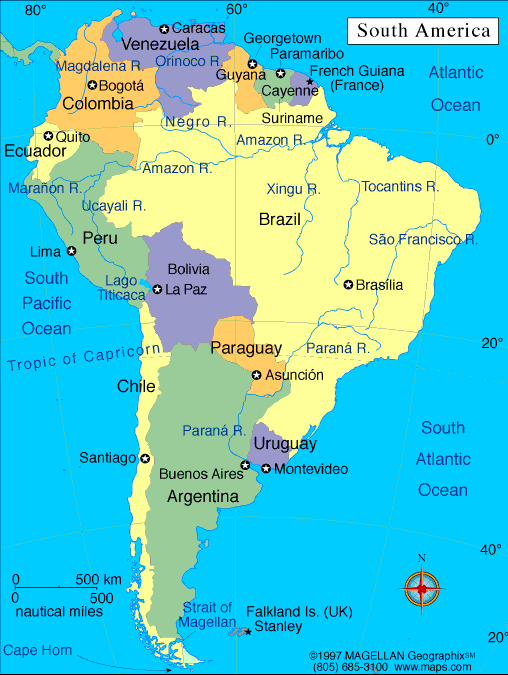
All right, I’ll try not to pick on Twilight too much (lord knows I’d like to), but just some points that really bother me (not counting factual errors like the whole “west coast” of Brazil thing [here's a map of South America if you don't get why that's eye-rolling).

1) Edward is undead, his skin is ice-cold, doesn't have blood circulating, but he's still able to be, ahem, intimate and produce a child. Of course, as this blogger puts it, "Then again, he’s taken twelfth grade chemistry like a hundred years in a row; maybe he’s developed a new form of Viagra or something."

2) Even after all her research in Twilight, Bella has no idea they sparkle instead of burn in the sunlight. In New Moon, Edward goes to get himself killed by revealing he's a vampire by what this forum poster calls a "sparklefest". As they put it, "did he not think of the fact that NOBODY KNOWS SPARKLING = VAMPIRE? Seriously, if they did see him in the sun, I bet they'd all just go, 'Dude, it's St Marcus' Day, not Mardi Gras. God, you're such a twat'."

3) Alice's visions. So many to choose from here (such as her visions only happening when convenient to the plot) but the big one I've seen pointed out goes against the rule Meyers has given her visions (that they can be changed based on people making different choices: "In Midnight Sun, Alice claims to have seen a vision of Bella as a vampire - implying that Bella has made the decision to become a vampire. At this stage, Bella doesn't even know that the Cullens are vampires. How, then, was Alice able to see something based on a decision that it would have been completely impossible for Bella to make?"

4) And we'll leave it at one more: "In Breaking Dawn, when Bella wakes up for the first time as a vampire, she describes being able to...hear all the way to the freeway. Sensory overload aside (even though such a high level of assault on the senses would probably have extremely damaging impacts), how is it that she is able to hear everything down to the freeway, yet Alice and Jasper were unable to hear her on the phone to James in the next room?"

The Da Vinci Code

1) Paternity Testing.  "Ok let's admit that the body is Mary Magdalen and you can do a DNA on the surving Magdalen descendant, you still don't have Jesus' DNA.  So, how are you going to prove that the child is Jesus' and Magdalen's and not Magdalen's and some other Joe Schmo."

2) Clues to the killer. At the beginning the dying man leaves a message with clues to get the main characters started on their quest. He adds in the Fibonacci sequence to make sure his granddaughter is brought onto the case. Was there any reason he didn't just write down who killed him and why? It seems he would have had plenty of time to.

Wicked/Wizard of Oz

1) Why didn't Elphaba (The Wicked Witch of the West)'s parents ever bathe her in water? As one forum poster here puts it, "I know she had an inhuman aversion to it even as an infant, but why wouldn't her folks wash her in it anyway?" It's a pretty good question in my opinion. Of course, this plot hole would be relatively easy to explain away by saying people tend to wash with something else if that's what Maguire wanted to do.

The Sound of Thunder

The Sound of Thunder by Ray Bradbury is "all about these guys that use a time machine to go back in time and hunt dinosaurs.  When they arrive in the past, there's a levitating walkway that they're allowed to walk on, but they CANNOT step off of it.  The idea is that if you alter anything from the past, it could change the way EVERYTHING happens in the future.  Long story short, one of the guys steps off the platform, accidently kills a butterfly, and when he comes back to the future, all the signs say the same thing, but are spelled differently.

"The biggest hole here is the fact that stepping off the walkway can ruin things, but killing a dinosaur, thus making it fall over, onto land that it never would have originally fallen on, also obviously antagonizing the dinosaur, which would change its course of direction from what it naturally would have been, doesn't matter.  Why does one butterfly from the human make a difference, but the butterflies that the dinosaurs fall onto, or the fact that dinosaurs are dying unnaturally soon makes no difference?" (Duncan) Personally, I would also like to add to Duncan's plot hole...there's a moving walkway in the [insert appropriate paleolithic era here]. How did someone build it/get power to it/etc. without changing anything?

Yet another time travel problem.

And, since I have family in town and blog posts may be few and far between for a week or so more, something to entertain yourself in my absence: Name the Movie by the Plot Hole: http://www.sporcle.com/games/Igon/plotholes_movies_cool (I’m sad I only got 9 of 12…)

Novel Blogs

First things first, I think blogs are awesome (I’m not sure what it would say about me if I didn’t think so with, you know, me writing this in a blog). Sure there are inane blogs out there, and they are the subject of some ridicule, but there are also hundreds of great blogs out there. I fully support anyone interested in keeping up a blog–especially if they have something interesting to say.

But that leads me to today’s post: Novel Blogs.

Writers of all kinds keep blogs. They can be portfolios for ghostwriters, writing tips (like this one), updates on publicity tours, or any number of other things. One popular type of blog for some writers is to set up a blog for their work in progress (WIP) where they post a chapter up at a time.

Now, depending on what your final goals are for your writing, these types of blogs can be a good or a bad thing.

On the positive side, a novel blog can get you some outside critiques, get your name up on the web as a writer, and–if you’re lucky–get you some publicity.

Negatively, however, these novel blogs can also seriously hurt your chances at traditional publishing in the future–at least for that particular WIP.

Having been in the middle of many arguments about this topic, I know there are some varying opinions on this topic (most of which hinge on how self-publishing is changing the publishing industry) but the long and short of it is:

When you sell your manuscript to a publisher (a reputable publisher) you aren’t selling the work or copyright. You are selling them the rights to publish your work. When you sign the contract with your publisher, you aren’t saying they own your novel (at least you shouldn’t be, always read your contract fully) you’re saying they can produce and sell your.

Almost always, the rights you are selling are exclusive (only that publisher may sell the book for however long the contract states), and more often or not, publishers are looking to contract First Publication Rights, that is, the right to be the first people to put your book out there.

As one blogger puts it: “the instant that you first publish your work you’ve used up your first publication rights… This is true no matter how that publication is achieved: whether you publish through one of the big conglomerates like Random House, a tiny independent like Salt or Bluechrome (which are growing in stature and reputation every day), whether you self-publish or get to market through one of the many murky vanity presses which lurk on the periphery of the industry: your book has been published and those first rights are irretrievably gone. “

That blogger is pointing out how important looking into your publisher is, but what he/she doesn’t say is that self publishing isn’t solely what happens when you go through some company and ready your book for sale online. Most publishers go off the simpler definition of “publish”, that is: “to disseminate to the public.” So, it doesn’t matter if your work is in book form, an e-book, or if you’re even getting paid for it. If your work is available in its entirety to the public, in print or online, many publishers consider your work “published” and your first rights already used. If the publisher you are hoping to work with only considers buying first publication rights, having your book online can make them pass on it–even if you only “published” the book on a blog.

Now, this is where that controversy I was talking about earlier comes in. While I never suggest people post works they want to publish traditionally online, some people like to point out that some authors have been picked up by big publishing houses because of their popularity online.

It’s possible, I won’t say that it isn’t. There are cases where “self-published” works online become such hits that they are picked up by big name companies. Cases like that may even become more common in the future. For now, though, at least in my opinion, chances of getting noticed as an internet sensation fall into the realm of possible, but not probable. And so, for now, it is always my suggestion that authors think before posting WIPs online:

1. Are you planning on trying to traditionally publish this WIP once you are done with it? If so, consider keeping it offline, or only publish an excerpt. Publishing a scene of a chapter of your current WIP on your site or blog won’t use your first publication rights the way posting the entire work will.

And more importantly:

2. Why do you want to post this WIP? Are you just looking for outside critiques? It’s possible to have people read your work without having it considered “published”. After all, the important part of the earlier definition of “publish” is the word “public”. If it isn’t possible for anyone to come across it and read it (such as you have a password to get to your site, are on a members-only site, or are just emailing the manuscript around to a few people) you have not “published” your work as you would have on a blog that is available to the world. Are you hoping to catch someone’s attention with it? Then put up an excerpt that you’re especially proud of. There are plenty of ways to do what you want without throwing an obsticle in your path later on.

Of course, if you just want to get your work out there and don’t especially want to publish traditionally, don’t worry about your novel blog. It’s just important to always think before you act as a writer–especially on the internet.

All of a sudden, he was suddenly there

Please excuse the delay in blog posts, I’m currently recovering from some nasty bug. Now that I am once again able to sit at a computer, we return to your regularly scheduled blog posts.

Today’s question:

Somewhere I heard that you should never use “suddenly” or “all of a sudden” in writing… I was just wondering if this was true or not.”

Now, before we start, it’s always important to remember that “never” is an abused word when it comes to writing tips. There are certain things that can make your writing weaker–such as over using “to be” verbs, or adverbs, or…–but it’s just as much of a problem if you hinder your writing by avoiding things like “to be” verbs or adverbs at all cost. Advice that begins with the word “never” should always be taken with a grain of salt. Or, as my friend likes to joke, “Never take advice that begins with the word ‘never’.”

That said, I don’t believe trying to stay away from using “suddenly” “immediately” “all of a sudden” etc. in your writing is a bad idea. Beyond the fact that it sometimes falls into the category of unnecessary words, using “suddenly” and its partners often has the exact opposite effect of what you want it to in writing. It makes the action seem less, well, sudden.

This comes down to one of the biggest problems about writing action scenes. Where in a movie or the like you’re able to control the pacing (wait just another second and then *bam* Monster is there out of nowhere) each reader reads at their own pace. It’s possible that they’ll read slowly enough there seems to be little tension, or have to do something and set the book down, or get distracted, or any other number of things that you can’t control for as an author.

So how, then, are we supposed to get that same jump-through-yourself moment you have in the movie? Use “suddenly” right? That’s what it means after all, all of a sudden. ”Suddenly the monster appeared.” It makes sense.

Counterintuitively, however, putting in another word makes the entire action less sudden to a reader.

Often when editing, I’ll put in the suggestion to keep sentences short in high action scenes. You can’t control much about the pacing as far as how your readers read a scene, but sentence length and paragraph breaks are a good way of speeding up and slowing down action. The shorter you keep a sentence the more immediate the action is. For example: “He ran.” Two words, the reader knows exactly what’s happening and is on to the next piece of information. Make it longer, however–”He began to run”–means it’s going to take the reader longer to make it through one action. The longer it takes to read something, the slower the action feels. The same goes for breaks. When reading, a comma is a generally a quick pause in the reader’s mind. A period is a full stop. (Hopefully how you read the past two sentences served as a good example for me). Commas blur things together. Periods break them apart. Therefore:

“She looked around, and then the monster was there.”

Seems to move more slowly than.

“She looked around. The monster was there.”

The same goes for using “suddenly” “all of a sudden” etc. “The monster was there” takes four words to get us from point A to point B. “All of a sudden, the monster was there” takes double that (and has a natural pause in reading it with the comma).

By writing that the action is sudden, we have successfully made the action that much less sudden in the pacing of the scene.

As with all of my other advice, you shouldn’t take this tip as gospel law. If “suddenly” makes a sentence flow more smoothly, use it. If it seems entirely necessary, use it. It is just one more piece of advice telling you to look carefully when you feel the need to point out something is sudden. Don’t hinder your writing trying to stick to “Never do X, Y, and Z” rules, but always consider how you can best serve your writing. If that’s by using an adverb or “was” or “all of a sudden” by all means use it. But, if there’s a better, stronger way to say what you mean, use that.

Follow

Get every new post delivered to your Inbox.

Join 38 other followers