If you have been on social media for any length of time, you likely have seen a meme that looks something like this:
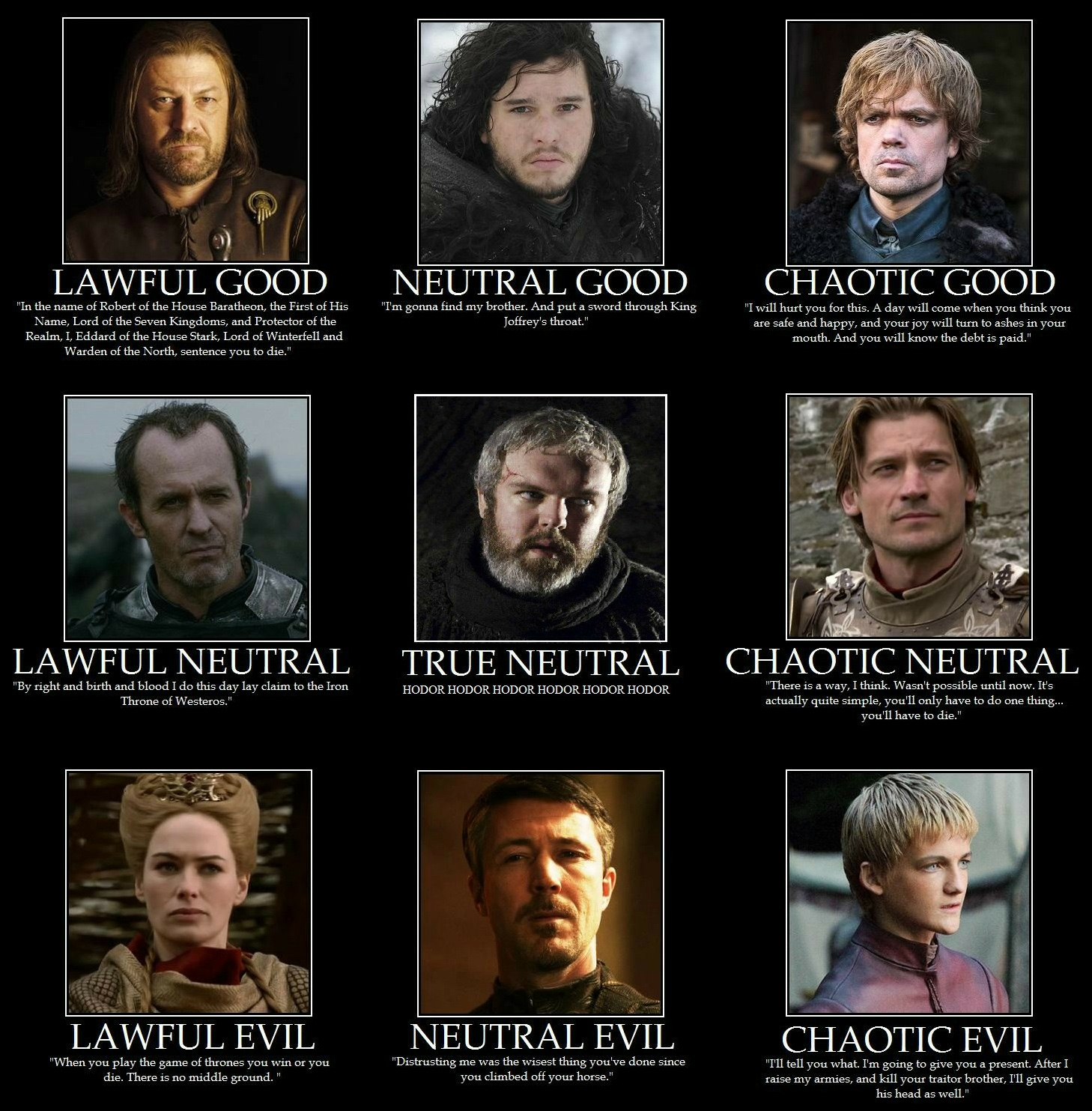
And half of them seem to use Game of Thrones character for whatever reason. (http://postitjournal.blogspot.com/2012/03/viewing-life-through-alignment-grids.html)
Long before these charts became “meme worthy”, players of RPGs like Dungeons and Dragons were familiar with building characters in a similar way, aligning their characters along a “moral and ethical axis”. A full (very handy) breakdown is available on TV Tropes, but it can basically be broken down into:

tvtropes.org
Now, these breakdowns don’t always work for fiction writers (as TV Tropes very smartly says, “remember that the vast majority of characters in fiction are not tabletop game characters, and therefore lack a canonical interpretation of alignment“) more and more I have found it helpful to think of characters who fit a “vague alignment”, both when it comes to writing and editing. Why? For the same reason the charts came into fashion for role playing games, I imagine. Because it is a handy way to develop just who your character is.
Personally, looking into alignments arose as part of writing my Broken Line Series. With each book following a different main character (and yet interlocking with each of the others) it became very important to develop each character as their own person, otherwise everything slowly began to get a little too wishy-washy with an ever-growing cast of characters. Thinking of a character in terms of a designation (along with plenty of other character building of course) it can be simpler to think just how they would react when thrown into a tough spot.
So, if dealing with a number of characters (or simply needing to flesh out a single character further) consider their alignments:
- Lawful Good: Simply put, the Lawful Good believes that, well, the law is good. Being a good person (which they strongly wish to be) requires upholding the law. This character believes in truth, justice, and other ideals seen as virtuous, but such strong convictions may also prove their undoing (see poor Ned Stark up there). They are so committed to their ideals, they may struggle to uphold them even to their own (or other’s) detriment.
- Neutral Good: For the Neutral Good, doing the right thing is very important, but the right thing doesn’t always mean the lawful thing. Following their personal morals, doing good is more important than upholding the law, but they also don’t see law as a bad thing. If they are able to do good by playing by the rules, they will. If they have to break a few laws to save someone, however, they don’t find themselves in an ethical quandary. As TV Tropes puts it, “Just think ‘basically nice person’ and you’ve probably got it.”
- Chaotic Good: Home to the rebels and free spirits, the Chaotic Good want to help people and do good, but they tend to believe that things like order and discipline get in the way. For all the Whovians out there, my personal favorite picture I’ve seen for Chaotic Good is The Doctor. The man always wants what is best for everyone, but isn’t about to let silly things like laws (even generally good ones) get in the way of achieving good.
- Lawful Neutral: The Lawful Neutral is “the rule-abiding sort”. Good and evil are all well and good, but not something that keeps them up at night. Law and Order (not the show) are what drives the Lawful Neutral with “justice” not necessarily coming into play. As TV Tropes says, “They’ll arrest a robber or rapist, but may also kick a family out of their home for failing to pay rent” even if the family missed rent for a “good” reason. TV Tropes and I agree probably the best example here is Inspector Javert from Les Mis (stealing bread to feed your starving family is no better than stealing cigarettes to hock to school kids). Any other character who is the same staunch type of Legalist would be a Lawful Neutral (protagonist, antagonist, or anyone in between).
- True Neutral: True Neutrals are either characters who want to “keep the balance” and thus not interfere (think the Elves staying out of things in Lord of the Rings) or characters that don’t care about just about anything for one reason or another (be it they’re too stupid to realize they should care, have a “calling” they see as above Earthly problems, or just simply want to be left alone).
- Chaotic Neutral: The Chaotic Neutral is either “the ultimate free spirit” or someone who is just plainly crazy. Chaotic Neutrals don’t wish to harm, but neither do they want to help others. Freedom is their be-all end-all. As long as you don’t try to rein them in, they really couldn’t care less what happens to anyone else.
- Lawful Evil: Heading into the villains and antiheroes, the Lawful Evil is the “sort of Evil that often ends up in charge.” Lawful Evil don’t care in the slightest about hurting people, but they care a lot of keeping order (whether because they believe it’s intrinsically important or because order is easier to exploit).
- Neutral Evil: As TV Tropes so gracefully puts it, “Sometimes known as the Asshole Alignment.” It doesn’t especially matter who gets hurt to the Neutral Evil, and it doesn’t especially matter to them if they play by the rules or not. If the rules suit their purposes, they’ll follow them. If not, they’ll break them. They are often considered more dangerous than the Lawful Evil or Chaotic Evil simply because you never quite know where they’re going to swing next. (For those who have read The Copper Witch/The Copper Rebellion, this is where I would honestly place our anti-heroine).
- Chaotic Evil: Just as interested in being a free spirit as the Chaotic Neutral, the Chaotic Evil is all about doing whatever they want, even if it hurts other (for some, especially if it hurts others). Rather than simply being willing to break rules if they don’t agree/they get in their way (like the other Chaotic alignments) Chaotic Evils often take great pleasure in destroying order/causing chaos. Batman’s The Joker is perhaps one of the best examples of Chaotic Evil.
(Need more information before you can place your characters? Read the full descriptions on TV Tropes or click any of the links above for more examples of the specific alignments).

 Jessica Dall