Word Limits

Today’s post: Word Limits or: Why won’t they publish my 300,000 word novel?

People write some long novels. James Fenimore Cooper’s Last of the Mohicans is 145,469 words long. Ayn Rand’s The Fountainhead 311,596. And, of course, as the king of long novels, Leo Tolstoy’s War and Peace is 587,287. With most novels clocking in around 100,000 words (give or take 20,000), Tolstoy has arguably written six books in one, and Rand a one-book trilogy (with the shorter of her two most famous works).

Word counts can be funny things. Interestingly enough, I seem to have some sort of power over my novels. If I’m aiming for a 80,000 word book, I tend to get one somewhere within that range give or take 5,000. My first NaNoWriMo novel, which had the goal of 50,000 words, wrapped up at around 50,500. Aiming for 80,000 with my latest project The Copper Witch (which has just moved into the submission stage) I finished up around 86,000.

Continuously managing to write a story within a general word count, though (be it through subconscious tinkering, or anything else) , doesn’t seem to be a universal trait amongst writers. And that’s something I completely understand. A story has a natural progression. It’s done when it’s done.

So what is there to be done when how long (or short) your novel is seems to be what’s keeping it from being published? Aren’t the word counts they give generally arbitrary anyway? As one NaNoWriMo Forum poster puts it:

I’ve read somewhere that 120 K is the upper limit for a new fantasy writer, which seems really… short for a fantasy novel…I still can’t believe it’s set as the upper limit.”

Now, first, I’d like to say I’ve never found 120,000 words short. My fantasy novels tend to be around 80,000, but perhaps that’s because I don’t write Tolkien-style epics.

Second, as the earlier books I’ve listed in this blog show, it’s possible to get a book published that is more than 120,000 words. You should never say “can’t” when it comes to publishing. Doing certain things can make it harder to get published, but nothing I have yet seen makes it impossible to get a book published.

But why do publishers even care about word counts? Sure, if the story drags on and on, that’s a problem, but if it’s action-packed and engaging for those 200,000 words, what’s the problem?

Having worked on both sides of publishing–as a writer and as someone working at a publishers–I can only point to one fact that is all to easy to forget as a writer. Your manuscript might be your baby as an author, but as a publisher, the manuscript is a product. Writing might be art to you, but writing is business to a publisher. Unless writing is your only source of income, money is something that might just be an added perk to us writers that coincides with seeing our books in print. To a publisher, however, those books are all business. It’s an added plus sometimes to give a first time novelist a shot at their big break, but if even a book you love isn’t likely to make a profit, it just isn’t something a publisher with a good business plan will take on.

So why does a publisher keep putting out the same generic vampire books? Because they sell. Why doesn’t a publisher put out any more vampire books? Because the market seems oversaturated and they aren’t as likely to sell (or the acquisition editor is sick to death of them).

And word counts come from this same need to mitigate risk and maximize profits. Beyond the fact that it’s likely many long manuscripts could do with a harsh paring down, there are two big problems with books over 120,000-150,000 words:

1. The longer the book is, the more expensive it is to produce. Unless you are going through a vanity publisher (and thus paying the press to put your book out) the general rule is money flows to the author, not from. A reputable publisher will pay for formatting, cover art, editing…and just about every other “start-up” cost there is to putting out a book. Focusing on the editing aspect of that, the longer your book is, the more they’re going to end up paying there editors. After all, there’s a reason I charge more editing a 200,000-word book than a 10,000-word one. The longer the book is, the longer it will take to edit. Especially edit well. If you’re paying an editor per project, you’re going to be paying for them more for a long project. If you’re paying an editor hourly, they’re going to have to take much more time to edit a long book. Even if you’re paying an editor a set salary, they may only be able to get one book done when  they generally would have three ready to go. Since most publishers worried about quality have at least three rounds of edits, that can add up to a lot of extra man-hours.

And then, of course, there’s just the production cost in general. With ebooks it’s changing a little, but as long as print books are popular, the longer a book is the more it will cost to print (ink, paper, etc.) Printing an initial run of 1,000 300,000-word books basically uses the same amount of supplies as 3,000 100,000-word books.

2. The longer a book is, the harder it is to sell. Now, this isn’t a “people don’t like reading long books” point. Obviously people are willing to read books that are longer than “average”. Going back to the fact that the larger a (print) book is, the more paper is needed to print it–the more paper in a book means the more it will cost to ship, and the more shelf space it takes up. Most bookstores prefer to have a range of books out, and thus don’t like taking many thick books, especially ones by unknown authors.

Likewise, with shipping and printing costs quite a bit higher for long books versus short ones, to make money off longer books they need to be priced higher. Now, not only do you have  to sell the story to someone (since not all plots are loved by all people) but you have to find someone who is willing to foot the cost of all that extra time and material. Someone who’s willing to pay for a book at $14.99 might not be so willing to by it at $24.99. There’s a psychology to marketing, and how you’re able to price things is a big part of that.

Add the fact that you have fewer books in general to sell in one run to the fewer buyers, and publishers see a lot of warning lights going off.

With the growing popularity of ebooks, perhaps the word count barriers will start to come down. The cost of pixels doesn’t go up with how long a book is. Even if you can’t decrease editing costs, you at least would be able to save money on printing and be able to price a long book close to a shorter book. But for now, limits on length when it comes to submissions makes complete sense to me.

Limits might be annoying to writers, but publishing isn’t about pleasing writers. You want the authors you work  with to be happy with edits, and cover art, and all of that stuff. But as a publisher, how the book sells dictates whether or not you get a raise, get promoted, or heck, even still have a job next month.

And so, with the surplus of manuscripts floating around out there, publishers can be picky about where they spend their time and money. While anything can happen based on whose desk a manuscript comes across, things that pose a financial risk (too long a book, an unknown author, a plot that doesn’t quite seem to fit any one genre) are often looked at critically.

After all, a book is art to an author, but business to a publisher.

—————————————————————————–

Want to carry this and other posts with you wherever you go? Download Write, Edit, Publish for free today.
Wy I Hayt Fonetik Axsents

All right. Be honest, how long did it take you to figure out the title? Did you even bother? All right, if you did, what is easier for you to read, that title or “Why I hate phonetic accents”?

Ok, I’ll be the first to admit that the English language makes little sense. It’s a Germanic language that was morphed by Anglo-Saxons, too far away to remember original German, adapted by the French during the Norman Conquest, and then had a thousand years to go through a vowel shift, changes, and added words (it’s reported Shakespeare alone invented 1,700 now common English words). Standardized spellings weren’t common for long after the Elizabethans (after all, Noah Webster decided to standardize “American” spellings in 1780) and many grammatical rules have come and gone, made by people often referred to as “pedantic” (split infinitives were only classified as “wrong” in the 20th century by scholars who more than likely believed English should follow Latin grammatical rules [where it’s quite literally impossible to split infinitives]). So why isn’t “phonetic” spelt “fonetik”? Because it comes from a Greek root, transcribed from the Greek Alphabet as ‘ph’ in the Latin alphabet, and it’s been that way since.

So, all of it is made up. So why can’t we make sure our character’s accents come out properly by having one say “dahlin'” one “dahrling” and one “derlin'”? The same reason people standardized language in the first place. It’s harder to understand. 

Truly, language as a whole is made up, if you want to argue it. But that doesn’t change the fact that it’s purpose is ultimately to have one person understand another. That vastly increases when you’re a writer. If you want to write something out phonetically as you understand it for your own notes, it doesn’t matter. If you’re expecting people to understand you in a novel/short story/article you’ve written, eet prabalee shudent b ritten liek dis.

Furthermore, how an accent sounds to you and how it sounds to someone else can be two very different things. Think of a British accent. How would someone with a British accent say “Really” to you? Reelee? Realeh? Rehleh?

Does it change if they’re speaking with a Kightsbridge Accent? London Accent? RP Accent? Cockney Accent? So now, not only is the phonetic spelling subjective, it can also be insulting if you don’t actually speak with that accent. Personally, I’d think I [in DC] say “really” something like “reelee” but I don’t speak with British accent. How do I know what sounds correct to someone from [insert place character is from]? After all, I’ve never heard someone say “pip, pip, cheerio” even though that’s supposedly British from what TV tells me. If you suddenly try to make your Irish character sound like the Lucky Charms Leprechaun saying top o’ the mornin’ to ya everywhere, you risk people considering you ignorant and/or insulting.

So is there any reason to write out an accent? In my opinion, no. In a novel I recently edited, there was an Irish character speaking with the thickest phonetically spelled attempted-accent I have ever seen (even sounding it out it didn’t sound Irish to me). Eventually I gave up trying to read what that character was saying (reading shouldn’t be that difficult in my opinion), leaving a note along the lines of “please, please, please don’t do this” but I do still remember one perfect example of the confusion spelling things out phonetically can cause.

“Fairreh”

Any guesses on that one? Perhaps some context, unphoneticized:

“Look, a fairreh!”

What I heard saying it? Fairy. It was a fantasy novel, so I thought, all right, fairies are showing up.

Too bad the author meant “Fire”

Just a small difference in the tone of the scene there.

Now, I’m not saying you can’t throw in small changes like “gonna” or “haveta'” if you feel the need to (e.g. “Tommy! Why haven’t you taken the trash out?” “Ah….I was gonna.”) but I highly, highly suggest staying away from trying to show your character’s accent bi mayking ehveree wurd fonetik.

But then, how do you show someone’s accent if you don’t spell it out?

I’d suggest some less intrusive (easier to read) ways:

1.  “He said with an X accent.” It’s simple, but showing accents in writing might be best suited with simple mentions. There are many ways to get it across in the same way:

“Hi,” he said with an Irish accent.

“Hi.”
She smiled at his lilting accent. It made even “hi” sound magical.

“Hi,” he said.
“Oh, that’s an interesting accent. Where are you from?”
“Ireland.”

“Hi,” he said, noticing how much his accent seemed out-of-place in the new school.

They all let you say he has an accent without  obscuring the actual words and making it hard to read.

2. Use speech patterns to show differences, not phonetics. Again, this is another one you have to be careful about not being insulting, but people from different areas don’t only have different accents, they use different grammar. Where I say, “I was going to go…” My great-uncle in West Virginia says, “I was fixin’ to go…” Where most people I’ve met say, “Turn off the light.” My college roommate from Brooklyn used to say, “Shut the light.” Don’t overdo it with regional slang (especially when you aren’t familiar with the region) since you’ll be in danger of going back to that “insulting” thing, but it tends to be a better way to show accents than, “I whas goeing too goe…” and “I whus fixen ta goh…”

3. If necessary, use phonetic spellings tastefully. As I said above, if your character doesn’t say “going to” properly, it might be all right to put “gonna” It’s a generally well-known version, and “I was gonna go…” would more than likely make sense to the bulk of your readers. Same with fixin’. Putting “fixing” just wouldn’t sound right in my head for “I was fixin'” Without the ‘g’ though, it’s still possible to generally understand what is being said. “I was fixin'” isn’t quite the same as “I whus fixen” The average reader will be able to read small changes like that easily. It’s when you start making people sound out every word that it gets tiring.

Now, can people write out phonetic accents well? I’m sure they can. Should they? In my personal opinion, no. Of course, that’s my personal opinion. As with everything else on this blog, people can take or leave what I say. They are all just suggestions after all. But, as I see it, anything that makes your writing difficult to understand isn’t generally good for it. After all, we standardized the language to be understood. And, as writers, it is our job to use language well.

How to Write When You Just Don’t Feel Like Writing

Hope Daylight Savings hasn’t screwed anyone up too much for those in places that observe it (like DC sadly…) So, for while all of us in a sleep-lacking daze, today’s post on how to write even when we may not feel like it.

For the most part, I am pretty lucky when it comes to avoiding writer’s block. I have enough ideas in my head at any one point I can jump back and forth between works when I get stuck on one or another. What does hit me, however, are times when I just don’t feel like writing. Now, these generally coincide with times I really don’t feel like doing anything, but working a full-time job along with freelancing and attempting to have a social life doesn’t leave me with a lot of time to both be able to not do anything for long stretches and be able to get some writing done (maybe when I’m a best-selling author with a 7-book deal, but for now…)

And so, that leads to a sad fact: Write even when you don’t feel like writing, or don’t write at all. Since I don’t see the latter as much of an option, that means I have to find ways to write even when I don’t feel like it.

Some of you might be lucky and have time so that you only have to write when inspiration takes you (as I used to be back as a student a while underemployed), but for the rest who are trying to juggle work, school, a family, loved ones, friends, sports, hobbies, and everything else you might have to do in your already busy life, here are some of my tips to getting past that “I just don’t wanna” feeling:

1. Work on something else. This is my big one. Even if you don’t have multiple novels going at once, it’s possible to get past a block on one story by working on something completely different for at least a little bit. You can start a piece of flash fiction, which is easily completed in one sitting. You can toy around with an idea you had a while ago (just put some characters down and see where it goes for a couple of pages). You can even write a “fan” fic of your own larger novel. Always want your characters to go to Italy but there’s no way that would work in your story? Send them now and chalk that writing up to character building.

2. Word Sprints. What is a word sprint, you ask? Obviously you’ve never been on the NaNoWriMo Forums. Word sprints are timed writing exercises where you do your best to write anything and everything you can think of in 1, 5, 10… minutes. You try to reach personal goals (100 words in 2 minutes) or can add a little more motivation by finding someone to race against (in person or online) or using a program like “Write or Die” where, depending what setting you put it on, after a certain time frame (5, 10, 20 seconds) of not writing, the program will have a pop up reminding you to keep writing, set off a rather unpleasant siren that won’t stop until you keep writing, or (on kamikaze mode) begin un-typing everything you’ve written.

3. Do something “avant garde”. Generally write in third person past tense? Write in first person present. Have a character pop up that has medium awareness or breaks the fourth wall. Throw yourself into the story. You might end up deleting the entire section, but that’s fine. Not everything you write has to be perfect and make it into the final (or even second) draft. It can give you a jump-start to get you back into writing in general just because it’s so different from what you’re used to.

4. Reward System. Ok, maybe you don’t want to eat a cookie for every word you write (unless you’re also working on being a competitive eater, because then, hey, two birds with one stone) but it’s sometimes possible to tempt yourself into writing the same way you bribe a kid into eating his/her vegetables. Really want some chocolate? You get some if you write 1,000 words. Thinking about getting yourself a new DVD? 2,000 words and it’s yours. It can even be something as simple as telling yourself you’ll let yourself sleep in Saturday morning an extra hour if you just get a chapter done.

5. Switch up how you write. For me, I tend to type a lot of what I write, just since it’s simpler come editing time, but there is definitely something to be said for handwriting when I’m in a slump. It also means it’s possible to write in bed while completely lying down (hard to type when on your side since you only have one hand). Bonus: It keeps me from getting bored and ending up on Facebook or reading Cracked.com.

6. Don’t Stress. The most important (and perhaps hardest) of the “get past a slump” tips. The more you stress about not wanting to write, the harder it’s going to be for you to write. If you feel like you’re forcing yourself, either your writing is going to sound, well, forced, or you’re not going to be able to write at all. Sometimes you just won’t be able to motivate yourself to write. It isn’t that big of a problem as long as it’s not every time you sit down. Take a coffee/hot chocolate/beverage of your choice break, watch a TV show, calm down and come back to writing later.

But They Did It…

First, sorry for being away a couple of days. As much as I do love my editing, it can take up a lot of time (luckily my most recent projects have overall been very good. It’s always nice when you truly enjoy reading what people are having you edit) but as I am feeling like a bad blog-poster, I wanted to make sure to get today’s post up. And what is today’s post, you may ask? Best Sellers and Good Writing.

Now, what are some of the best-selling books/series of all time? – Lord of the Rings – Harry Potter – The Da Vinci Code – The Girl with the Dragon Tattoo – Twilight Some of these books have sold over 100 million copies. But does that mean they’re well written? No, not necessarily. Now, I’ve already touched on some of my problems with Twilight in previous blog posts, but of all of the books listed, do you think we could get a consensus on one that everyone thinks is entirely brilliant without any flaws? Though I haven’t read all of the books I’ve listed, I have read a couple. But even the ones I enjoyed didn’t come off to me as faultless. J.R.R. Tolkien can overdo it with the description–the world is brilliant, but I totally skipped that three page description of a tree in Return of the King. Dan Brown’s characters can be one-dimensional–I read The Da Vinci Code in about a day, but couldn’t say I connected with/saw anything all that interesting in the characters. And, as much as I have enjoyed the Harry Potter series, there are plenty of people who point out J.K. Rowling’s writing problems:

“Rowling’s prose is as flat (and as English) as old beer, while Harry himself is not a boy of depth or subtlety.” — Guardian (U.K.)

In any decent story, the plot is advanced as characters make decisions. In Goblet of Fire, Harry has to enter a tournament because his name pops out of a cup. And he can’t decide not to enter because… the rules of magic say so! Things are just being thrown at Harry because the writer wants to throw them. (It’s even worse than an episode of 24).” — Daniel Radosh In his comment after his main article criticizing Rowling’s adverb use.

Don’t get me wrong, I am in no way saying that these books are awful–as I said, I enjoyed many of them–but they aren’t perfect. As one poster on a yahoo forum put it: “I know that JK Rowling is a popular writer, but she is not a good writer. Many people use the argumentum ad populum fallacy to argue that JKR is a good writer. (AKA: The books are popular so the books must be written well). Popularity may sometimes be a result of high quality writing, but it can’t be used as evidence that the books are well written.” And truly, that’s what it comes down to. There is no test you have to pass to be a writer. Writing a best seller isn’t about carefully crafting a book after years of study under a master writer. J.R.R. Tolkien was a linguist who ended up making Middle Earth partially out of his love for foreign (often made up) languages. J. K. Rowling supposedly wrote down the idea for Harry Potter on a cocktail napkin. Stephenie Meyer was a receptionist and then a housewife when she wrote Twilight. Years of dedication and work–while it can help–isn’t what makes an author write a best seller. Honestly, part of being a best seller seems to be, at best, luck. It’s being in the right place at the right time with something someone likes. Some people might write brilliant works that are never seen in their lifetimes. Some people might write a so-so novel they don’t care about in a week that sells 500 million copies worldwide. It might not be fair, but that always seems to be the nature of writing. What it does mean, though, is that best-selling authors aren’t any more infallible than anyone else. Copying one won’t save you from making writing mistakes any more than just trying to write something on your own.

This is especially true if you end up copying things that many people don’t like about the best-selling author’s writing (for example, J. K. Rowling’s use of adverbs or Stephenie Meyer’s purple prose). If a book you’ve read inspires you (best seller or obscure) think about what it is about the book that reaches you. What you’ll often find is that the books that generally reach you most do so because of their plot, characters, or something much more broad than just word use/writing style. Writing flowery prose, like Meyer, won’t make your book as popular as Twilight. Spending five pages describing every detail in your world, like J. R. R. Tolkien will at times, will not mean your book will be magically as well received as Lord of the Rings. Gain your inspiration from other authors you admire, but don’t use them as the end all be all for what writing should be.

Write what feels natural to you, learn, grow, take critiques, and become your own author. Not someone trying to emulate X. It’s likely you’ll write better that way.

How -Not- to Take a Review

Recently I posted about how to take a critique, since I know all to well how hard it can be to see your work red-lined after an edit or sit there listening to someone tell you all the problems they had with your work. It’s hard, but very helpful in making your writing the best it can be, be the critique from a friend, writers’ group, professional editor, or your publisher.

Coincidentally (I’m doing my best not to use “ironically” incorrectly, so coincidentally it is) not too long after I posted that article, I got an irate email from an author I recently wrote a review for (as I am a reviewer over at ePublish a Book) demanding the review be removed.

*Before continuing, I would like to say here that this article is in no way meant as an attack against said author. There will be no mention of the author’s name, her book, or links to the review in question. Instead, as with most of my blog posts, I am attempting to use personal experiences to give advice and clear up misconceptions about writing, editing, publishing, and reviewing. All of the following is meant to help those with misconceptions about how the review process works, and I am more than happy to answer additional questions left as comments, tweeted, or emailed to me.*

Now to start, I fully admit I can be a critical reviewer. I do my best to never be unfair, rude, or mean, but I am completely honest in what I think about the books I have read. If you get a good review from me, you have fully earned it. Still, even if I didn’t like a book, I do my best to point out what the author has done well. Unless there is absolutely nothing redeeming about a book, you will not see a review that is only disparaging either.

As that’s my goal as a reviewer–not lampooning ok books and only gushing about great books–I tend to write many mixed reviews: reviews along the lines of “I liked the story, but the prose was needlessly flowery” or “The characters were amazingly realistic, unfortunately the plot didn’t live up to their well-constructed depth” (Neither of those are from actual reviews, but you get the idea). The review in question was likewise mixed.

Obviously the author wasn’t pleased with the critical parts of the review, as not long after it posted I received an email along the lines of:

Take it down. If you are going to punish an effort, at least tell people first.”

Now, I won’t post the rest of the emails back and forth (there were quite a few with me telling her I wasn’t going to take it down and how reviews generally worked) since that would make for a needlessly long blog post and I don’t think it’s entirely professional to divulge the entirety of private correspondences when they aren’t exactly flattering, but I would like to hit on a few points for anyone who might have some misconceptions about requesting reviews.

1. Unless you are paying for a review, you have no control over what the reviewer writes about your book. As much as I might like to, as it says on my reviews and editing services page, I accept “no money or gifts from authors seeking reviews.” Now, the reason I don’t accept money or gifts is not because I hate gifts nor because I believe reviewing is a job that no one should get paid for. It’s because it’s a conflict of interest. There are some “reviewers” out there that you can send money and they’ll give you nice blurbs to put on your front cover, but I am not one of them. If it were possible to buy a good review from me it would  undermine my credibility as a reviewer. How would people know if I actually thought the book I’m reviewing is a good book or a book I hated but was paid to say good things about it? If I think it’s a good book I’ll say so, if it’s an ok book, that too. If I think it’s a bad book, well, sorry, you’re getting a bad review. Since you aren’t paying me, you don’t get to decide what I say.

2. No control means you do not get to edit the review nor determine whether or not the review is posted. Going back to the “at least tell people first” part of that first email, later emails made clear that–in the event that the review was not glowing–the author expected to get a copy of the review before it was posted to edit (or at least approve) it. While I’m not inherently opposed to the idea of giving an author a copy of what will be posted (though I’ve never heard of that happening outside of the aforementioned reviews-for-hire) it would not give the author the power to pull the article or edit it (e.g. “I don’t like what you say here about my book, can you make it nicer?”) so mostly that would just give the author time to see the review the day before everyone else does.

3. This fact (the author not getting to edit or having to approve a review) is, as far as I know, an industry standard. I can’t say I’ve talked to the entire industry, but no one I have talked to (reviewers/editors I know) has ever given someone asking for a review a copy of the review before hand, nor have they allowed edits. As an author you give them your book and wait until it’s posted. Assuming that you are going to get some say over the review shows either you have no idea how reviewing works or you have only ever paid for reviews/asked for people to give you good blurbs for the dust jacket. Basically, if you act as though you get a say, it makes you look unprofessional.

4. By asking for a review, you are taking the chance of getting a bad review. Going along with the fact that you don’t get a say in what is said in a review if you don’t pay for it, you have to accept that it is possible you won’t get a good review. If you’re extremely worried, try reading other reviews the reviewer you’re contacting has written. Anyone who reads my reviews will see that I don’t often gush about how wonderful a book is, and will point out anything I especially don’t like even in books that I generally like. If you want a review that’s 100 percent amazing you can cut and post to your website, you should either hope your book is completely brilliant or find a reviewer who writes more 100 percent positive reviews. I aim for totally honest reviews as a matter of principle.

5. If you absolutely will only accept a glowing review, ask upfront if the reviewer will refrain from posting a bad review. Now, first off, I DO NOT SUGGEST YOU DO THIS. It again comes off as unprofessional, but if you are absolutely insistent on not having any bad reviews up anywhere of your book, ask up front about it (otherwise it probably won’t cross the reviewer’s mind [see: not industry standard]). Personally, if someone asked that, I’d pass on reading their book entirely. Perhaps there’s someone who’d agree to it, but I’m certainly not one of them. It’s your choice over whether or not you’ll accept a bad review, but you have to accept you’re also passing up a possible good review in your quest to have nothing bad ever written about your book.

6. There’s no such things as bad publicity. Ok, so there is technically (say it comes out that you’re a serial killer or that your book causes brain aneurysms), but in general the old adage is true. So you got a critical review. So what? Not everyone is going to love your book. Ask someone what their favorite book is. They could gush, it could be critically acclaimed, and… there will still be people out there who slam it. Part of being a writer is accepting that fact. If you have a thin skin, you don’t have to look at anything posted about it, but it’s going to happen. Anyway, it’s better to have a so-so review on a heavily trafficked site to get your name out there than it is to only have a couple glowing reviews somewhere no one’s ever going to see them. Who knows, perhaps someone will like the sound of your book, no matter the review, and buy it. They aren’t going to if they’ve never heard of it, even if you have some people gushing about it.

7. A bad review isn’t punishment. Going back to the first email, I’m not sure what effort the author was talking about (requesting the review or publishing a book) but as it isn’t hard to request a review (just send an email) I’m going to assume “punishing an effort” refers to the book. First, as an author you unfortunately don’t get any points for effort. It would be sort of awesome if you did, honestly, but your work is going to sink or swim based on its own merit. If a book you wrote in a week is great, you’re more than likely going to get a great review, if a book you spent three decades working on and edited fifty times is bad, you’re still going to get a bad review. Second, a bad review–like a harsh critique–isn’t personal. The reviewer isn’t trying to punish you, discredit the work you put into the book, or attack you as a writer. They’re just honestly giving their opinion of the book they’ve read.

8. If you disagree with a review, it’s ok to say so, but ranting won’t help you. So you’ve decided to go ahead and ask for a review, and it unfortunately is overwhelmingly negative. FIRST, take a couple of hours, an afternoon, a day, however long it takes until you can think about it rationally. Bad reviews sting, I understand, perhaps even more so than critiques. However, it is not the end of the world. One bad review isn’t going to stop people from buying your book or make people think you’re obviously an awful writer.

Now, it’s hard to get any part of reviews changed (they’re opinions, so there generally aren’t factual errors to dispute and if the reviewer didn’t “get it” you at least have to take partial blame for not writing clearly enough for them to understand) but if there’s something you strongly disagree with, go ahead and contact them about it. You’ll likely get a “sorry, that’s how it is” email back, but it’s possible your reviewer will at least talk to you about why they felt a certain way, if you’re nice. Sending several angry emails and making demands will not get you anywhere. We get it, many reviewers are writers too, we know how you’re feeling. That doesn’t change the fact that our reviews need to hold up to certain standards, otherwise it undermines our credibility.

If you feel a review is unnecessarily rude or unfair, you can likewise email the writer’s editor and nicely try to make your points. As they posted it, it’s likely they too will support their writers (if they thought it was awful, they wouldn’t have put it on their site) but most will at least be willing to explain their decision, and if you’re lucky they may be sympathetic. Ranting at them about how awful and unreasonable a reviewer is being about a review they chose to post isn’t going to endear you.

And so, I hope that helps anyone who is unclear about the reviewing process. Like authors who want a pat on the head while editing, authors who want a pat on the head from a reviewer (and assume they’re going to get one) just makes for unhappy authors and unhappy reviewers. Never a good thing.

He said, She said

Not too long ago now, I wrote a post about Showing and not Telling. While it’s always a good idea to show people what’s happening than tell them it (makes for more interesting reading for one) I didn’t agree with the method my old high school English teacher gave me for trying to stop yourself from telling–don’t use “to be” verbs.

You can read the rest of that post here, but today’s blog is going to focus on a different hotly debated, often hated aspect of writing: The Dreaded “said”.

As someone who’s written a lot of  dialogue, I’m sure I have used more than my share of “he/she/I said”s, and I never much thought about it until I started seeing posts like this in the NaNoWriMo forums:

When I’m writing dialogue, it’s so hard to think of words besides ‘said’.
Does anyone have any websites that could give me, and other writers, lists of words that could be used besides ‘said’?

And, “300 Ways to Say Said” a post complete with a list of 300 words you can use in tags, from “he/she/it/I accused” to “he/she/it/I yowled

So, should you worry about using “said” too much in your novel/novella/short story?

Personally I agree with the post following the last of the list, “and ‘said’ is better in 99% of the cases.

All right, that answer might be a little extreme, but as a whole, I have to say I agree with the sentiment. There is a time and a place to use other words (is your character whispering, yowling, or screaming? Go ahead and say so) but like trying to avoid using “to be” verbs, avoiding “said” to the point where it makes your writing awkward is much, much worse than having a far share of he said, she saids around the page.

1. People are trained to skip reading “said”s. It’s an odd phenomenon, but it’s a real one. Tags are added to dialogue to make sure the reader doesn’t get confused about who’s talking. For example, if Bill, Tom, and Nancy are having a conversation, you can’t have something along the lines of:

“I’m here!” Bill said.
“Welcome.”
“Took you long enough.”
“Yeah, what took you so long?”

How would anybody know who’s talking? Did Tom say “Welcome” or did Nancy? Is the person who said “Welcome” also asking what took Bill so long, or is there actually a fourth person in the room?

Half of the reason we use tags is just to have the name there. Even without any extra words, it would make more sense if the dialogue read:

Bill, “I’m here!”
Tom, “Welcome.”
Nancy, “Took you long enough.”
Tom, “Yeah, what took you so long?”

That’s basically script format, but it at least tells you who’s speaking. Said is nearly the same equivalent. People glance at the tag long enough to see the name there, and the said tends to roll right off them. Put in other words, though, and their attention starts being draw straight to the tag.

“I’m here!” Bill exclaimed.
“Welcome,” Tom soliloquized.
“Took you long enough,” Nancy scolded.
“Yeah, what took you so long?” Tom contributed.

Maybe you aren’t using said over and over again, but suddenly the attention is on the tag rather than what’s actually being said…and that’s generally a bad thing. (For the record, all of those tags are suggested in the “300 Ways to Say Said” thread).

2. Instead of replacement words, you can tag things with actions. Going back to the first point, let’s look at the words replacing “said”. Ok, let’s keep exclaimed, Bill’s really excited, no reason not to say that. But the others? We can use action tags instead. So, rather than be stuck with “Bill said, Tom said, Nancy said, Tom said” you can have:

“I’m here!” Bill exclaimed.
Tom looked up from his work. “Welcome.”
“Took you long enough,” Nancy said.
“Yeah.” Tom frowned. “What took you so long?”

You still have the names close enough to the tags that you know who’s speaking, but you aren’t using awkward sounding words to keep from using a natural word.

Bonus: You’re showing people rather than telling them. Say you had “Tom scolded” rather than “Tom frowned”. You could do that, but what does scolding really look like? Is he shaking his finger? Frowning? Pursing his lips? ‘Scolded’ doesn’t have a strong picture attached to it. ‘Frowned’ does.

3. People aren’t always yelling/whispering/screaming… There’s a reason using replacement words sound weird when reading dialogue tags–and it’s not just we’re all used to the word said. Words that replace said are often strong ones. If someone is saying something quietly, whispered is probably a better word to use (it means someone’s speaking quietly after all). More than often, though, people tend to just say things. When was the last time you had a conversation where a person was exclaiming, shouting, and yelling everything they were saying in a normal conversation (i.e. not a fight or in a mental ward)? If your characters are having a perfectly nice conversation, but one person keeps whispering, or yelling, or scolding, I’m going to wonder exactly what’s wrong with them. Good if your character is trying to reach Hamlet levels of insane. Not so good if they’re supposed to be rational characters discussing where their friend went.

4. Too often, it feels like you’re trying too hard. As I talked about in my earlier article, “Hey Look! I’m a Writer!” Syndrome, trying to be fancy with your writing doesn’t make you look like a good writer, it makes you look like someone who doesn’t know what they’re doing, and thus are trying too hard. You shouldn’t be lazy or cavalier about your writing, but that certainly doesn’t mean you have to labor over every word to make sure it fits with every other artistic gem. Just like it’s perfectly fine to say “The sun rose” rather than “The golden orb floated into the azure sky” it’s perfectly fine to say “He said” rather than “He exclaimed with a fervor”. There’s a time and a place for poetic/flamboyant language, but using it just because you don’t want to be boring or think that’s what good writers do is almost always a bad thing.

And so, with everything else with writing, I always say, say what you mean, but don’t make your writing unnatural just because you think you need to be doing something else to be a “good” writer.

How to Take a Critique

Anyone who’s had a look around at some of my other blogs probably knows that I am in the process of having a couple of books come out this summer (one under my name, one under a pseudonym). Anyone who follows my Twitter account (or Facebook Fan Page) also probably knows I just sold a short story to a magazine that will be printed in the near future.  All of that, combined with the fact that I edit projects freelance means most of my time lately has been editing/reading edits/reworking edits… and the list goes on and on.

Now, I fully believe being a writer helps you be a good editor. The two don’t necessarily go together (I’ve met some editors who are awful writers and some writers who are awful editors) but part of both jobs is to have a good ear (eye?) for what sounds right on the page.

The other way around, though, I don’t think there’s quite as strong a connection. Great editors can be great writers, of course, but all the other little things that make for a good editor don’t necessary flip straight over to being a good writer. What being an editor does do for writing, however, is help you take critiques.

Luckily for my editor side, every author I have recently worked with has been great (thank you all if you’re reading) but I know very well how bad things can get when you’re editing something for someone who really just wanted a pat on the head to say how good their work is and for you to catch typos.

Now, the writer in me fully understands how hard it can be sometimes to have someone ripping apart your work. As much as I might not like something I’ve written, it seems to fall into a “no one can beat up my brother (erm, writing) but me!” situation when someone else starts pointing out flaws.

But, having been on both sides of the editing process, I also know how helpful editors can be (and not just for the typos). Looking at the most recent round of edits I got on one manuscript, I see my editor pointing out things here and there that I’ve pointed out as problems in manuscripts I’ve read. Obviously I agree that those things need to be changed, but I didn’t catch those problems when it was just me reading my own writing. It’s possible to be too close to your writing to see problems that are obvious for someone else, and thus I always suggest having other people look your writing over before moving on with plans (be it submitting to agents, publishers, or self publishing). It doesn’t have to be a professional editor if you don’t want to pay for one, but at least have a writing group or go through a novel swap with someone else.

To get the most out of editing/critiques though, you have to fight down that urge to automatically defend yourself, so, some important things you can do to make editing most helpful and least painful:

1. Listen silently. This is perhaps most important if you’re speaking with your critiquer/editor in person, but the same holds true any time you are reading a comment. Don’t start defending yourself before they’re done speaking. It’s hard–believe me, I know–but sit silently, listen to/read what they have to say, and then take a deep breath before going forward. It’s possible your reviewer/editor/critiquer has no idea what they’re talking about, but cutting them off to tell them they don’t know what they’re talking about (or not reading a comment because you disagree) won’t help you at all. Listen, absorb, then speak.

2. Just because the edit is “wrong” doesn’t mean you should ignore it. Ok, this of course doesn’t go for edits that make a sentence grammatically wrong, or that introduce typos (sometimes, especially with MS Word Track Changes, typos can appear based on where the program thinks you want something deleted. If you suddenly have “I hadd a boat” feel free to take off the extra ‘d’). This goes for an edit that reworks a sentence into something you didn’t mean. For example, in my recently edited manuscript, the editor changed this sentence:

“The girl stood outside, half-hidden under the overhang.”

to

“The girl stood, half-hiding on the overhang outside.”

Um, no. I didn’t mean the girl was hiding on top of the overhang, I meant the overhang was hiding her. (Someone on the second story can only see part of her past the overhang). Those sentences mean two very separate things, and I definitely didn’t mean the second one. Still, that doesn’t mean I automatically reject the change and move on. It is more helpful to go back, explain that’s not what you meant, and ask if there’s something that would make the sentence clearer. It’s possible the editor was reading too quickly, but it’s also possible that “under the overhang” was confusing the image in her head (sadly readers don’t automatically see exactly what us writers do).

3. Critiques/Reviews/Edits aren’t personal. All right, if the review is “Your writing sucks, your parents should be ashamed of having you as a child” or something along those lines, you’re more than welcome to think the reviewer is a jerk and ignore them. Most of the time, however, edits aren’t personal attacks on you, or even your writing style. A comment that says “This part is dragging, I’d be tempted to stop reading” or the like isn’t an attack. It’s an honest opinion that says that some of your readers might be getting bored and skip ahead (or worse, set the book down all together). Don’t be hurt by it, take it as a chance to rework the section so people love reading it.

4. It’s OK to disagree with your editor/reviewer/critiquer. Going along with not throwing out an idea just because it’s not what you mean, it’s also all right to completely disagree with your editor on some points. Editors aren’t perfect, it’s possible they’ve changed something that you know you had right (and have the grammar guide to back you up on). It’s possible they just aren’t familiar with a word and thus changed it to something that doesn’t quite mean what you meant. If they’re connected to your publisher, yes, you’ll have to work it out with them (often publishers have final say), but if it’s a friend or someone you’ve hired for an edit/critique it’s all just suggestions as to what they think would be best. You can take or leave any of the changes.

5. Figure out if you actually want a critique. While I fully believe all writing can only be completely at its best after some outside edits (be them from a friend, professional or publisher) some people really just don’t want them (see my point about people who want a pat on the head and typos taken out). If you don’t want to work on your story/don’t want anything changed, ask someone to go through and look for typos, and then move on. As a professional editor, I’ve had one or two cases of people who–while they are willing to pay a few hundred dollars for me to go over their work–don’t actually want me to tell them I’d suggest changes. For the most part, it just ends in several emails about how all my edits are wrong, and then me giving up and only pointing out typos and things that are blatantly wrong/confusing to keep them happy. If you want to pay me content edit prices for copy edit work, fine, I won’t stop you, but it would save money and headaches to just say you want a copy edit/proofreading*.

Edits (good ones at least) help make a story the best it can be, and as hard as it might be, not trying to defend yourself is going to be the best way to learn from them. Nobody is perfect, nobody’s writing is perfect. If you’re willing to hear that, even an imperfect editor can help make your writing that much better.

*Before hiring anyone to edit your work, it’s always good to get an editing sample–even if they’ve come very highly recommended–so you can see if how they edit is what you’re looking for. Offering a 5 page sample edit isn’t just how I prove myself, it’s how I make sure my clients would be happy with my in-depth edits. Edits should be helpful, not a headache.

———————————————————————————–

Want to carry this and other posts with you wherever you go? Download Write, Edit, Publish for free today.

$*&# @#*%

Note: In an attempt to keep this blog as family friendly as possible, strong language will be censored (e.g. a**, f***, s***, etc.) [yes, I couldn’t fight the urge to start and end that with Latin abbreviations…] and external links to sites/clips/articles which include strong language/adult content will be marked with a caret (^) so as not to be confused with other asterisks (*). If you prefer not to read such content, please avoid those links. You have been duly warned.

**************************************************************************

Television and Movies have some fun rules when it comes to what actors can and can’t say on screen. Where plays and novels have not had many problems with restricted content, state censorship of motion pictures has gone back nearly as far as motion pictures themselves. This censorship of motion pictures eventually gave way to The Motion Picture Production Code (perhaps better known as The Hays Code) which strictly governed what could and couldn’t be shown between the 1930’s and 1960’s. Though quite long in its entirety, The Hays Code included some points such as:

II. Sex. The sanctity of the institution of marriage and the home shall be upheld. Pictures shall not infer that low forms of sex relationship are the accepted or common thing.

V. Profanity. Pointed profanity (this includes the words, God, Lord, Jesus, Christ – unless used reverently), or every other profane or vulgar expression however used, is forbidden.

And the list goes on and on.

Though The Hays Code is no longer around, it’s predecessor, the MPAA movie classification system is still alive and strong, currently marking movies as G, PG, PG–13, R, or NC–17 based on the movie’s content and the way that content is handled.

Other broadcasted media finds itself likewise watched by The Federal Communications Commission (FCC).  This governing body decides what is allowed on the air, and is the reason George Carlin couldn’t say his “Seven Dirty Words^” on television, much to the chagrin of some TV writers. Some more risqué shows, such as Fox’s Family Guy, have gone so far as to out right mock the FCC (in song)^ during their broadcast.

However, while the screen and airwaves might be regulated, plays and books aren’t.

If you so desired, you could see a fully naked Daniel Radcliffe in a recent production of Equus, and you’ll never see an ‘R’ rating on a book just because a character says f***. You certainly won’t find major outlets refusing to carry books that would likely be NC-17 films the way many major movie theatres often cap what they show at R. So novelist/playwrights don’t have to worry about how they use strong language in their work. But should they?

In my opinion, yes and no. As with everything else in writing, it’s important to think about the pros and cons about what’s being put down on paper, and what you’re trying to accomplish, when you use strong language.

1. Pro: Real people swear. In an earlier blog, I touched on the pros and cons of dialogue and narrative. Though it isn’t the point of that blog, it’s briefly mentioned that it’s important to keep dialogue sounding natural. Well, depending on who you know, it’s possible more than half of what you hear in any one sentence involves strong language. It’s possible to use “clean swears” some times, but we all know people who wouldn’t say “Darn it!” or “Shoot!” if they banged their knee against a table. If your character would swear, it’s awkward sometimes trying to get around it. After all, as John Brophy wrote in his 1930 book, Songs and Slang of the British Soldier: 1914-1918:

It [F***] became so common that an effective way for the soldier to express this emotion was to omit this word. Thus if a sergeant said, ‘Get your f***ing rifles!’ it was understood as a matter of routine. But if he said ‘Get your rifles!’ there was an immediate implication of urgency and danger.”

Can you imagine a soldier in the trenches really say, “What the frick???”

2. Con: Strong language can lose readers/make readers uncomfortable. All right, maybe you don’t want to censor yourself just because someone might be offended, but if you’re writing for publication it is something to think about. Are you willing to turn some people off just so you can use the exact language you want? If yes, use it. If not, strongly consider toning it down. As a part of one review for my book Grey Areas, one person mentions language is why they’d rate the book as 3.5/5 instead of 4/5:

Now… this would have been 4 stars but all the swearing was a bit much for me. Yes, yes – I know – Demons – bad guys – of course they swear! I totally get that, and I agree. Don’t get me wrong – I don’t mind a couple in a scene when the situation really calls for it, but there were a lot of f-bombs.”

For me, the swearing was carefully planned in the book (one group swears [often] the other doesn’t at all), but doing that I (and the rest of us who want to do something similar) have to accept it can make some people uneasy.

3. Pro: You can tell a lot about a character based on the language they use. Going back to the first point (real people swear) you can quickly characterize someone based on the type of language they use. Do they swear? How often do they swear? What (if any) words are taboo to them? Do you have a character that swears in every sentence, but still won’t say f***? Do you have a character who won’t even say ‘Jesus’? Just by knowing that, you (and the reader) know a lot about your characters (and you have a good place to figure out more about your characters if you’re doing a Character Questionnaire. Why do they/don’t they swear?)

4. Con: Swearing can be a crutch. As my mother use to say, swearing is often the sign of a poor vocabulary. Now, I believe that can be far too easily generalized (nothing wrong with swearing if that’s how your character talks) but if you’re using strong language in places that might be better served with other words, it can be lazy (and often weaker) writing.

5. Pro/Con: Rare strong language can be shocking. This point can really be a pro or a con depending on how you look at it. As with the soldier example up there, when a character often uses strong language, it loses its effect (e.g. “Get your f***ing riffles). However, if a character doesn’t swear, the one time you hear that character swear, it becomes very clear very quickly how serious/upset they are. Whether that means you should use a lot of strong language or little depends on whether you want “Get your f***ing riffles!” to be routine or urgent.

And I’m sure there are more, but those are what I generally consider when it comes to strong language in otherwise unmoderated writing. Feel free to supply your own considerations, though comments/tweets/emails will be moderated for language (re: family friendly) before posting.

Head Jumping

Pretty much anyone who’s read a book has probably seen narrative written in first and third person. Some people may have even seen a couple in second. Everyone has their favorite to write in, and generally read, but I’ve always been rather partial towards third person. (Specifically third person limited).

Now, before I continue, First/Second/Third Person Points of View (POV) are something most people have heard about, but as a quick refresher:

In a first-person POV the story is relayed by a narrator, who is also a character within the story, so that the narrator reveals the plot by referring to this viewpoint character as “I” (or, when plural, “we”). For example: “I walked into the club…

In second person, the narrator refers to one of the characters as “you”, therefore making the audience member feel as if he or she is a character within the story. (“You see the man walking toward you.”) Not very popular, it’s mostly seen in “Choose your own adventure” books.

Third person has two subsets—limited and omniscient. In both, every character is referred to as “he”, “she”, “it”, or “they”. In limited, the narrator is a character in the story, much like first person) only referred to as “s/he” rather than “I”. In omniscient, the narrator is a being outside the narrative relating all the character’s actions (as though they are watching the action unfold on stage/below them).

Everyone feeling refreshed? Okay, on we go.

Each POV has their own pros and cons, but first person and third person-limited are by far the most popular in modern literature.

Interestingly, after reading so many first novels working as an editor, I find that first time novelists seem drawn to first person (not as a rule, but as a general observation). I’m not quite sure why that is (perhaps the connection writers tend to feel towards first characters?) but it does offer some protection from a common third person limited problem. Head jumping.

If you’re writing in third person, stop and take a look at your writing. Are you showing the world as how your main character would see it? Then you’re in third person limited. Now, do you still say how every character is feeling when it comes up? That’s okay, but only if you stay in one character’s POV. Otherwise, it’s head jumping. And head jumping can be both annoying and confusing.

Without the confines of telling a story in first person–where you’re forced to stay in one character’s head–many people find themselves telling the reader what each character is feeling when it suits. We start in Character A’s head, showing the world as they experience it, and say what they’re feeling. For example:

A felt her stomach flutter.

As the POV character, A can know how she’s feeling. And it’s good to say. You’re showing how she’s feeling, not telling the reader how she’s feeling. Top marks for you. A can’t however know how character B is feeling. For example:

A felt her stomach flutter.
B looked back, knowing she was in love.

I know, not a great example there, but still, 1) B can’t know that unless they’re a character with some sort of omniscient powers and, 2) You’re in A’s point of view, A can’t know what B knows. It is a POV slip.

It may not seem like the biggest deal for some people, but going back and forth in third person limited shifts the entire world. As I said before, in both first person and third person limited you are showing the world through a character—both their point of view, and how they experience their world. A might be a pessimist, for example, while B is an optimist. In B’s POV, therefore, the reader is going to be experiencing the scene that is happening differently. Not markedly, perhaps, but through B’s eyes, not A’s. By jumping back and forth, you shift the entire view the reader is getting, which can offer a strange sense of vertigo.

Luckily there are some things you can do to stay in one POV in third person.

 1. Decide who’s experiencing the event. Think about whose eyes you’re seeing the story through (or the scene through). That is the person who is going to be telling everyone their personal experiences. Don’t slide into someone else’s just because you want their reaction.

-And more importantly-

2. Think about what the POV character could see to give other characters’ reactions. Perhaps the POV character can’t know the other character’s having their stomach flutter, but they can see them place a hand on their stomach, or swallow, or (if nothing else) you can say it seems the other character is experiencing something (A placed a hand on her stomach, looking as if it fluttered uncomfortably). The last might not be the best way to go about it, but it’s better than head jumping.


It can be a little harder to funnel your writing through one character’s POV, but lazy writing doesn’t make for good writing, so just take a little longer and think about what the POV character could know. It will also help with the age-old showing vs. telling problem. You will be forced to show actions rather than just saying what characters feel. And, after all, you can’t just say how your characters feel. That makes me feel angry. 

—————————————————————————–

Want to carry this and other posts with you wherever you go? Download Write, Edit, Publish for free today.

War on Was

This blog post actually comes from an in-person request to talk about the old “Showing vs. Telling” discussion.

Hands up, how many people rolled their eyes at the thought of hearing “show, don’t tell.” Congratulations, you have probably been part of a creative writing class (or at least an English class that did a section on creative writing). I admit I don’t remember a lot of my Senior English class in High School, but for the creative writing section towards the end, I do remember that being said over and over again. “Show, don’t tell.”

Eye rolling aside, as overused as that advice seems to be, it is a good piece of advice overall (I make it often as an editor). As a reader, it’s much more interesting to be shown what’s happening than being told. I mean, which one of these seems to be more interesting?

A: “It was raining. It made Tim angry.”

B: “The rain fell down the window. Tim watched, clenching his fists.”

Votes? I’m going to guess at least the majority say B. Why? Because A tells us what’s happening (It’s raining. Tim’s angry) B gives an image of the rain falling to picture and shows what’s happening to let us know Tim’s angry. It’s just not as interesting being told as it is to be able to picture things.

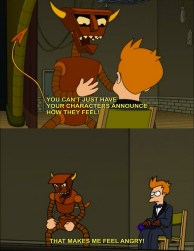
Obviously, this is a pretty common problem people have. As a writer, you have a picture in your head. It sometimes slips away that your reader isn’t seeing what you’re seeing. Also, it’s easier to just say what’s happening in your head than explain every movement. You can see your character’s angry, so why wouldn’t you put “He was angry”? The problem is well known enough that it’s even spoofed in the Futurama episode, “The Devil’s Hands are Idle Playthings“:

Your lyrics lack subtlety! You can’t just have your characters announce how they feel. That makes me feel angry!

enhanced-buzz-30540-1374721309-7

buzzfeed.com

Like getting past “Hey look! I’m a Writer!” Syndrome, I think learning to show rather than tell is something many writers simply start to grow out of as they read and write and edit more. After enough time, you get more comfortable and stop trying as hard, and that makes for better writing (in my opinion at least). The note I generally leave in manuscripts I’m editing is, “What is he/she doing? How would we know they’re sad/angry/happy/etc.

Of course there are suggestions to help weed out telling. Unfortunately, I think many suggestions are far too often abused. The one I hear most often is Don’t use To Be verbs.

Now, I completely understand that piece of advice, and I often point out places not to use them in manuscripts I’m editing. “To be” verbs (is, are, was, were, am, been…) are weak. They don’t have an image associated along with them. Picture “She ran.” You can see what’s happening, right? Now picture “She is.” The fact that “she” exists is all you get from the second. Not thrilling reading if something’s supposed to be happening. If any other verb is possible for an action, you probably shouldn’t use was, “It was raining”? “The rain fell.” “She was running”? “She ran.” Just by taking out the to be verb the sentences become stronger, and are showing, not telling.

This “to be” verb problem is well know (This site, for example, has an entire article about it) and generally easily correctable. The problem starts, however, when this tip is abused. “Don’t use to be verbs when you don’t have to” is good advice. “Don’t use to be verbs” isn’t.

Going back to that English class Senior Year of High School, the teacher actually gave us the task of writing the entire assignment (a 10-page short story) without using any “to be” verbs. Now, I can understand you try to make a point in English classes about things, and taking things to extremes help some people switch out of problem writing entirely, but what most people I know took away from that exercise was that “to be” verbs are evil and should be avoided at all cost. I admit, I spent a good portion of class trying to figure out how to switch out all my “was, weres, and be’s” and it took me a long time to feel all right using any sort of “to be” verb in any of my writing a while after that.

And that’s why I classify it. “Don’t use to be verbs when you don’t have to.” If there’s a better, stronger word you can use, use it. Don’t spend time, however, avoiding “to be” verbs at all costs. Some times you need them, and trying to take them out just makes the writing awkward.

Is Main Street a sleepy part of town? It’s ok to say “Main Street was never busy.” You don’t have to try to finesse the sentence to “Main Street sat in the center of town, never busy.” If you prefer the second, all right, but “to be” verbs are normal. People speak with “to be” verbs. Things can be described with “to be” verbs. It is important to not bore people with a lot of telling in your work, but it’s also important to keep your writing sounding natural.

So, as with everything, don’t take every rule as gospel, ask for help/critiques, and trust yourself.