“Intensive Purposes”

Ok, I’ll be the first to admit I haven’t always gotten sayings right. Homophones, similar words, it’s easy enough to get a phrase wrong. Some are so common, it’s likely you might not realize they aren’t the actual saying. Here’s a few I’ve recently cleared up in my editing:

(For the purposes of this article, the incorrect phrase will be bolded with its intended meaning following. The proper saying will be bolded and underlined in the paragraph following)

Intensive Purposes. (Meaning: “For every functional purpose; in every practical sense; in every important respect; practically speaking.”)   The one I saw this morning editing, and what sparked this blog post. I actually thought this was the saying myself up until a couple of years ago when I was corrected. It makes sense, “for all intensive purposes…” the purposes are important, intense…but no. The correct form is Intents and Purposes. So why isn’t intensive purposes correct? Because the saying comes from a 16th century English law, originally “to all intents, constructions, and purposes.” Shortened to “intents and purposes” it’s now easily mistaken for “intensive purposes”

Per Say. (Meaning: As such; as one would expect from the name). A mistake that’s easy to understand (after all, it basically just comes out and says “as it says”, right?) the saying is actually Per Se. Why? Because it’s Latin. Se might not be an English word, but in Latin, “se” means “itself” (or himself or herself depending, but we’ll just stick with “itself”). Therefore, per se means “by itself”.

– Wallah. (Meaning: There it is, ta-da, presto). Another misunderstanding of a foreign word. When people write “Wallah!” they generally are trying to write what they’ve heard “Voila!” (a French word coming from the words vois [to look] and la [there or it]) as. While it might more technically come out to “look there!” it’s generally used (in France and in the English-speaking world) as “Here it is!” or “Ta da!” (for example “You add some ribbon, and voila! A new dress!”)

As added incentive to use the proper spelling, “Wallah” is itself a word meaning: “One employed in a particular occupation or activity” (coming from a Hindi word [vala] meaning “pertaining to or connected with”). Not what I think people mean when they say something along the lines of “Wallah! A new dress!”

– Say “I”. (Meaning: I agree). Perhaps it isn’t a foreign language misunderstanding, but this one is a replacing a common English word with one a little more obscure. Aye. Say “I” generally makes sense in the context (If you consider it something along the lines of: “If you agree, volunteer yourself.”) but “Say ‘Aye’”  makes even more sense, quite literally meaning “yes“. So “say ‘aye’ ” is asking people to say yes to a vote.

– Bunker Down. (Meaning: to take shelter; to assume a defensive position to resist difficulties). This mistake comes from a combination of places, I think. 1) taking the military phrase “bunk down” (meaning to go to bed) and 2) misunderstanding the proper phrase Hunker Down. While it might make sense to have “bunker down” as an extension of “bunking down” a bunker generally is “a bin or tank especially for fuel storage, as on a ship” or “an underground fortification” While it is possible to make “bunker” a verb, the verb forms are bunkered, bunkering, and bunkers, never just bunker. Hunker, on the other hand, means “To squat close to the ground”, “To take shelter, settle in, or hide out”, or “To hold stubbornly to a position” Bunker might make sense if you ignore the noun/verb problem, but hunker undoubtedly makes more sense.

– Reek Havoc. (Meaning: to cause a lot of trouble or damage). The “havoc” part of this saying doesn’t need much explanation. After all, havoc means: “wide and general destruction : devastation”. So, since you have the destruction part of “cause a lot of damage” all you need is the “a lot”. Reek means “to give off or become permeated with a strong or offensive odor” so, metaphorically, it could make sense. Someone who “reeks charm” gives off a lot of charm, so someone who “reeks havoc” causes a lot of destruction. The saying, however is Wreak Havoc , which makes slightly more sense with one of the meanings of “wreak” being to “inflict or take vengeance”. Rather than giving off havoc (“reeking” havoc) someone is inflicting havoc (wreaking havoc).

– Hone In. (Meaning:Directing yourself towards/zooming in on a target). Like the others, hone in generally makes sense. Meaning “to sharpen” or “to perfect” it’s possible to understand hone in as sharpening your direction or sight towards a target. The correct saying, however, is Home In. Coming from the idea of homing pigeons which were commonly used in the 19th Century to deliver messages, home in now covers anything that’s directing itself towards a target (such as missiles). So HOMing pidgeons=HOME in.

Of course, this might be starting to fall under the “popular use changes the lexicon” phenomenon. With enough people using this saying incorrectly, it’s possible it will start being accepted as “hone in” (even if that’s not the original saying).

– Maul It Over. (Meaning: take your time to think about something). One of the funnier mistakes I’ve found, I’m sure it comes from “maul” sounding similar to “mull”. Of course, a maul is a heavy hammer and to maul is to beat, bruise, mangle, or handle roughly. While I suppose it’s possible to maul a thought, people generally are looking for the slightly less violent Mull It Over. While interestingly enough, to mull something can mean to pulverize it, mull over a thought is using mull’s second meaning: “to consider at length : ponder” You are considering a thought at great length, not beating it up.

– Mute Point. (Meaning: a point that has been rendered irrelevant). While this “mute point” might have originally meant “[a point that is] to be definitively determined by an assembly of the people” it currently means (at least in the US) that the point is irrelevant to whatever is happening. And that’s why mute makes sense, yes? Someone who is mute can’t talk, you don’t need to talk about that point, wallah (cough, voila) you have a mute point. Properly, however a “mute point” is actually a Moot Point While the definition of “moot” might not help explain why it’s “moot” not “mute” (moot meaning “subject to debate, dispute, or uncertainty”) a moot point comes from a law student practice (starting in the 16th century) of participating in “moot cases”. Using these practice or hypothetical cases, the students could discuss hypothetical case law. Thus, a point in a moot case was hypothetical, and often not relevant to actual cases, bringing us Moot Points.

– Squash Their Hope. (Meaning: Kill someone’s hope; stop someone from hoping something will happen). This mistake may make the most sense to me. You’re trying to kill someone’s hope. If you squash a bug, you kill it. Ergo “Squash their hope” makes sense. Though a valid conclusion, the saying is actually Quash Their Hope. Perhaps a little more obscure (but two hundred years older than the word “squash”) quash means “to make void, annul, crush.” So, while “squash” might be the same sort of idea (crushing something) quash brings along all sorts of other fun meanings. (Not only are you crushing someone’s hope, you’re defeating it forcibly.)

– Ripe with Conflict. (Meaning: Conflict abounds). Ripe makes some sense here. Something that is “ripe with conflict” means there’s a lot of conflict going on. Ripe fruit means it’s really full and ready to eat. It doesn’t completely make sense, but who says idioms have to? Well, idioms don’t, but the proper saying (Rife with conflict) makes just a little more sense. You see, “rife” means: “plentiful” or “abundant”. So something “rife with conflict” is abundant with conflict. Makes just a little more sense than “ripe”.

The main problem with these misunderstood sayings is, as I’ve pointed out, most generally make sense if you don’t think about them too much (you can even make an argument for some going both ways, as I know since my fiance and I spent the better part of a meal debating “hone in” and “bunker down” when I originally talked about writing this article). As long as a saying generally makes sense, people don’t tend to think about them too much. After all, someone might tell you to “take a knee”. If you aren’t a sports person, it might not make sense why, as Urban Dictionary puts it, that means “taking a temporary break from an activity” but you can come up with some reason for it (kneeling would be taking a break…) If you heard the saying a few times as “take a T” you could likewise more than likely come up with a reason for it (T…it’s a sports metaphor…Take a timeout? That works).

Misusing several sayings isn’t about not understanding the words, it’s about not hearing something correctly, and coming up with something that generally makes sense. Idioms are, after all, figurative. They only generally have to make sense.

Just, generally, the actual saying has a reason it’s the way it is, and thus makes a little more sense than its alternatives.

———————————————————————————-

Want to carry this and other posts with you wherever you go? Download Write, Edit, Publish for free today.
The Unneeded Words

Recently, I talked about how long novels (generally over 120,000 words) can have problems getting published.

Beyond all of the generally valid reasons publishers may have for saying away from long novels for business reasons, there is the added fact that many long novels could do with a harsh editing before publishing–something the publishers likely don’t want to spend their time doing.

As I said before, if a story demands for a long book, and the 200,000+ length is nearly entirely action-packed or, at least, interesting, there’s no problem with it. If the story drags, however, you have more of a problem. Even if the writing isn’t quite up to purple prose levels, there are very few reasons to be wordy in most forms of creative writing.

And so, if you’re trying to cut down on your word count, keep some of these things in mind:

1. Unnecessary Scenes. Not every scene you write is necessary to your plot. There might be a cute date night or someone running into an old friend that gives you some fun banter, but while reading the story…it does nothing to advance the plot. Unless a scene serves a purpose, it sadly might be better to cut it–especially in a long book.

– Is the scene necessary to the plot?
– Does it show us something about a character that hasn’t been shown before?
– Does it have necessary background information that has to come out now (hopefully not in an info dump [see below])?

If not, seriously consider cutting it. If you can’t bear to see the conversation go, you can always save it elsewhere (I have folders for each project on my laptop with outlines, manuscripts, and a document with all the cut scenes that had to go but I still love–most just because the dialogue amuses me).

This likewise goes for laundry lists of actions. It’s perfectly allowable to have time jumps in novels. The characters get in their car, and then, scene break, they pull up to their destination. You don’t need pages of them talking about nothing in the car, playing the license plate game, explaining how they’re changing their clothes, brushing their teeth somewhere…unless it’s somehow important, you can time jump.

2. Info Dumps. For those not wanting to click over to Wikipedia, an info dump is a long section of text that gives a bunch of back story all at once. Worst thing about info dumps? They’re often unneeded (or at least parts of it are). While we authors do (or at least should) know the entire history of a character (where they grew up, how long they’ve been in a job, who their parents are, why they don’t like so-and-so) it may or may not be important to the plot. An info dump slows down the action (Oh no! It’s the villain! Looks like the Main Character’s (MC) is really going to have to run for it…oh, five pages about how the villain became a villain and how he doesn’t like the MC…what was going on again?) and more than likely, it isn’t necessary.

Pick out the important bits (do we need to know the villain was abused as a child? Does that come up later? Do we need to know he went to Villain University?) and then find a way to weave that information in later. While hopefully your weaving it in doesn’t surface as an “As you know, Bob” even that is preferrable, in my personal opinion, to an info dump. “As you know, Bob”s will likely take up less space (with the unnecessary parts already clipped) and keep the action moving.

3. Too much description. Now, description is good. As I’ve said before, it’s a sad fact, but readers don’t see what’s happening in our heads while we’re writing. Without description it’s either just a bunch of people moving around empty spaces, or worse, floating dialogue. What you don’t need is every last detail in a room (see my comment about skipping those three pages of description about that tree in Return of the King).

Like everything in writing, how much description to use is a fine balance. Tell me the MC is in a classroom. You can say there’s a whiteboard, tables, a podium…whatever you see. You don’t, however, need to spend a page giving every last detail, especially if it’s not important. Is the exact pattern of the carpet going to come up later? Do we need to know how many posters are up and what each is of? If not, consider cutting back a bit–or at least not doing it all at once.

Like an info dump for exposition, description dumps aren’t good. Maybe the pattern of the carpet will be important. Can that come up later? Say a little while later the character looks down at their feet because they’re bored. They can start counting how many stars are across the floor? That way you get the pattern in without, “The room was large with X number of tables. Whiteboard took up one wall, there were 7 posters on the others. In the back… The carpet was… Three windows faced east… yada yada yada.”

4. Wordy phrasing. While not everything has to be in its most succinct form, it’s possible to cut down on your word count and make your writing/imagery stronger a lot of the time by rephrasing things. For example:

The sheets were soaked through, made a squishing sound when Sam moved.”

Not awful, and it’s good to get senses involved in a scene (too often people forget smell and sound for sight when writing). But I would edit it like this:

The sheets were soaked, squished when Sam moved.

Squishing would also work, but since squish is an onomatopoeia, “squished” gives me the same sound as “made a squishing sound” You have the same effect, and give a stronger feeling without all the words couching the sound. Now the sentence has gone from 12 words to 8 words. Chopping out 4 words at a time in a 100,000 word novel can add up quickly.

5. Redundancy. Has it been said before? Cut it. No matter how important a fact is, repeating it over and over isn’t just space consuming, it gets annoying.

All the same, she was happy to be there.”
Two paragraphs later.
Happy to be there, she…”
A paragraph later.
She really was happy to be there.”

We get it, we get it, she’s happy to be there. If a point is very important, maybe say it twice, but more likely than not, the reader will get it after one time. That means you can take out at least 11 words there (“Happy to be there” and “She really was…”) Again, that adds up.

This likewise goes with scenes that are redundant. Did your MC already talk about how he really wishes he could go home? Maybe you need to restate that later, but you don’t need to spend multiple scenes with the character talking about the same thing. Especially not if it is something the character is complaining about. A lot of complaining, whining, or angsting gets old quickly. Namely because a character is continuously complaining about something, but doing nothing to fix it. The plot doesn’t move forward and the character seems one-note.

6. Unneeded Words. And, last but not least, what this blog is titled after–all those little words that sneak in that really don’t need to be there. I believe, so far this year, I have yet to return an edited manuscript that isn’t at least 1,000 words shorter than when I got it (even with adding in needed words/sentences). Even without the other things on this list, there always tends to be unnecessary words.

Now there are plenty of words that can be unnecessary depending on context, but the three I find myself deleting the most are “up”, “very”, and “that”.

Now, if you have someone look up, yes you need up, but often I find “She stood up” or “She raised her hand up” For the first, there isn’t much difference between “She stood” and “She stood up” Up is contributing nothing. For the second, raising implies “up” You don’t “raise your hand down” thus you don’t need to specify.

“Very” is a modifier that “very” often gets abuse. I know I use it all the time (you can probably find plenty of “very”s in this blog). Mostly, though, “very”s get cut before adverbs/adjectives in my editing.

He ran very quickly.”
Her singing was very beautiful.”

Very can bog the sentence down, and they change “very” little. It’s still possible to picture someone running quickly or singing beautiful without modifying it with “very”

As for “that” I have a bit of a vendetta, I admit. Lets look at some examples:

I hope that I don’t fall.”
It was comforting knowing that she wasn’t alone.”
He couldn’t believe that he had been there so long.”

There’s nothing technically wrong with those sentences, but let’s get rid of those “that”s:

I hope I don’t fall.”
It was comforting knowing she wasn’t alone.”
He couldn’t believe he had been there so long.”

Have the sentences lost any of their meaning by taking out “that”? Not really.

So, depending on how often you use unneeded “up”s, “very”s, or “that”s in sentences, you can cut your word count down substantially just by taking out words that don’t serve a purpose.

————————————————————————

Want to carry this and other posts with you wherever you go? Download Write, Edit, Publish for free today.

Wy I Hayt Fonetik Axsents

All right. Be honest, how long did it take you to figure out the title? Did you even bother? All right, if you did, what is easier for you to read, that title or “Why I hate phonetic accents”?

Ok, I’ll be the first to admit that the English language makes little sense. It’s a Germanic language that was morphed by Anglo-Saxons, too far away to remember original German, adapted by the French during the Norman Conquest, and then had a thousand years to go through a vowel shift, changes, and added words (it’s reported Shakespeare alone invented 1,700 now common English words). Standardized spellings weren’t common for long after the Elizabethans (after all, Noah Webster decided to standardize “American” spellings in 1780) and many grammatical rules have come and gone, made by people often referred to as “pedantic” (split infinitives were only classified as “wrong” in the 20th century by scholars who more than likely believed English should follow Latin grammatical rules [where it’s quite literally impossible to split infinitives]). So why isn’t “phonetic” spelt “fonetik”? Because it comes from a Greek root, transcribed from the Greek Alphabet as ‘ph’ in the Latin alphabet, and it’s been that way since.

So, all of it is made up. So why can’t we make sure our character’s accents come out properly by having one say “dahlin'” one “dahrling” and one “derlin'”? The same reason people standardized language in the first place. It’s harder to understand. 

Truly, language as a whole is made up, if you want to argue it. But that doesn’t change the fact that it’s purpose is ultimately to have one person understand another. That vastly increases when you’re a writer. If you want to write something out phonetically as you understand it for your own notes, it doesn’t matter. If you’re expecting people to understand you in a novel/short story/article you’ve written, eet prabalee shudent b ritten liek dis.

Furthermore, how an accent sounds to you and how it sounds to someone else can be two very different things. Think of a British accent. How would someone with a British accent say “Really” to you? Reelee? Realeh? Rehleh?

Does it change if they’re speaking with a Kightsbridge Accent? London Accent? RP Accent? Cockney Accent? So now, not only is the phonetic spelling subjective, it can also be insulting if you don’t actually speak with that accent. Personally, I’d think I [in DC] say “really” something like “reelee” but I don’t speak with British accent. How do I know what sounds correct to someone from [insert place character is from]? After all, I’ve never heard someone say “pip, pip, cheerio” even though that’s supposedly British from what TV tells me. If you suddenly try to make your Irish character sound like the Lucky Charms Leprechaun saying top o’ the mornin’ to ya everywhere, you risk people considering you ignorant and/or insulting.

So is there any reason to write out an accent? In my opinion, no. In a novel I recently edited, there was an Irish character speaking with the thickest phonetically spelled attempted-accent I have ever seen (even sounding it out it didn’t sound Irish to me). Eventually I gave up trying to read what that character was saying (reading shouldn’t be that difficult in my opinion), leaving a note along the lines of “please, please, please don’t do this” but I do still remember one perfect example of the confusion spelling things out phonetically can cause.

“Fairreh”

Any guesses on that one? Perhaps some context, unphoneticized:

“Look, a fairreh!”

What I heard saying it? Fairy. It was a fantasy novel, so I thought, all right, fairies are showing up.

Too bad the author meant “Fire”

Just a small difference in the tone of the scene there.

Now, I’m not saying you can’t throw in small changes like “gonna” or “haveta'” if you feel the need to (e.g. “Tommy! Why haven’t you taken the trash out?” “Ah….I was gonna.”) but I highly, highly suggest staying away from trying to show your character’s accent bi mayking ehveree wurd fonetik.

But then, how do you show someone’s accent if you don’t spell it out?

I’d suggest some less intrusive (easier to read) ways:

1.  “He said with an X accent.” It’s simple, but showing accents in writing might be best suited with simple mentions. There are many ways to get it across in the same way:

“Hi,” he said with an Irish accent.

“Hi.”
She smiled at his lilting accent. It made even “hi” sound magical.

“Hi,” he said.
“Oh, that’s an interesting accent. Where are you from?”
“Ireland.”

“Hi,” he said, noticing how much his accent seemed out-of-place in the new school.

They all let you say he has an accent without  obscuring the actual words and making it hard to read.

2. Use speech patterns to show differences, not phonetics. Again, this is another one you have to be careful about not being insulting, but people from different areas don’t only have different accents, they use different grammar. Where I say, “I was going to go…” My great-uncle in West Virginia says, “I was fixin’ to go…” Where most people I’ve met say, “Turn off the light.” My college roommate from Brooklyn used to say, “Shut the light.” Don’t overdo it with regional slang (especially when you aren’t familiar with the region) since you’ll be in danger of going back to that “insulting” thing, but it tends to be a better way to show accents than, “I whas goeing too goe…” and “I whus fixen ta goh…”

3. If necessary, use phonetic spellings tastefully. As I said above, if your character doesn’t say “going to” properly, it might be all right to put “gonna” It’s a generally well-known version, and “I was gonna go…” would more than likely make sense to the bulk of your readers. Same with fixin’. Putting “fixing” just wouldn’t sound right in my head for “I was fixin'” Without the ‘g’ though, it’s still possible to generally understand what is being said. “I was fixin'” isn’t quite the same as “I whus fixen” The average reader will be able to read small changes like that easily. It’s when you start making people sound out every word that it gets tiring.

Now, can people write out phonetic accents well? I’m sure they can. Should they? In my personal opinion, no. Of course, that’s my personal opinion. As with everything else on this blog, people can take or leave what I say. They are all just suggestions after all. But, as I see it, anything that makes your writing difficult to understand isn’t generally good for it. After all, we standardized the language to be understood. And, as writers, it is our job to use language well.

He said, She said

Not too long ago now, I wrote a post about Showing and not Telling. While it’s always a good idea to show people what’s happening than tell them it (makes for more interesting reading for one) I didn’t agree with the method my old high school English teacher gave me for trying to stop yourself from telling–don’t use “to be” verbs.

You can read the rest of that post here, but today’s blog is going to focus on a different hotly debated, often hated aspect of writing: The Dreaded “said”.

As someone who’s written a lot of  dialogue, I’m sure I have used more than my share of “he/she/I said”s, and I never much thought about it until I started seeing posts like this in the NaNoWriMo forums:

When I’m writing dialogue, it’s so hard to think of words besides ‘said’.
Does anyone have any websites that could give me, and other writers, lists of words that could be used besides ‘said’?

And, “300 Ways to Say Said” a post complete with a list of 300 words you can use in tags, from “he/she/it/I accused” to “he/she/it/I yowled

So, should you worry about using “said” too much in your novel/novella/short story?

Personally I agree with the post following the last of the list, “and ‘said’ is better in 99% of the cases.

All right, that answer might be a little extreme, but as a whole, I have to say I agree with the sentiment. There is a time and a place to use other words (is your character whispering, yowling, or screaming? Go ahead and say so) but like trying to avoid using “to be” verbs, avoiding “said” to the point where it makes your writing awkward is much, much worse than having a far share of he said, she saids around the page.

1. People are trained to skip reading “said”s. It’s an odd phenomenon, but it’s a real one. Tags are added to dialogue to make sure the reader doesn’t get confused about who’s talking. For example, if Bill, Tom, and Nancy are having a conversation, you can’t have something along the lines of:

“I’m here!” Bill said.
“Welcome.”
“Took you long enough.”
“Yeah, what took you so long?”

How would anybody know who’s talking? Did Tom say “Welcome” or did Nancy? Is the person who said “Welcome” also asking what took Bill so long, or is there actually a fourth person in the room?

Half of the reason we use tags is just to have the name there. Even without any extra words, it would make more sense if the dialogue read:

Bill, “I’m here!”
Tom, “Welcome.”
Nancy, “Took you long enough.”
Tom, “Yeah, what took you so long?”

That’s basically script format, but it at least tells you who’s speaking. Said is nearly the same equivalent. People glance at the tag long enough to see the name there, and the said tends to roll right off them. Put in other words, though, and their attention starts being draw straight to the tag.

“I’m here!” Bill exclaimed.
“Welcome,” Tom soliloquized.
“Took you long enough,” Nancy scolded.
“Yeah, what took you so long?” Tom contributed.

Maybe you aren’t using said over and over again, but suddenly the attention is on the tag rather than what’s actually being said…and that’s generally a bad thing. (For the record, all of those tags are suggested in the “300 Ways to Say Said” thread).

2. Instead of replacement words, you can tag things with actions. Going back to the first point, let’s look at the words replacing “said”. Ok, let’s keep exclaimed, Bill’s really excited, no reason not to say that. But the others? We can use action tags instead. So, rather than be stuck with “Bill said, Tom said, Nancy said, Tom said” you can have:

“I’m here!” Bill exclaimed.
Tom looked up from his work. “Welcome.”
“Took you long enough,” Nancy said.
“Yeah.” Tom frowned. “What took you so long?”

You still have the names close enough to the tags that you know who’s speaking, but you aren’t using awkward sounding words to keep from using a natural word.

Bonus: You’re showing people rather than telling them. Say you had “Tom scolded” rather than “Tom frowned”. You could do that, but what does scolding really look like? Is he shaking his finger? Frowning? Pursing his lips? ‘Scolded’ doesn’t have a strong picture attached to it. ‘Frowned’ does.

3. People aren’t always yelling/whispering/screaming… There’s a reason using replacement words sound weird when reading dialogue tags–and it’s not just we’re all used to the word said. Words that replace said are often strong ones. If someone is saying something quietly, whispered is probably a better word to use (it means someone’s speaking quietly after all). More than often, though, people tend to just say things. When was the last time you had a conversation where a person was exclaiming, shouting, and yelling everything they were saying in a normal conversation (i.e. not a fight or in a mental ward)? If your characters are having a perfectly nice conversation, but one person keeps whispering, or yelling, or scolding, I’m going to wonder exactly what’s wrong with them. Good if your character is trying to reach Hamlet levels of insane. Not so good if they’re supposed to be rational characters discussing where their friend went.

4. Too often, it feels like you’re trying too hard. As I talked about in my earlier article, “Hey Look! I’m a Writer!” Syndrome, trying to be fancy with your writing doesn’t make you look like a good writer, it makes you look like someone who doesn’t know what they’re doing, and thus are trying too hard. You shouldn’t be lazy or cavalier about your writing, but that certainly doesn’t mean you have to labor over every word to make sure it fits with every other artistic gem. Just like it’s perfectly fine to say “The sun rose” rather than “The golden orb floated into the azure sky” it’s perfectly fine to say “He said” rather than “He exclaimed with a fervor”. There’s a time and a place for poetic/flamboyant language, but using it just because you don’t want to be boring or think that’s what good writers do is almost always a bad thing.

And so, with everything else with writing, I always say, say what you mean, but don’t make your writing unnatural just because you think you need to be doing something else to be a “good” writer.

How to Take a Critique

Anyone who’s had a look around at some of my other blogs probably knows that I am in the process of having a couple of books come out this summer (one under my name, one under a pseudonym). Anyone who follows my Twitter account (or Facebook Fan Page) also probably knows I just sold a short story to a magazine that will be printed in the near future.  All of that, combined with the fact that I edit projects freelance means most of my time lately has been editing/reading edits/reworking edits… and the list goes on and on.

Now, I fully believe being a writer helps you be a good editor. The two don’t necessarily go together (I’ve met some editors who are awful writers and some writers who are awful editors) but part of both jobs is to have a good ear (eye?) for what sounds right on the page.

The other way around, though, I don’t think there’s quite as strong a connection. Great editors can be great writers, of course, but all the other little things that make for a good editor don’t necessary flip straight over to being a good writer. What being an editor does do for writing, however, is help you take critiques.

Luckily for my editor side, every author I have recently worked with has been great (thank you all if you’re reading) but I know very well how bad things can get when you’re editing something for someone who really just wanted a pat on the head to say how good their work is and for you to catch typos.

Now, the writer in me fully understands how hard it can be sometimes to have someone ripping apart your work. As much as I might not like something I’ve written, it seems to fall into a “no one can beat up my brother (erm, writing) but me!” situation when someone else starts pointing out flaws.

But, having been on both sides of the editing process, I also know how helpful editors can be (and not just for the typos). Looking at the most recent round of edits I got on one manuscript, I see my editor pointing out things here and there that I’ve pointed out as problems in manuscripts I’ve read. Obviously I agree that those things need to be changed, but I didn’t catch those problems when it was just me reading my own writing. It’s possible to be too close to your writing to see problems that are obvious for someone else, and thus I always suggest having other people look your writing over before moving on with plans (be it submitting to agents, publishers, or self publishing). It doesn’t have to be a professional editor if you don’t want to pay for one, but at least have a writing group or go through a novel swap with someone else.

To get the most out of editing/critiques though, you have to fight down that urge to automatically defend yourself, so, some important things you can do to make editing most helpful and least painful:

1. Listen silently. This is perhaps most important if you’re speaking with your critiquer/editor in person, but the same holds true any time you are reading a comment. Don’t start defending yourself before they’re done speaking. It’s hard–believe me, I know–but sit silently, listen to/read what they have to say, and then take a deep breath before going forward. It’s possible your reviewer/editor/critiquer has no idea what they’re talking about, but cutting them off to tell them they don’t know what they’re talking about (or not reading a comment because you disagree) won’t help you at all. Listen, absorb, then speak.

2. Just because the edit is “wrong” doesn’t mean you should ignore it. Ok, this of course doesn’t go for edits that make a sentence grammatically wrong, or that introduce typos (sometimes, especially with MS Word Track Changes, typos can appear based on where the program thinks you want something deleted. If you suddenly have “I hadd a boat” feel free to take off the extra ‘d’). This goes for an edit that reworks a sentence into something you didn’t mean. For example, in my recently edited manuscript, the editor changed this sentence:

“The girl stood outside, half-hidden under the overhang.”

to

“The girl stood, half-hiding on the overhang outside.”

Um, no. I didn’t mean the girl was hiding on top of the overhang, I meant the overhang was hiding her. (Someone on the second story can only see part of her past the overhang). Those sentences mean two very separate things, and I definitely didn’t mean the second one. Still, that doesn’t mean I automatically reject the change and move on. It is more helpful to go back, explain that’s not what you meant, and ask if there’s something that would make the sentence clearer. It’s possible the editor was reading too quickly, but it’s also possible that “under the overhang” was confusing the image in her head (sadly readers don’t automatically see exactly what us writers do).

3. Critiques/Reviews/Edits aren’t personal. All right, if the review is “Your writing sucks, your parents should be ashamed of having you as a child” or something along those lines, you’re more than welcome to think the reviewer is a jerk and ignore them. Most of the time, however, edits aren’t personal attacks on you, or even your writing style. A comment that says “This part is dragging, I’d be tempted to stop reading” or the like isn’t an attack. It’s an honest opinion that says that some of your readers might be getting bored and skip ahead (or worse, set the book down all together). Don’t be hurt by it, take it as a chance to rework the section so people love reading it.

4. It’s OK to disagree with your editor/reviewer/critiquer. Going along with not throwing out an idea just because it’s not what you mean, it’s also all right to completely disagree with your editor on some points. Editors aren’t perfect, it’s possible they’ve changed something that you know you had right (and have the grammar guide to back you up on). It’s possible they just aren’t familiar with a word and thus changed it to something that doesn’t quite mean what you meant. If they’re connected to your publisher, yes, you’ll have to work it out with them (often publishers have final say), but if it’s a friend or someone you’ve hired for an edit/critique it’s all just suggestions as to what they think would be best. You can take or leave any of the changes.

5. Figure out if you actually want a critique. While I fully believe all writing can only be completely at its best after some outside edits (be them from a friend, professional or publisher) some people really just don’t want them (see my point about people who want a pat on the head and typos taken out). If you don’t want to work on your story/don’t want anything changed, ask someone to go through and look for typos, and then move on. As a professional editor, I’ve had one or two cases of people who–while they are willing to pay a few hundred dollars for me to go over their work–don’t actually want me to tell them I’d suggest changes. For the most part, it just ends in several emails about how all my edits are wrong, and then me giving up and only pointing out typos and things that are blatantly wrong/confusing to keep them happy. If you want to pay me content edit prices for copy edit work, fine, I won’t stop you, but it would save money and headaches to just say you want a copy edit/proofreading*.

Edits (good ones at least) help make a story the best it can be, and as hard as it might be, not trying to defend yourself is going to be the best way to learn from them. Nobody is perfect, nobody’s writing is perfect. If you’re willing to hear that, even an imperfect editor can help make your writing that much better.

*Before hiring anyone to edit your work, it’s always good to get an editing sample–even if they’ve come very highly recommended–so you can see if how they edit is what you’re looking for. Offering a 5 page sample edit isn’t just how I prove myself, it’s how I make sure my clients would be happy with my in-depth edits. Edits should be helpful, not a headache.

———————————————————————————–

Want to carry this and other posts with you wherever you go? Download Write, Edit, Publish for free today.

$*&# @#*%

Note: In an attempt to keep this blog as family friendly as possible, strong language will be censored (e.g. a**, f***, s***, etc.) [yes, I couldn’t fight the urge to start and end that with Latin abbreviations…] and external links to sites/clips/articles which include strong language/adult content will be marked with a caret (^) so as not to be confused with other asterisks (*). If you prefer not to read such content, please avoid those links. You have been duly warned.

**************************************************************************

Television and Movies have some fun rules when it comes to what actors can and can’t say on screen. Where plays and novels have not had many problems with restricted content, state censorship of motion pictures has gone back nearly as far as motion pictures themselves. This censorship of motion pictures eventually gave way to The Motion Picture Production Code (perhaps better known as The Hays Code) which strictly governed what could and couldn’t be shown between the 1930’s and 1960’s. Though quite long in its entirety, The Hays Code included some points such as:

II. Sex. The sanctity of the institution of marriage and the home shall be upheld. Pictures shall not infer that low forms of sex relationship are the accepted or common thing.

V. Profanity. Pointed profanity (this includes the words, God, Lord, Jesus, Christ – unless used reverently), or every other profane or vulgar expression however used, is forbidden.

And the list goes on and on.

Though The Hays Code is no longer around, it’s predecessor, the MPAA movie classification system is still alive and strong, currently marking movies as G, PG, PG–13, R, or NC–17 based on the movie’s content and the way that content is handled.

Other broadcasted media finds itself likewise watched by The Federal Communications Commission (FCC).  This governing body decides what is allowed on the air, and is the reason George Carlin couldn’t say his “Seven Dirty Words^” on television, much to the chagrin of some TV writers. Some more risqué shows, such as Fox’s Family Guy, have gone so far as to out right mock the FCC (in song)^ during their broadcast.

However, while the screen and airwaves might be regulated, plays and books aren’t.

If you so desired, you could see a fully naked Daniel Radcliffe in a recent production of Equus, and you’ll never see an ‘R’ rating on a book just because a character says f***. You certainly won’t find major outlets refusing to carry books that would likely be NC-17 films the way many major movie theatres often cap what they show at R. So novelist/playwrights don’t have to worry about how they use strong language in their work. But should they?

In my opinion, yes and no. As with everything else in writing, it’s important to think about the pros and cons about what’s being put down on paper, and what you’re trying to accomplish, when you use strong language.

1. Pro: Real people swear. In an earlier blog, I touched on the pros and cons of dialogue and narrative. Though it isn’t the point of that blog, it’s briefly mentioned that it’s important to keep dialogue sounding natural. Well, depending on who you know, it’s possible more than half of what you hear in any one sentence involves strong language. It’s possible to use “clean swears” some times, but we all know people who wouldn’t say “Darn it!” or “Shoot!” if they banged their knee against a table. If your character would swear, it’s awkward sometimes trying to get around it. After all, as John Brophy wrote in his 1930 book, Songs and Slang of the British Soldier: 1914-1918:

It [F***] became so common that an effective way for the soldier to express this emotion was to omit this word. Thus if a sergeant said, ‘Get your f***ing rifles!’ it was understood as a matter of routine. But if he said ‘Get your rifles!’ there was an immediate implication of urgency and danger.”

Can you imagine a soldier in the trenches really say, “What the frick???”

2. Con: Strong language can lose readers/make readers uncomfortable. All right, maybe you don’t want to censor yourself just because someone might be offended, but if you’re writing for publication it is something to think about. Are you willing to turn some people off just so you can use the exact language you want? If yes, use it. If not, strongly consider toning it down. As a part of one review for my book Grey Areas, one person mentions language is why they’d rate the book as 3.5/5 instead of 4/5:

Now… this would have been 4 stars but all the swearing was a bit much for me. Yes, yes – I know – Demons – bad guys – of course they swear! I totally get that, and I agree. Don’t get me wrong – I don’t mind a couple in a scene when the situation really calls for it, but there were a lot of f-bombs.”

For me, the swearing was carefully planned in the book (one group swears [often] the other doesn’t at all), but doing that I (and the rest of us who want to do something similar) have to accept it can make some people uneasy.

3. Pro: You can tell a lot about a character based on the language they use. Going back to the first point (real people swear) you can quickly characterize someone based on the type of language they use. Do they swear? How often do they swear? What (if any) words are taboo to them? Do you have a character that swears in every sentence, but still won’t say f***? Do you have a character who won’t even say ‘Jesus’? Just by knowing that, you (and the reader) know a lot about your characters (and you have a good place to figure out more about your characters if you’re doing a Character Questionnaire. Why do they/don’t they swear?)

4. Con: Swearing can be a crutch. As my mother use to say, swearing is often the sign of a poor vocabulary. Now, I believe that can be far too easily generalized (nothing wrong with swearing if that’s how your character talks) but if you’re using strong language in places that might be better served with other words, it can be lazy (and often weaker) writing.

5. Pro/Con: Rare strong language can be shocking. This point can really be a pro or a con depending on how you look at it. As with the soldier example up there, when a character often uses strong language, it loses its effect (e.g. “Get your f***ing riffles). However, if a character doesn’t swear, the one time you hear that character swear, it becomes very clear very quickly how serious/upset they are. Whether that means you should use a lot of strong language or little depends on whether you want “Get your f***ing riffles!” to be routine or urgent.

And I’m sure there are more, but those are what I generally consider when it comes to strong language in otherwise unmoderated writing. Feel free to supply your own considerations, though comments/tweets/emails will be moderated for language (re: family friendly) before posting.

Head Jumping

Pretty much anyone who’s read a book has probably seen narrative written in first and third person. Some people may have even seen a couple in second. Everyone has their favorite to write in, and generally read, but I’ve always been rather partial towards third person. (Specifically third person limited).

Now, before I continue, First/Second/Third Person Points of View (POV) are something most people have heard about, but as a quick refresher:

In a first-person POV the story is relayed by a narrator, who is also a character within the story, so that the narrator reveals the plot by referring to this viewpoint character as “I” (or, when plural, “we”). For example: “I walked into the club…

In second person, the narrator refers to one of the characters as “you”, therefore making the audience member feel as if he or she is a character within the story. (“You see the man walking toward you.”) Not very popular, it’s mostly seen in “Choose your own adventure” books.

Third person has two subsets—limited and omniscient. In both, every character is referred to as “he”, “she”, “it”, or “they”. In limited, the narrator is a character in the story, much like first person) only referred to as “s/he” rather than “I”. In omniscient, the narrator is a being outside the narrative relating all the character’s actions (as though they are watching the action unfold on stage/below them).

Everyone feeling refreshed? Okay, on we go.

Each POV has their own pros and cons, but first person and third person-limited are by far the most popular in modern literature.

Interestingly, after reading so many first novels working as an editor, I find that first time novelists seem drawn to first person (not as a rule, but as a general observation). I’m not quite sure why that is (perhaps the connection writers tend to feel towards first characters?) but it does offer some protection from a common third person limited problem. Head jumping.

If you’re writing in third person, stop and take a look at your writing. Are you showing the world as how your main character would see it? Then you’re in third person limited. Now, do you still say how every character is feeling when it comes up? That’s okay, but only if you stay in one character’s POV. Otherwise, it’s head jumping. And head jumping can be both annoying and confusing.

Without the confines of telling a story in first person–where you’re forced to stay in one character’s head–many people find themselves telling the reader what each character is feeling when it suits. We start in Character A’s head, showing the world as they experience it, and say what they’re feeling. For example:

A felt her stomach flutter.

As the POV character, A can know how she’s feeling. And it’s good to say. You’re showing how she’s feeling, not telling the reader how she’s feeling. Top marks for you. A can’t however know how character B is feeling. For example:

A felt her stomach flutter.
B looked back, knowing she was in love.

I know, not a great example there, but still, 1) B can’t know that unless they’re a character with some sort of omniscient powers and, 2) You’re in A’s point of view, A can’t know what B knows. It is a POV slip.

It may not seem like the biggest deal for some people, but going back and forth in third person limited shifts the entire world. As I said before, in both first person and third person limited you are showing the world through a character—both their point of view, and how they experience their world. A might be a pessimist, for example, while B is an optimist. In B’s POV, therefore, the reader is going to be experiencing the scene that is happening differently. Not markedly, perhaps, but through B’s eyes, not A’s. By jumping back and forth, you shift the entire view the reader is getting, which can offer a strange sense of vertigo.

Luckily there are some things you can do to stay in one POV in third person.

 1. Decide who’s experiencing the event. Think about whose eyes you’re seeing the story through (or the scene through). That is the person who is going to be telling everyone their personal experiences. Don’t slide into someone else’s just because you want their reaction.

-And more importantly-

2. Think about what the POV character could see to give other characters’ reactions. Perhaps the POV character can’t know the other character’s having their stomach flutter, but they can see them place a hand on their stomach, or swallow, or (if nothing else) you can say it seems the other character is experiencing something (A placed a hand on her stomach, looking as if it fluttered uncomfortably). The last might not be the best way to go about it, but it’s better than head jumping.


It can be a little harder to funnel your writing through one character’s POV, but lazy writing doesn’t make for good writing, so just take a little longer and think about what the POV character could know. It will also help with the age-old showing vs. telling problem. You will be forced to show actions rather than just saying what characters feel. And, after all, you can’t just say how your characters feel. That makes me feel angry. 

—————————————————————————–

Want to carry this and other posts with you wherever you go? Download Write, Edit, Publish for free today.

War on Was

This blog post actually comes from an in-person request to talk about the old “Showing vs. Telling” discussion.

Hands up, how many people rolled their eyes at the thought of hearing “show, don’t tell.” Congratulations, you have probably been part of a creative writing class (or at least an English class that did a section on creative writing). I admit I don’t remember a lot of my Senior English class in High School, but for the creative writing section towards the end, I do remember that being said over and over again. “Show, don’t tell.”

Eye rolling aside, as overused as that advice seems to be, it is a good piece of advice overall (I make it often as an editor). As a reader, it’s much more interesting to be shown what’s happening than being told. I mean, which one of these seems to be more interesting?

A: “It was raining. It made Tim angry.”

B: “The rain fell down the window. Tim watched, clenching his fists.”

Votes? I’m going to guess at least the majority say B. Why? Because A tells us what’s happening (It’s raining. Tim’s angry) B gives an image of the rain falling to picture and shows what’s happening to let us know Tim’s angry. It’s just not as interesting being told as it is to be able to picture things.

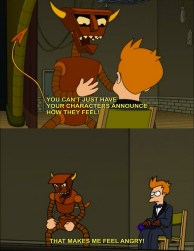
Obviously, this is a pretty common problem people have. As a writer, you have a picture in your head. It sometimes slips away that your reader isn’t seeing what you’re seeing. Also, it’s easier to just say what’s happening in your head than explain every movement. You can see your character’s angry, so why wouldn’t you put “He was angry”? The problem is well known enough that it’s even spoofed in the Futurama episode, “The Devil’s Hands are Idle Playthings“:

Your lyrics lack subtlety! You can’t just have your characters announce how they feel. That makes me feel angry!

enhanced-buzz-30540-1374721309-7

buzzfeed.com

Like getting past “Hey look! I’m a Writer!” Syndrome, I think learning to show rather than tell is something many writers simply start to grow out of as they read and write and edit more. After enough time, you get more comfortable and stop trying as hard, and that makes for better writing (in my opinion at least). The note I generally leave in manuscripts I’m editing is, “What is he/she doing? How would we know they’re sad/angry/happy/etc.

Of course there are suggestions to help weed out telling. Unfortunately, I think many suggestions are far too often abused. The one I hear most often is Don’t use To Be verbs.

Now, I completely understand that piece of advice, and I often point out places not to use them in manuscripts I’m editing. “To be” verbs (is, are, was, were, am, been…) are weak. They don’t have an image associated along with them. Picture “She ran.” You can see what’s happening, right? Now picture “She is.” The fact that “she” exists is all you get from the second. Not thrilling reading if something’s supposed to be happening. If any other verb is possible for an action, you probably shouldn’t use was, “It was raining”? “The rain fell.” “She was running”? “She ran.” Just by taking out the to be verb the sentences become stronger, and are showing, not telling.

This “to be” verb problem is well know (This site, for example, has an entire article about it) and generally easily correctable. The problem starts, however, when this tip is abused. “Don’t use to be verbs when you don’t have to” is good advice. “Don’t use to be verbs” isn’t.

Going back to that English class Senior Year of High School, the teacher actually gave us the task of writing the entire assignment (a 10-page short story) without using any “to be” verbs. Now, I can understand you try to make a point in English classes about things, and taking things to extremes help some people switch out of problem writing entirely, but what most people I know took away from that exercise was that “to be” verbs are evil and should be avoided at all cost. I admit, I spent a good portion of class trying to figure out how to switch out all my “was, weres, and be’s” and it took me a long time to feel all right using any sort of “to be” verb in any of my writing a while after that.

And that’s why I classify it. “Don’t use to be verbs when you don’t have to.” If there’s a better, stronger word you can use, use it. Don’t spend time, however, avoiding “to be” verbs at all costs. Some times you need them, and trying to take them out just makes the writing awkward.

Is Main Street a sleepy part of town? It’s ok to say “Main Street was never busy.” You don’t have to try to finesse the sentence to “Main Street sat in the center of town, never busy.” If you prefer the second, all right, but “to be” verbs are normal. People speak with “to be” verbs. Things can be described with “to be” verbs. It is important to not bore people with a lot of telling in your work, but it’s also important to keep your writing sounding natural.

So, as with everything, don’t take every rule as gospel, ask for help/critiques, and trust yourself.

Mary Sues

All right, here’s a controversial topic around the writing community. Speaking about Twilight yesterday got one of my friends talking about what a Mary Sue Bella is.

Most people who have hung around a writing community for any amount of time have heard of Mary Sues (especially Fan Fiction sites). For those who haven’t, as TV Tropes puts it, “Mary Sue is a derogatory term…[used] to describe a particular type of character. This much everyone can agree on. What that character type is, exactly, differs wildly from circle to circle, and often from person to person” (if interested you can read the entire article here, but standard TV Trope warning: it’s addictive).

Still, for not having a set definition, there’s plenty of talk about Mary Sues in literary circles. You can find “litmus tests” to see if characters you are writing are straying too close to Mary-Sue Territory (like the ones here and here) and it seems that just about everyone can agree that writing a Mary Sue is a bad thing.

In my favorite haunts, the NaNoWriMo forums, you often find threads similar to this:

Now I know there are tests and quizzes on the net for this kind of thing, but I’d like your opinions.

“Her name is XXXX. She’s an auntie to a two month old boy ; loves him more than anything, just like she did her brother before a hoarde of zombies killed him (her brother). She’s in love with one of the guys in her renegade, although she has issues with being close to him as she is afraid she will lose him like she lost her brother. She tried to kill herself because she was depressed after her brothers death. She’s an orphan (her parents were turned into zombies and she killed them) and she’s seventeen. She has brown hair, is a little over average height (just enough for it to be noticeable and look a little odd, not quite enough to make her look like a freak), has blue eyes and her weapon of choice is a .45 pistol and a wooden broom handle. ”

Now, of course it’s nearly impossible to tell someone if their character is a Mary Sue (or at least Sue-like) from a list of characteristics (after all it really tends not to be the character, but how you use them), but going back to TV Tropes:

“The prototypical Mary Sue is an original female character in a fanfic who obviously serves as an idealized version of the author mainly for the purpose of Wish Fulfillment. She’s exotically beautiful, often having an unusual hair or eye color, and has a similarly cool and exotic name. She’s exceptionally talented in an implausibly wide variety of areas, and may possess skills that are rare or nonexistent in the canon setting. She also lacks any realistic, or at least story-relevant, character flaws — either that or her “flaws” are obviously meant to be endearing.

“She has an unusual and dramatic Back Story. The canon protagonists are all overwhelmed with admiration for her beauty, wit, courage and other virtues, and are quick to adopt her as one of their True Companions, even characters who are usually antisocial and untrusting; if any character doesn’t love her, that character gets an extremely unsympathetic portrayal. She has some sort of especially close relationship to the author’s favorite canon character — their love interest, illegitimate child, never-before-mentioned sister, etc. Other than that, the canon characters are quickly reduced to awestruck cheerleaders, watching from the sidelines as Mary Sue outstrips them in their areas of expertise and solves problems that have stymied them for the entire series. (See Common Mary Sue Traits for more details on any of these clichés.)”

There’s of course some wiggle room on these traits, but the general consensus seems to be summed up in this NaNoWriMo forum post:

I’m not personally opposed to Sue-like characters (many beloved characters, from James Kirk to Harry Potter, score high on the litmus test), but they have to be done carefully not to be off-putting.”

And what did all this Mary Sue talk lead me to think about? Editing of course. While I assure everyone that I will never name names about books I have worked on (1. It’s unprofessional 2. It’s just rude) the main character of a recent book I was contracted on has slowly left me feeling like she’s more and more Sueish. On one of the above litmus tests she scores about a 54 (most likely stemming from a combination of “tragic back story” “unbelievably beautiful/all men want her” and “mouthpiece for authors beliefs”) which is marked as: “36-55 points: Mary-Sue. Your character needs some work in order to be believable. But despair not; you should still be able to salvage her with a little effort. Don’t give up.” A couple more points and you’re into Uber-Sue territory.

Now, this particular character is definitely not inherently unlikable as some characters I have heard discribed as Sueish are. It took about half the story before I started getting especially annoyed with her. And I’m definitely not attacking the author. Believe me, if someone dug out that first novel I wrote in high school, one of the characters would score at least that high on a Mary Sue test. I would be the first to admit to the new-author trap that is Mary Sue creation. I think, like many problems in novels, Mary Sues fade as you write more and more. When you start out, your Main Character (MC) is your baby, your perfect creation. It makes sense that people like her, and those that don’t are jealous. She’s just that awesome. More characters you write, the less you’re going to attach yourself so completely to one MC and fall into the “Wish Fulfillment” trap.

In this certain novel, however, the main unlikability of the MC is the fact that the work is so black and white around her. All the male characters are only interested in sleeping with her (or at least want to sleep with her on top of being her friend), the female characters are either “good” characters, and completely enthralled with her or “bad” characters who don’t like her because they’re jealous. There is even a line that goes along the lines of “I didn’t believe he wasn’t attracted to me” after the first male character ever says he isn’t. While there are times this line could work–in first person, it’s possible that the character is just really vain. That’s a completely valid personality flaw–in this case, though, it’s probably a completely truthful observation because, well, every male character is attracted to her. And she wouldn’t be as awful to be vain. Not like she has flaws. This man even then goes on to say she’s beautiful in pretty much the same breath.

In the same vein, when Miss Sue goes off on one of the many tirades she does on topics the author obviously finds important, the other characters either completely agree with her–even though they have no reason to as far as their upbringing/personal beliefs/etc.–meet her rather valid, thought out points with something along the lines of “uh, I never thought of that” or “uh, you’re wrong, just because, uh, you’re wrong,” or they’re just bad, bigoted people you aren’t supposed to like in the first place. And this happens over and over and over again.

And in essence, that final point makes for my definition of a Mary Sue. A Mary Sue–while often has many of the traits listed in the TV Tropes–is ultimately a character that bends the story around them. It doesn’t matter what other characters would realistically do, they react to the Mary Sue because that’s obviously the way all characters would react to her. She’s perfect and beautiful and…perfect. No matter how she acts, people have to love her. If they don’t, it’s because they’re jealous of how perfect she is. Things that happen to her in the story happen because she’s who she is. There’s no random happenstance, no logical progression, just “Oh, another guy. He’s going to want to get with her. No, it doesn’t matter he’s married. No, nothing will stop her amazing awesomeness.”

And that’s what’s annoying about them. As nice as it might be for an author to be able to write a character they wish they were, or someone who is able to say everything they’ve ever wanted to say, they’re at best boring to read about and more often just annoying. Even agreeing with at least a good share of this Sue’s points, I don’t want to hear them, especially not when it’s another tirade at another character that is so obviously unenlightened that they need this character to yell at them and change their entire way of thinking.

It’s not impossible to get a book published with a Mary Sue for a main character. It’s not even impossible to have a best seller with a MC Mary Sue (cough, Bella Swan, cough). It just isn’t interesting to read. Give me a character that has flaws, give me a character that has things happen to her just because she’s in the wrong place at the wrong time, heck, give me a character that lectures, but against competent debate partners. To me, those are all preferable to a perfect character and a black and white world.

Inner Filters

Today’s Twitter question comes from @MustardSeedRisk (a journal you can find here: http://themustardseedrisk.com/) reading:

@JessicaDall Q: What is the best mindset to avoid ‘filtering’?

Now, there are a couple of different ways filtering can be used when talking about writing. First, there’s the idea of your character filtering everything that’s happening before it gets to the reader, which of course makes for slow (most of the time weak) writing, for example:

“She saw the ball falling through the air. She heard the window shatter…”

Rather than:

“The ball fell through the air. The window shattered…”

Since MustardSeedRisk asked about mindset, however, I’m going to venture to guess that they’re asking about inner filters, or feeling the need to filter yourself before you even actually write a scene, character, or entire story for one reason or another.

There are plenty of reasons to feel the need to filter your writing. You might not feel comfortable writing certain sorts of scenes; something might feel too personal to put out there, or you might be much too aware that if you get this [novel/short story/play/etc.] published/produced you’re going to have your sweet conservative grandmother reading/seeing it. With how personal writing can be, it makes complete sense that it isn’t always the most comfortable idea, writing those things down when you’re intending for other people to read it.

Now, inner filters are not always a bad thing. In the same way having a filter when out with people can keep you from losing friends, some level of filter keeps a controversial book from just being insulting. Filters become bad, however, when they keep you from actually writing a story that could be great if you could just get yourself to put it on paper.

So how can you get past those filters? Everyone has their own way of breaking through, but I can offer some suggestions.

1. Decide if the scene/character is actually necessary: Of course, this only works when it’s a part of a story that’s keeping you from writing, not the story itself, but if you have a half-finished story sitting somewhere lost on your computer or in notebooks and you just can’t finish it because it’s gotten to a point where you aren’t comfortable writing it, figure out if the scene/character you’re avoiding is actually needed. For example, my reference to Sexy Discretion Shots earlier. I’ve never written erotica, and I’m not especially comfortable writing in-depth sex scenes, so there’s no reason for me to stop writing just because I’ve come to a place where a sex scene might be called for. Just like there’s no need to put a random sex scene in a story that doesn’t call for it, there’s no need to be graphic about what’s happening if you don’t want to be. After all, if you aren’t comfortable writing about it, it probably isn’t going to be very good anyway. It’s possible to do the lead up then “fade to black” coming back in after a scene you aren’t comfortable with ends. Aren’t comfortable about having a character tortured? If it isn’t absolutely necessary, jump it. Aren’t comfortable with the language a character uses? If it isn’t necessary, cut it. Simple as that.

2. Pretend you’re only writing for yourself: Ok, you’ve looked back, and it’s completely necessary for your character to swear up a storm based on how you’ve characterized him. You’re ok with that, but you don’t want your friends/parents/children/etc. to know that you even know those words. Pretend, at least for the time being, that you’re only writing for yourself. Your eventual plan may be to publish, but for now, it’s just you and the paper. Just because something’s written doesn’t mean it has to be read. I have written stories that I only finished because I didn’t actually consider other people reading them. It was only after going back and rereading and editing that I even considered the possibility of it getting out there. If you are able to write something without worrying about other people seeing it, you’ll be able to finish the story before thinking about things you might want to change. And it’s possible at that point you won’t want to change it any more.

3. Remember you can always use a pen name: This goes back to the earlier point, if you’re filtering yourself because you have the fear of someone else reading it, you can always publish under a pseudonym. Tell those you don’t mind reading it the name, for everyone else, it can just be a book by John Doe. It’s completely under your control.

4. Have someone else look over it: Sometimes filtering comes from worrying about doing a touchy topic incorrectly more than having someone read the story in general. Perhaps you’re filtering out a character who you originally imagined as bisexual because you don’t want to be insulting, or someone with autism since all you know about that is from Rainman. That sort of filter can be good in some ways. There are certain things that people far to often over do. Just because a character is homosexual does not mean that he thinks, “Girlfriend, those shoes are fabulous,” or she only wants to wear flannel. Just because a character is clinically depressed doesn’t mean that they are automatically goth and just because a character is goth doesn’t mean they’re clinically depressed. If you aren’t comfortable with writing a character because they are X or have Y, it doesn’t mean you should completely filter yourself, it means you should have someone help you with that character. As a whole, people who are attempting to filter certain controversial topics , and push through anyway, are much more likely to end up with insulting characters since that unfilterable thing becomes all that character is. A person with a disorder isn’t their disorder, someone’s sexuality only affects with whom they have sex. If you feel a filter is affecting how you can write a character who is X or has Y, find someone to talk to and pick their brain before forcing yourself forward. Once you’re more comfortable with the topic, the filter should become less of a problem.

5. Ask yourself if this is something you really want to write: So you’ve done everything else. You’ve talked to someone with X and know how to not be insulting, you’ve determined this scene is completely necessary to the plot, you’re writing for yourself so you don’t have to worry about what other people think, and…You’re still filtering yourself. And it’s really hurting the story. At this point, you really just have to ask if this is a story you are ready and willing to write. Perhaps it’s a great story, it just isn’t something you’re comfortable with. Decide if it might not be better to just put it aside. It doesn’t have to be forever, just until you’re more comfortable with it. After all, not being comfortable with your own story and characters just makes everything sound forced anyway. You won’t have a great story if everything you write sounds forced and stilted, no matter how amazing and timely the plot. Sometimes forcing writing just isn’t worth it.

—————————————————————–

Want to carry this and other posts with you wherever you go? Download Write, Edit, Publish for free today.