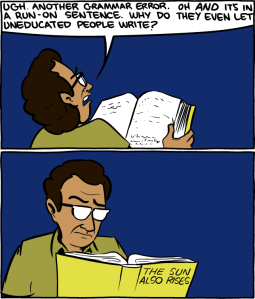
Adjectives and Adverbs

Keeping on my “parts of speech” kick, today’s post will cover another part of speech that is commonly misused–adverbs. Unlike pronouns which replace nouns, adverbs are modifying words more akin to adjectives. As both adjectives and adverbs modify words, however, their largest problem is being confused with one another.

As a refresher:

Adjectives are words that modify nouns. The short boy with brown hair, for example. Short and brown are both adjectives, modifying the nouns “boy” and “hair” respectively.

Adverbs are words that modify verbs. The short boy bounced the ball forcefully. Forcefully is an adverb, not an adjective, since it is modifying the verb “bounced” not either of the nouns (“boy” or “ball”).

As a helpful tidbit, adverbs often end in -ly making it a little simpler to differentiate them and adjectives.

Luckily, for the most part, people have some natural idea whether to use an adjective or an adverb, especially since adverbs should be used relatively sparsely (double adverbs there!) in prose as it is. (More often than not, it is possible to use a stronger verb rather than an adverb in writing: said softly=whispered; ran quickly=sprinted). The largest problem I tend to find in writing, however, is quicker vs. more quickly.

Part of this comes from the lexicon. When speaking, people–more often than not–tend to use as few syllables as possible. That’s why not using contractions seems odd. Few people say, “That is why I am not going to go…” when they could just say “That’s why I’m not going to…” With “quicker” being, well, quicker to say than “more quickly” people speaking tend to use it as a catch-all (“If he doesn’t do his homework quicker he’s going to be late”).

So what’s the problem? “Quicker”, when used properly, is an adjective. Okay, okay, you can get into an argument about English evolving with usage and using “quicker” as an adverb not being the end of the world (it really isn’t), but the fact is “more quickly” is the proper phrasing to make “quick” an adverb.

Most tips I have seen suggest using “quickly” over “quicker” in formal works with “quicker” being all right informally (again, not the end of the world), but I, personally, tend to use this as a narrative vs. dialogue tip in my own writing. If it sounds too formal for your character who says “ain’t” and “gotta” to turn around and say “more quickly” don’t try to force it. The voice of your character comes first in dialogue. In narrative, however, proper grammar seems a little more important (works written as missives notwithstanding).

Will this rule change in the future? Possibly. Someone once railed against splitting infinitives, after all. But for the time being, it is always my suggestion to use “more quickly” over “quicker” when it comes to adverbs unless it is a conscious choice about voice.

The Problem with Pronouns

As far as parts of speech go, pronouns are not too hard to understand. Where a noun is a person, place, or thing (as School House Rock taught us all) a pronoun is a word which is used as a general substitute for a noun (for example Tommy and the dog would be nouns, he and it would be pronouns).

Since we tend to use pronouns so much in speech, people very rarely (I’ve found) have problems using proper pronouns when writing fiction (outside of cases where there is a genderless character, which is a different problem with if it’s proper to use “it”, singular “they”, or some gender-neutral pronoun like “xe”). People know they don’t have to write “Tommy” over and over again in a paragraph. “He” can take over and make things seem a little less cluttered.

No, the most common problem writers come up against with pronouns is using them vaguely. For example:

Tommy looked between himself and John. He was dressed in orange…”

In this case, “he” is used correctly as a pronoun. It is replacing a noun. The problem becomes, which noun is it replacing?

Perhaps it becomes a little clearer as the sentence continues (“He was dressed in orange while Tommy was dressed in…“) but that doesn’t really fix the problem. With that first “he” the reader is now left trying to figure out which “he” is being talked about, and then go back and fit things together at the end of the sentence (“Oh, okay, Tommy’s in green, that means that “he” was John”). Not only can that be annoying, but it starts killing the flow of the story. You want a reader keep moving forward and–hopefully–get sucked into the action. You don’t want them reading a sentence, jumping back to the beginning, figuring it out, and only then continuing forward. It might not take a reader too long, but it still breaks tension and can quickly grow annoying (and that’s assuming the reader can figure it out. Sometimes, especially in dialogue, you just have to guess in general and go with it).

So, while pronouns are a good thing in writing (it would feel clunky and unnatural to not refer to anything in your story as he, she, it, they, or so on) writers have to be careful to watch for when one pronoun can refer to two different people/objects. This can happen in just about any scene you’re writing, but here are a few examples:

1. One person; or Two people, two different genders.

In a scene where you have one character acting, or two characters written as different genders for any reason (a man and a woman; a man and a character that identifies as female; etc.) you for the most part are in the clear. “He” and/or “She” should only be referring to one person at a time. If using the above example:

One person: “Tommy looked at himself. He was dressed in orange.” He is obviously “Tommy” so there is no pronoun confusion.

Two people, different genders: “Tommy looked between himself and Sally. She was dressed in orange…” Assuming normal gender assignments, Tommy is not going to be referred to as “she” and thus it’s simpler to assume “she” is Sally.

Dialogue between two people of different genders also becomes simpler this way as it is possible to go back and forth using simply “he said”s and “she said”s without the reader getting lost.

2. Two people, same gender.

As the first example shows, having two people in a scene who would share a pronoun (two “he”s, “she”s, or “it”s) leaves you more open to having pronoun confusion. The trick to watch out for here is not inserting another noun in between a noun and its intended pronoun. Should you change the above example to “Tommy looked at John. He was dressed in orange. Tommy didn’t like orange, that was why he was wearing green.” The first sentence is directed at John and there is no other noun between “John” and the first “he” thus you don’t have Tommy (“himself”) and John fighting for the next pronoun. As John is not in the third sentence entirely, there is no confusion that Tommy is the “he” wearing green.

This set up can lead you into situations where all of a sudden it becomes awkward to use pronouns in general (you want to refer to two different “he”s in a sentence but end up with:

a) “Tommy looked at John. He didn’t like how he was looking at him.”

b) “Tommy looked at John. Tommy didn’t like how he was looking at Tommy” (since “he” and “him” would go together)

or c) “Tommy looked at John. He didn’t like how John was looking at him.”

In this case, none are the ideal (as there is room for confusion with all of them) but sometimes a situation like this comes down to the lesser of two (or three) evils. “C” would be the best choice, as you can keep one person as pronouns “Tommy” becomes “he” and “him” while you aren’t stuck only using names. (When you come up against this issue, see which is the least confusing while being the least awkward sounding).

3. More than two people.

When you get into a group situation in a scene (where there are multiple people running around) do your best to only use pronouns to refrain from saying a name over and over in the same sentence (“Sally looked up, eyes narrowed. Sally said…” vs. Sally looked up, eyes narrowed. She said). Since the reader will have to keep track of multiple “he”s and “she”s in the scene, it’s better not to make it any harder than it already is and just use names.

——————————————————————————-

Want to carry this and other posts with you wherever you go? Download Write, Edit, Publish for free today.

Toe Tappin’ Copyrights

While bumming around the internet, recently, looking for mentions of my work, I came across review of my book, The Bleeding Crowdon “Books? Yes Please!” (link here). While it’s always nice to find good reviews for your work (good always feels better than bad, after all) what really struck me reading it was the reviewer’s comment that two main characters’ relationship in the story reminding her of song lyrics. Besides getting the song stuck in my head after looking it up (say what you will about Taylor Swift, but some of her songs are darn catchy) the comment got me thinking about the inspiration songs can have on writing.

I’ve mentioned before how song lyrics can make for good writing prompts, and I fully admit I have taken inspiration from songs before for my writing (perhaps I wasn’t thinking of Taylor Swift when I wrote The Bleeding Crowd, but the title was not-so-subtly inspired from a song). If a song or its lyrics inspires someone to write, I fully support writers running with it.

As long as they don’t run afoul of copyright law.

Copyrights, as most things buried in legalese are, are not the easiest things to understand at first glance. What’s public domain, what’s allowed under “fair use”…as writers we have to both love them for protecting our work and curse them for keeping us from using a line of another work that explains a scene perfectly.

While all modern creative works tend to fall under some sort of copyright (which means using anybody else’s words from a work after the early 1920s can get you in legal hot water) song lyrics can be a special sort of mine field. While sometimes you can get away with using a small percentage of something as “fair use” songs tend to be so short even a line or two might put you into enforceable copyright territory–and record labels are notorious for litigating anything they think is close to infringement.

For this reason, the most common advice you’ll get about using song lyrics in your writing is simply don’t.

Now, anyone who has read fan fiction sites might be familiar with “song fics” (stories that are built around/interspersed with transcribed song lyrics the author feels inspired/captures the scene they are writing). While these might be a staple of the fan fiction community, publishing any of these scenes with the intent to sell them would be a legal nightmare (and not just because fan fiction tends to use other writer’s characters which is also a copyright no-no). Since most fan fiction is written for the enjoyment of other fans/are posted with no intent for the writer to make money of their story, fan fiction as a whole tends to fly under the radar of people who might otherwise start suing. Once that story you wrote about Percy Jackson dancing with Sailor Moon to Taylor Swift’s “22” starts hitting the presses for you to sell, the legal departments of those publishers/studios/labels start whirring to life. And that is a fight no writer really wants to get into.

So what are your choices if you want to have your characters listen to a popular song in your story?

1. Mention it by title and move on.

While the lyrics of a song can be (and most often are) copyrighted, titles cannot (otherwise how could you have multiple books/songs sharing the same title?) You are more than free to write a scene which includes, “Joe turned on the radio and Tool’s ‘Lateralus’ came blasting over the speakers.” Or, “Sam groaned, this had to be the third time the club had played ‘Blurred Lines’ already tonight.” Mentioning the song titles and moving on allows you to attach a song you want to your writing while staying on the non-sue-able side of publishing.

2. Get permission from the artist/studio.

If you really want to use the actual lyrics for a song, rather than just mentioning it by name, you can also write to whoever owns the copyright for a song and respectfully request permission to use the lyrics in a book you are writing. Sometimes you may get lucky and they’ll say “sure, go for it” but even to get a ‘yes’ it’s recommended you give yourself 4 to 6 months advance time to get everything sorted away before trying to publish. You also have to accept you might also get a ‘sure, but pay us $X for using it’ (see this article on how much $X can be) or just a straight ‘no’ when you contact them–meaning you’ll need to write that part out before you publish all the same.

Note: Just attributing the lyrics to someone as you would a quote in a school essay does not mean you don’t also need permission to use the lyrics in the first place. Citing=/=permission.

3. Tempt fate.

So you want to use the lyrics, but don’t want to waste the time asking for permission. You can always go ahead and tempt fate and see if you get away with it (but really DON’T, it’s not worth it).

4. Just don’t.

Does your story really, really, really need those lyrics in it to be perfect? 99 times out of 100, probably not. In fact, naming a certain song/using a specific song in a scene will tend to only date your story. Unless you want your story to specifically be “[State] in 2007”, don’t have your characters listening to “Fergalicious” at a club. Songs rise and fall so quickly that what is extremely hot one year will drop off and become “oh yeah, that song” soon enough. If you’re going for a generic “present day” time period for your story, naming specific songs is a bad idea. If you are writing a certain year, but don’t have a character really in to pop culture, naming a song is generally unnecessary. Leave your characters at listening to “[genre] music” and use the specific song that inspired you as just that–inspiration.

—————————————————————————–

Want to carry this and other posts with you wherever you go? Download Write, Edit, Publish for free today.

Eh, It’s Not My Style

Comments on Hemmingway

smbc-comics.com

One of my favorite things a high school writing teacher ever told me was that English classes in school are to teach you all the rules of the language so you’ll know which ones to break when you start writing creatively. Now, there are some “rules” you can’t get around using without sounding like you don’t speak English very well, but starting sentences with conjunctions, ending with prepositions, and split infinitives are all “rules” English classes teach that become less than important when writing a poem, short story, or a novel. As an editor, I know the correct use of who and whom, but if an author is writing dialogue for a character who doesn’t, I’m hardly going to force a “whom” into their mouths. In such cases, the overall style of the writing is more important than each and every (sometimes arbitrary) writing rule.

Now, this fact should not be taken as carte blanche to write however you want with the argument that it’s your style and therefore good writing. Style is about making conscious choices about how a character would speak (for example, it might be appropriate to have malapropisms for a character who’s trying to sound smarter than they are) not about excusing poor writing (if you have made an unintended malapropism, it’s probably for the best someone catches that before you start sending your manuscript out).

Note: It is also important to state that even if you have made an intentional style choice, it doesn’t necessarily make that style “good” writing. A stylistic choice is more subjective as to if it’s good or bad, but you can still have “bad” writing when you’ve made a conscious choice.

So, you’ve made it through your manuscript and consciously chosen which writing rules you want to use for each character and which ones you don’t.  Sarah’s character is exceedingly proper and uses every arbitrary grammar rule on the books. Her best friend, Jane, is much more colloquial. Awesome. You have some great characterization starting with just that jumping off point. But what about all those little writing rules you have never quite gotten an answer about? Will adding an extra ‘s’ in James’s look out of place with all of Sarah’s ‘whom’s and ‘am I not’s? Does James’ mean there’s more than one James? Has anyone actually given us an answer on that?

In fact, not really. Unlike being able to mark “he am” as an improper conjugation, all of the following “problems” don’t have one correct answer. So what should you do when it comes to some object belonging to a James? The trick is to simply be consistent. If you use James’ five times, don’t use James’s on the sixth.

Since consistency is the real issue here, groups that deal with a number of different writers/authors (such as newspapers or publishers) tend to follow one of a number of “style guides”. Instead of keeping a record of what is correct and incorrect grammatically, these style guides help writers remain consistent from one person to the next. So while there isn’t really a “right” answer when it comes to any of the following problems, there are some style guides writers can choose to follow in the hope of remaining consistent within their industry. While academic papers often use APA or MLA style guides, and journalists tend to use AP Style, most publishers I’ve come across use Chicago Manual Style (CMS) when combating all of these “style” issues. So, if you’re a creative writer and wish to follow a style guide, CMS is your best bet.

And so, here are some tips on what to do about some of the most common “I’ve heard it both ways” writing issues out there:

1. Serial Comma. Also called the Oxford or Harvard comma, serial commas come into play when you’re listing multiple items.

For example: I went to the store to get apples, oranges, peaches, and grapes. Now, if you can’t tell, that last comma in the list is bolded. Why? Because people can’t agree if that comma needs to be there or not. Personally, I use the serial comma (which is what CMS suggests, so most novels use them as well) but, grammatically, you don’t have to have a comma there. “I went to the store to get apples, oranges, peaches and grapes” is still just as grammatically correct.

Of course, serial commas can save you some trouble, as this internet meme shows us. For those not wanting to click off the site, it’s the classic: “We invited the strippers, JFK, and Stalin” example. With the comma, you have a list, without the comma, it possibly sounds like the strippers are JFK and Stalin. Just a little difference. Of course, it would be possible to clear that up with changing the sentence slightly rather than using a serial comma (We invited JFK, Stalin and the strippers), but personally I, and CMS, prefer not getting into that mess to start with.

What CMS Says: Use serial commas.

2. Periods in Abbreviations. Most recently, my friends and I got into a debate as to whether Los Angeles should be abbreviated “LA” or “L.A.” As with everything else on this list, both are “correct” (nobody is going to see LA or L.A. and immediately shake their head at what a poor editor your book must have had.

What CMS Says: Put a period after every abbreviated word (abbrev., Rev.) unless it is a technical abbreviation (cm for centimeters, etc.) and a period between each letter in an abbreviation that is comprised of multiple words (U.S.A. rather than USA and L.A. instead of LA)

3. Possessives ending with ‘s’. Always the quintessential “What should we do…?” question, the ‘s being singular and s’ being plural doesn’t quite work when you have a name that already ends with ‘s’. Most people tend to go with whichever they find less confusing/sounds better to them. In this case, it’s more important that you’re consistent between words rather than as a whole (you could have James’s and then Atlantis’ if you like, just don’t have James’s and then James’).

What CMS Says: Use ‘s if monosyllabic (James’s, Burns’s) but only an apostrophe if more than one syllable (Artemis’, Jesus’)
[UPDATE (9/13/14): CMS now says all singular possessives should have ‘s, so it would now be James’s and Artemis’s]

4. Writing out numbers. Numbers like making things so difficult. They come in English words (one, two, three…) and Arabic numerals (1, 2, 3…), and that’s not even mentioning other systems such as Roman numerals (I, II, III…). So are we supposed to write them out, use the Arabic numbers, or do something else entirely. It’s up to you and your style guide. Personally I tend to write numbers out when writing, but I see plenty of people use the Arabic numbers. (I haven’t seen anyone use Roman numerals in their writing [other than chapter headings] but that might just be a difficulty thing).

What CMS Says: Write out numbers 1 – 99 (one through ninety-nine) and then use Arabic numbers for anything larger than two digits (100, 4500, 5,430,458,302). Note: There are special rules for percentages and other special uses of numbers. Refer to your style guide if you aren’t sure one way or the other.

shakespeare

smbc-comics.com

5. British vs. American Spellings. When it comes to picking British or American spellings of words (colour vs color; programme vs. program) it’s generally best to stick to what you’re used to. Did you grow up in a country that taught “British English”? Then stick to that. Are you more comfortable with American spellings? Use those. The more you try to force yourself to use spellings that you aren’t used to, the more likely you are to start flopping between the two. And it’s correct to use either, even if your characters are British when you’re American, or American when you’re British. The main thing  to take away here, as always, is to be consistent. People worked to standardize spellings for a reason. It makes things easier/less distracting to read.

What CMS Says: Being an American-made guide (the “Chicago” in the name isn’t there by random chance) CMS suggests the American spelling of words (behavior, jeweled, etc.) however most publishers have an “in-house” style guide that will take precedence in this case. If they have no problem with whatever spelling you have used, they’ll leave it alone. If they do, their editors will change it. As long as you are consistent one way or the other, it won’t affect your submission chances.

6. Italicizing vs. Underlining. When it comes to emphasizing a word, people tend to either italicize it or underline it. Both obviously are ways of setting one word apart from the others in a sentence. Most style guides (including CMS) prefer italics to underlines when it comes to added emphasis (as they are less intrusive on a page while still adding emphasis when read) but I have met more than one publisher that prefers underlines, at least in manuscripts. Feel free to use whichever you prefer (I personally default to italics per CMS), just be careful if a publisher specifically asks for one over the other in a submission.

What CMS Says: Italicize when going for emphasis, but do so sparingly.

7. Double Spaces After Periods. Oh the flame wars about whether or not you need double spaces after periods. There have been a number of articles about whether or not people should keep doing so. Many older typists had the necessity of hitting the space bar twice after the end of each sentence drilled into them with no mercy. Some teachers still teach this. The fact is, while hitting space twice on a typewriter might have been useful, most word processing systems have an algorithm that makes for a little extra space after an end of a sentence anyway. Hitting the space bar twice only serves to make too large of a gap at the end of each sentence. Is it incorrect to add double spaces at the end of a sentence? Technically no. Is it unnecessary (or possibly hazardous) when typing on anything but a typewriter? It can be.

What CMS Says:  Their official line is, “There is no reason for two spaces after a period in published work.” They further go on to state their reasons as to saying “no” to double spaces: (1) it is inefficient, requiring an extra keystroke for every sentence; (2) even if a program is set to automatically [watch for] an extra space after a period, such automation is never foolproof; (3) there is no proof that an extra space actually improves readability (4) two spaces are harder to control for than one in electronic documents; and (5) two spaces can cause problems with line breaks in certain programs.

—————————————————————————-

Want to carry this and other posts with you wherever you go? Download Write, Edit, Publish for free today.

Die! Die!

This past weekend, I finally caught up on Season 3 of HBO’s Game of Thrones. Yes, yes, I’m a little late to the party (or wedding, I suppose) but lacking HBO myself, I was entirely reliant on my good friend kindly opening up his home and TiVo for ten hours of sex and gore marathoning. And so over two evenings, we got me entirely caught up and ready for just as gory Season 4.

Quite the experience.

Ok, even having left off reading somewhere in the middle of Book 2, I had some idea what I was getting myself into. Though I had avoided the specifics, I was well aware of the basic principle of GoT, everyone dies. And so when Episode 9 happened, I was decidedly less than shocked. Honestly, as we headed into 2 a.m., my first thought was “How can George R.R. Martin manage to do that? I would be exhausted if I killed off so many of my characters at once.”

Now then, I’m the first to admit that I’m an author who grows attached to her characters (last time I killed off a Main Character in a story I was crying over my keyboard). Those around me are more than familiar with me talking about my characters as if they are real people, and I tend to be of the, “They’re the characters, they know what they should do better than I do,” school of writing. While all of that seems to work for my writing, it does make it difficult to do anything too, too horrible in story.

So the question is, is that a problem?

Personally, I believe it is a matter of degrees. Bad things happen in real life. People die. People get hurt. Depending on your setting, life might even take a note from Thomas Hobbes and become “nasty, brutish, and short” (especially true if your novel involves something like war). If you are reaching the point where you are unable to give your characters any struggles in their lives, that is definitely a problem. After all, wants and struggles are the heart of a good story. Completely contented people who have no hardships whatsoever do not make for compelling storytelling.

Does that mean you had to massacre/torture/jerk your characters around à la George R. R. Martin? Hardly. Should your story demand it/should you wish to none of those things are off the table, but they are also not needed to make a compelling story. Not every story has a happy ending, but stories with happy endings are in no way inherently less compelling than those with tragic ones.

And so, when it comes to writing, the means justifies the end. As long as you write a compelling story, and do what is necessary to keep that story true to itself, whether your characters end up happy or dead really is up to you. It’s just about finding what works for both your story and you.

Writing Through Writer’s Block

As my twitter followers will know, this July I was convinced to take part in Camp NaNoWriMo (perhaps against my better judgment). An offshoot of the original National Novel Writing Month (NaNoWriMo), Camp NaNoWriMo aims to keep people writing through the summer by having two “sessions” (one in April, one in July) where “campers” can set word count goals they want to complete by the end of the month (unlike the 50,000 word goal of NaNoWriMo, campers can set goals anywhere from a few hundred words to over 100,000 for the month of April or July).

Having hit a snag on the third book of a trilogy I’ve been writing, I was convinced to join Camp this year–after all, that’s what NaNoWriMo is about, giving a hard deadline as motivation to actually get some writing done. Figuring I could at least do 1,000 words a day, I set my word count goal at 31,000 for the month and started away.

As always, the month started out well. Freshly motivated, I had a number of productive days that put me a good week ahead of schedule. Newly confident, I even upped my goal to the standard 50,000. I churned out a few more scenes, full steam ahead…and then hit a writer’s block. Hard. I had some vague idea of where I wanted the story to go from where I was, but how to keep going came up at a blank. A couple of days staring at a blinking cursor, and all of a sudden I was dropping behind rather drastically. Either I’d have to write or drop out all together.

And so I set out to vanquish what my twitter follower and fellow Camper, Leigh (@spionchen), cleverly referred to as the Block-ness monster–which, as any writer will probably know, is easier said than done.

As with everything in writing, different things work for different people when it comes to how we get words down on the page. Some people even find it better to wait out a writer’s block until they’re inspired again. For those looking to blast their way through, however, here are a few tips:

1. Set a hard deadline. Some people thrive under pressure, some people don’t. If you’re the type who was never able to get a paper done in school until that due date was looming up ahead, think about setting a hard deadline. The lucky out there might have a publisher breathing down their necks for a manuscript (“We contracted you for a series! Where’s book three??”) but even you who don’t have a contract forcing you to write, you can still motivate yourself with deadlines. You can take part in a program like NaNoWriMo, can join a writing group/have a writing partner to whom you feel accountable, or even just set a goal yourself (assuming you’re able to keep yourself motivated with just that circle on the calendar). Would I have gotten through my writer’s block without Camp NaNoWriMo? At some point, yes. Would it have been this week? Probably not.

2. Avoid distractions. Some people write best with music playing, some in a coffee shop, some in complete silence. Finding what works best for you really comes down to trial and error. The important thing is to figure out what does and doesn’t allow you to write. Can you have a TV on in the background? Or do you start watching that instead of writing? Does having a wifi connection help with your research? Or does it mean you’re spending your “writing time” on Facebook or blogging (Man, if I could count the 600 words so far for Camp…) There are programs, such as Scrivener or Dark Room that provide “full screen” word processing (so you don’t see all the other tabs and applications you might rather be playing with) if you find yourself distracted on a computer, or it might just be as simple as putting on noise-cancelling headphones with some Vivaldi if that is what helps you focus. The main thing is to be aware and figure out what is distracting you from actually writing.

3. Bribe yourself. I’ve heard it said, “It works for kids, why wouldn’t it work for you?” Just like getting a child to sit still with the promise of a toy later on, rewards work really well when you’re in a slump and can’t seem to reach a goal (especially when you’re working on self-imposed deadlines). Some writers do this with the basics (Once I hit 20,000 I can eat/sleep/perform some other basic function required to stay alive), some writers bribe with food (500 more words and I get that piece of chocolate cake in the fridge), some writers bribe with things (If I finish this chapter tonight, I’ll buy myself that new pen I really wanted…) Whatever works for you, setting a reward can help give you that last little nudge you need to keep going.

4. Jump around. Whether or not this one works really varies from person to person. Some people need to write chronologically for their stories to make sense. Others, however, might find it helpful to write the scenes that excite them and then go back to fill in all the middle parts. As long as you can force yourself to go back and do the middle parts later, jumping around to the scenes you like can at least get you back into the flow of writing. Just make sure you keep track of the scenes you have already written so you can fit them together later. Some writing programs such as previously mentioned Scrivener and yWriter offer platforms which allow writers to write scenes in separate chunks and then rearrange them once all the scene are written (the more advanced version of index cards and a bulletin board) but it is also possible to do so with just a word processor if you don’t want to buy/download a special program (personally, I open two documents, one the actual manuscript, one for scenes, and then title each scene I will put in later in the second document [KYLE MEETS JOHN, JOHN AND MARY FIGHT ABOUT KYLE, etc.] As long as they are all clearly titled, it’s possible to fit them together into the first document with just a little more effort).

5. Just start writing. And when all else fails, there’s always just writing until it starts to make sense. Perhaps more a pantser thing than a plotter, this is finally what got me past my two-day writer’s block for Camp NaNoWriMo. Not finding anywhere to jump to, not able to bribe myself, as un-distracted as I was likely to get, the NaNo deadline at least motivated me to try putting words to paper–any words. While the first few hundred words were still like pulling teeth, and I’ll likely cut most of what turned into a rambling monologue by the main character about all the bad things that had happened to her, it at least got me into the flow of writing. I topped out the day at 2,000 words (400 more than needed to stay on par with a 50,000 word goal daily) and even losing those words later, I at least ended up writing a scene that not only actually could fit with the plot, but one that got me back on track for the scene after that, and the next after that. First drafts are meant to be sloppy (it’s why you don’t write something and go straight to publishing). Even if you end up writing drivel, at least you have written something, and that’s the first step to get past your writer’s block. As us tweeting campers will say #fixitlater.

————————————————————

Want to carry this and other posts with you wherever you go? Download Write, Edit, Publish for free today.

Just a Pretty Face

As I’ve said before, I am a dialogue person. For whatever reason, dialogue is more fun (and plainly easier) for me to write than pretty much anything else. Of course, for novels, narrative, description, and all of that fun stuff is just as important, so my biggest challenge has always been slowing down enough to be sure to write down just exactly how these things I’m seeing in my head actual look (since for some reason, readers aren’t yet able to see exactly what I’m seeing when I write without me actually writing descriptions…odd that).

Of course, when trying to write description, it’s important to have a clear picture of characters and places in your head. There are only so many times you can give a character blond/brown/red hair and blue/brown/green eyes before even your own characters begin to lose shape in your head. When asked a while ago what a character from a book I wrote years ago looked like, I admit even I couldn’t remember. Not generally a good sign.

So while some characters might spring to mind very clearly, what do you do when you come up to a roadblock as to what a character looks like other than tall/short/average with X hair and X eyes?

I’m sure there are a number of solutions people have come up with, but mine, personally, is simple: Look at peopleWhile the first things you might use to describe someone in real life might be the same things you already had for a character (height, weight, coloring) studying a face, a real face, will give you a better picture in your head as to what actually makes a person rather than a person-shaped blob (am I the only one with blobby characters to start with? maybe?)

As for finding faces for inspiration, there are three different ways to generally go about it:

1. Watch people around you. Assuming you don’t live in some remote cabin/underground/in the Australian outback, most people come into regular contact with other humans on a day-to-day basis. By watching the people you interact with, it’s possible to start compiling features that shape your character. The man at the bakery’s hair, the girl on the metro’s chin, looking at what makes a person unique will help you move past X hair and X eyes. Of course, the downside to this can be the creepy factor. Staring at someone next to you at the bank will no doubt make you look odd/suspicious. “I’m a writer” only works so many times as an excuse.

2. Look at celebrities. Since staring at people on the street can get you weird looks, a lot of my writer friends prefer this route. After all, you’re supposed to stare at TV and Movie stars for long chunks of time. Some writers even prefer to “cast” their novel as they go along (Jane would be played by Jennifer Lawrence, Sam by Ryan Reynolds, etc. etc.) By picturing the “movie” version of your novel, it makes it really simple get more about your characters than just hair and eye color (and can serve as some good motivation to keep going when you hit a crisis of confidence–who wouldn’t want to see their story on the big screen?). While I do use this tactic from time to time (one of the characters in my WIP would totally be Darren Criss in my head…) I personally find I still can’t use this solution that often. While you have more of a chance to study celebrities than people in your every day life, you also have more of a chance to get used to their personality (or at least the personality you see on camera). While you might not have meant it to be, basing a character off how Natalie Portman looks in Black Swan might end up giving you a character slightly more psychotic than you originally intended–simply because you start writing that character, not your own.

3. Use Google Image Search to look up headshots. And so we get to my personal favorite solution when it comes to finding faces for characters–using Google Images to look up pictures of random people. While you might still have a little bit of the creep factor (staring at random people online…? Okay…?) it isn’t quite as bad as staring at people on the street.  And while you can spend a long time studying the picture, you don’t also know who the person is and have that coloring your perception (added bonus, you can also find much more “average” people in these kinds of headshots than you can in Hollywood. Not everyone wants the “nerd” in their story to look like  Rachel Weisz in glasses). To use this method, you can just go to images.google.com, type in what you’re looking for (headshot girl red hair, headshot old man) and you will come up with pages of faces to look at without looking like a creep to anyone but the people at Google recording your searches (but if you’re a writer, they probably already think you’re a druggy serial killer based on those searches anyway, so who really cares?)

———————————————————————

Want to carry this and other posts with you wherever you go? Download Write, Edit, Publish for free today.

Wishlists and Trends

Last week, agents (and publishers) from all over posted to Twitter with types of stories they were currently looking for using the hashtag “#MSWL” (Manuscript Wishlist). A great (and very helpful) idea to help authors try to connect with agents/publishers who might be interested in the type of story they had written, it also turned out to be rather disheartening for authors who scrolled through not finding a single agent looking anything like their novels. Some accounts even went so far as to post things along the lines of, “I’m swamped with X, NO MORE STORIES WITH X.”

Pretty much there’s no way to react to that other than, “Ouch, harsh.”

So what do you do if you’re grouped in with the great “X” no agent seems to want? Scrap the novel you spent however long on and start on something it seems agents actually want? No and no.

The first thing all authors have to remember is publishing is a business. Our novels are our babies. Something creative that we see (most of the time) as great/worthy of being read. Publishers, sadly, don’t look at manuscripts with an eye towards what they think the world should read, they look at manuscripts trying to find something that will make them money. If that means thirty-thousand vampire novels or the same generic love story over and over again, that’s what they are going to pick up. Since agents only get paid when they sell your story to a publisher (or at least should only get paid when they sell your manuscript, if not get a new agent) they need to look for things they think publishers will think are going to sell. This is not to say publishers are some faceless, greedy, corrupt organizations–most people get into publishing because they love books–it’s simply if they can’t sell what they publish, everyone’s paycheck is going to bounce and they’ll soon be out of a job.

And so agents/publishers often end up buying on trends. A couple years back vampires were hot. Judging on new books I know are coming out/what many agents seemed to mention in #MSWL, time travel is the next thing on the rise (as far as fantasy goes).  Obviously these aren’t the only kind of stories that will be published during the life of the trend, but if they are what publishers are finding sell, they’re going to be easier to get published.

So you should set your other novel aside and get to work on a time travel novel, right?

Again…no. The tricky thing with trends is that they’re fleeting. They don’t all last the same amount of time, but each one always hits a point where it starts dying off and publishers stop buying them as much (if at all, depending on how saturated the market gets). And publishing takes time. First you have to write the book. Then you have to edit it. Then you have to make sure it’s polished. Then you have to submit it. An agent might take a couple of months to get back to you and ask for a full manuscript. Then they might take another month to let you know if they decide to take it. Then they may want to work with you to polish it even more. Even if you get through all of this and get to start shopping your manuscript while still at the height of a trend…you’re already too late. It’s taken you several months at this point after however long it took you to write the darn book in the first place, and it will take at least another year for it to come out (the publisher will send it through several rounds of edits, it has to go to layout, a cover has to be designed, you have to pre-market…publishing is a slow, slow beast). If publishers only start looking at your manuscript at the peak of the trend, they will probably assume the trend will be dying by the time your book gets out, and will be just as likely to pass on it as any other book at that point. Following the trend hasn’t given you quite the edge you were looking for.

So the only way to capitalize on a trend is to already have a completed book ready to shop when a trend hits. And since there’s no way to know when a trend is going to hit, what good does that do you? It just seems like dumb luck whether or not you have written a book that ends up being “on trend”.

And yes, yes it is. Like much else in publishing, hitting a trend or not is mostly just a matter of being in the right place at the right time.

So why even bring this up? Just to be more depressing?

No, to make the simple point: Don’t force yourself to write a story just because it fits whatever’s big at the moment. Maybe you want to write a time travel story. Great, then go for it. If it’s a plot that interests you, you might do something amazing with it. If you’re only trying to capitalize on a trend, however, you’re likely to be disappointed. You forced yourself to write something you only sort of wanted just because it would sell–and now no one wants it because you’re too late to the party. Trying to find an agent and publisher can be frustrating enough as it is. No need to add to that frustration by making yourself miserable during the fun part (actually writing the thing).

And so, I think a tip @KMWeiland posted earlier today on Twitter fits the moral of the story perfectly:

“Don’t worry about what the world considers the perfect novel. Write your perfect novel, and let the world come to you.”

Who knows? Maybe by the time you’re finished, you just might catch the next trend.

——————————————————————-

Want to carry this and other posts with you wherever you go? Download Write, Edit, Publish for free today.

Character Flaws

A little while back, I wrote a post about Mary Sues. For those who are not yet aware of this term, TV Tropes gives a pretty good definition:

The prototypical Mary Sue is an original female character in a fanfic who obviously serves as an idealized version of the author mainly for the purpose of Wish Fulfillment. She’s exotically beautiful, often having an unusual hair or eye color, and has a similarly cool and exotic name. She’s exceptionally talented in an implausibly wide variety of areas, and may possess skills that are rare or nonexistent in the canon setting. She also lacks any realistic, or at least story-relevant, character flaws — either that or her “flaws” are obviously meant to be endearing.

“She has an unusual and dramatic Back Story. The canon protagonists are all overwhelmed with admiration for her beauty, wit, courage and other virtues, and are quick to adopt her as one of their True Companions, even characters who are usually antisocial and untrusting; if any character doesn’t love her, that character gets an extremely unsympathetic portrayal. She has some sort of especially close relationship to the author’s favorite canon character — their love interest, illegitimate child, never-before-mentioned sister, etc. Other than that, the canon characters are quickly reduced to awestruck cheerleaders, watching from the sidelines as Mary Sue outstrips them in their areas of expertise and solves problems that have stymied them for the entire series. (See Common Mary Sue Traits for more detail on any of these cliches.)

Mary Sues as a whole are dreaded in writing communities. There are litmus tests all over the place for people to test whether or not their character is one, people debate whether or not characters X and Y are Mary Sues (or their male equivalent, the Gary Stu or Marty Stu), and I don’t believe that’s going to go away any time soon.

You see, one of the reasons Mary Sue/Gary Stu are so dreaded by writers is because they are just so common. I have jokingly called being an author “multiple-personalities for control freaks” Perhaps we authors don’t actually have multiple personalities, but we do have complete control over a world when we’re writing. And that can go to your head a little sometimes. Especially when you’re just starting out.

Of course, building well-developed, non-Sue characters is something that you learn to do as you get better at writing (writing is a skill, after all, the more you do it, the better you get). But there is one way I often see authors (especially new authors) trying to stay away from Mary Sues that I don’t believe works 99 times out of 100. The “traits and flaws” list.

Before, I talked about how often times Mary Sues become Mary Sues because of how the world reacts around them. To be interesting, characters as a whole should react in ways that are realistic to realistic situations happening around them. The world should not bend its rules for them (anybody else would be expelled for this, but you’re special, so…on your way) and other characters shouldn’t change dramatically in response to them (Well, I’ve been an evil, misogynistic bas***d this entire book, but you are so special, and logical, and sweet, and [X characteristic] you have melted my heart in one well-done diatribe and I now see the error of my ways!) The world shaping itself around the character is part of what makes Sues so annoying.

Another part is how perfect Sues tend to be.

Everybody has flaws. It’s part of what makes us human. When you have a character that doesn’t, it makes them naturally unrealistic, and generally unlikable (especially when they then spend half the book complaining about things that aren’t flaws being awful for them: “I wish I weren’t so much prettier and more popular than the other girls…it’s so hard being me…”) So, you’re worried you have a Mary Sue (or someone told you they’re Sue-ish) what’s the logical thing to do? Give them flaws of course.

And so more than once, I’ve come across posts like this:

Is my character a Mary Sue?

She is intelligent/clever, funny, witty, friendly, adventurous yet responsible, free-spirited, optimistic, talkative, creative/artistic, and basically talented. For faults, she’s a non-domestic woman in the time where a  woman’s job was to be at home, and maybe she is intolerant towards people who are slower than her in brain power.

Now, always the answer to “Is my character a Mary Sue” almost always is ,”depends how you use her.” But in this situation, my Mary Sue sensors are seriously going. For one, look at how many positive traits there are (intelligent, funny, optimistic…). Then look at the “faults”. One basically boils down to “free-spirited and people are down on her for it” (not a character flaw as much as a situation). The other could be a flaw, but prefaced by “maybe” it does not seem overly likely this flaw will be general, but just pop out as a token “flaw” to prove that the character isn’t perfect. It’s much like making a character’s flaw be “clumsiness” tends to boil down to, “Look, she isn’t perfect! She just tripped and…awww, look how cute she is with all her clumsiness. It just makes people love her more!”

And so writing out “Good Traits” vs. “Flaws” lists don’t do much to help you with a building a well-rounded character. A character, like a person, is a personality that is made up of a bunch of traits, but is not only those traits. It is not important to balance “one good trait for one bad trait” in each of your characters, it’s important to really think about their traits as one larger personality. As one of the best pieces of advice I have seen in the NaNoWriMo forums lately  puts it:

Usually, a person’s negative traits are the flip-side of their positives. For example, A person who’s unflinchingly honest may be tactless and over-blunt. A person who’s super dependable, who sees every task through to completion, may also be a person who doesn’t know how to admit he’s in over his head on some overambitious project.

“Your character is free-spirited and creative, among other things. What is the flip-side of that? Might your character tend to be impractical or a bit idealistic (naive) at times? And (this is a really important point) what are the consequences of being impractical, idealistic, or naive? How does this affect her actions, the other characters, and the development of the plot?

“If you can relate your character’s imperfections to her good qualities, and if  you can make her imperfections matter in some meaningful way, you will be well on your way to avoiding a Mary Sue.

So, don’t worry yourself with “Good trait, bad trait” lists. Consider the character’s personality, and what that means to how they relate to the world (rather than how the world relates to them) you’ll be much better off than trying to decide whether or not your character is well-balanced by “here are her good traits, here are her flaws.”

You can’t write that!

News Alert: The Bleeding Crowd is coming out August 27th, for those interested, from Melange Books. In the mean time, you can find my short story, In a Handbasket, available for free here through Boxfire Press. Please enjoy!

*****************************************************************

A common theme I have been seeing on my favorite haunt, the NaNoWriMo forums, lately, are questions about what you are and are not allowed to write. The first time I saw this question, I was a little surprised, but now that I’ve seen it more than once, I figured I would take the chance to cover it here.

While the NaNoWriMo site came down for repairs before I could find the original thread (literally asking what you are and are not allowed to write), but today’s post which sparked this post includes this line:

But since a character in my novel is a rapist (and yes, this is essential to the plot and the ending) there are some rape scenes…I heard that you can’t actually show the act happening (I think that’s a bit weird, considering how other acts of violence are considered totally fine) but whatever, it’s not that important.”

Ok, rape is a touchy subject, I don’t think anyone is going to argue it isn’t (especially not after all of the news stories out in the past couple of days). There are many, many people who have experienced some form of sexual assault in their lives (men and women) and there are several more who don’t care to read about things such as rape in their novels/short stories/etc. But does that mean you can’t write about it.

Honestly, my first reaction when reading that post was, “Where did you hear that you can’t write/show a rape happening in your story?” Part of me just really wanted to know if it was a passing comment the poster had picked up and internalized, or if someone in a creative writing class was teaching there are certain things that you can and can’t write about. Because honestly, when it comes to creative writing, there is very little you can’t write about.

This advice might be a little different in countries that are known to censor writing (there are a few out there where less-than-complementary writing about the government can end up with the writer in prison, I believe) but at least in the United States (and any other country with no state-sponsored censorship), the list of what you can’t write is pretty short:

1. You can’t plagiarise. That is, if someone has written something before you, you can’t take it word-for-word and call it your own. At least not without getting sued (same goes for things under copyright you haven’t gotten permission to use, even with proper credit given).

2. Libel. You can’t present something detrimental to someone’s character/life as true that is not. (This is more relevant in journalistic writing, but basically don’t write that your neighbor likes to kill people in his spare time and act like it’s true when it’s not [if it is true, you can write it, but please, call the police first]).

3. Child Pornography (if you’re in Australia or Canada). Both countries have laws banning cartoon, manga, or written child pornography. Outside of those countries, it isn’t illegal (though it is still rather icky, just saying).

And, well, that’s about it. There are a couple more things that aren’t protected under freedom of speech/the press that the Supreme Court has ruled on, but if you’re writing fiction, it more than likely doesn’t apply to you.

The long and the short of it is, there is no morality police who is going to swoop down on you for writing something that could be offensive. We don’t live in a police state. There is no Hays Code that prohibits, rape, drug use, swearing, graphic sex, blasphemy, or any other topic from being put into print. If you are ok writing it, you’re more than allowed to put it down on paper.

This does not mean, however, that people are required to give you a platform to distribute it. While you are allowed to write about something many people might find offensive/disgusting/reprehensible, publishers/distributors are more than allowed to not publish/distribute it on their site.

For example, for romance/erotica publishers, you will often find notices such as this on their submission page: “We  do not accept: scatological stories, incest/twincest, sexual content  involving anyone under the age of eighteen, snuff, rape or bestiality.

You are more that allowed to write something incestual, you may even be incredible popular with it in your story (I’m looking at you George R. R. Martin), but that doesn’t mean you can demand that someone publish your book just because you wrote it.

Far too often, I come across someone who has had a post removed from a forum online, and they start railing about how the site is violating their First Amendment rights. I’ve said it once I’ll say it again, A private company/person/other private entity cannot infringe on any of your constitutional rights. The Bill of Rights protects you from the government. The government isn’t allowed to take down your blog. Someone hosting it for you, however, can. It’s their site, they can choose what they’d like to put out there. (Note that I don’t just say publishers, but distributors. Many right remember some controversy over Amazon.com pulling books and banning authors from selling on their site. If you violate their content guidelines, even as a self-published author, they have the right to remove you. You can read more about that here.)

So, can you write about touchy subjects? Sure. Should you? That’s a little trickier. Like everything with writing, it’s about trade offs. Think about what your goals are. Do you want to market to a wide audience/be able to pitch it to every publisher in your genre? Maybe you should second guess how detailed you’re going to be about that scene. You know the one I’m talking about. Are you writing a gritty, adult novel that will most likely find a home in a niche market? Have at it. If you’re willing to write it, no one is going to stop you.

And so, write what your story needs. Most likely the only thing limiting your writing is you.