Who are you, again?

To many writers, myself included, names are partially what make a character. I’ve touched on how a new name can completely change a character, but even after an author has found the perfect name for a character, there comes another problem: introducing the character to the reader.

Recently in the NaNoWriMo Forums, a writer asked for advice on, “how to appropriately introduce new characters and offer their names.” The poster acknowledged that there seem to be two ways to introduce names to the reader. 1) Using the character’s name whether or not it has been used before or 2) wait until the names come up in dialogue.

So which should be used? Honestly, a little of both.

Introducing characters is one of those moments when you really have to nail down who your POV character is. With first person and third person limited being the most popular POVs by far these days, writers will most likely be writing with one character relating the story/a scene (either as “I” or “s/he”) It is possible to change POVs between scenes, especially in third person, but each scene should follow one character (otherwise it becomes head jumping). Once you know who the POV character in a scene, it becomes simpler to know when to share names.

1) If the POV character knows another character’s name, use it. Since you are in the POV character’s head, there is no reason to wait for someone to say another character’s name if the POV character knows it. Would you really call your friend “the tall man” or “the blond man” when you know his name is “Tim”? It is forcing in awkwardness where it needn’t be. (Note: The same goes for using nicknames. If POV character calls someone “Tim” in their head, there’s no reason to use “Timothy” in the narrative. Just be consistent [you shouldn’t flip between Tim and Timothy in narrative if you start with one]).

2) If the POV character doesn’t know another character’s name, wait for it to come up. Hopefully, this won’t be a long wait, but it would be a POV slip to say a name when your character would have no way of knowing it. Luckily, people tend to introduce themselves pretty early on when they aren’t known to someone. Stalling some with “the blonde girl”, “the young girl” or “the happy girl” shouldn’t be a problem. As soon as the character is introduced or the POV character gets a name, you can switch to using the new character’s name (e.g. another character in the scene calls “the blonde girl” Sally. It is fine to use Sally from that moment on because the POV character now has a name).

The biggest thing is you simply don’t want to confuse your readers. The sooner you can introduce a name and use it consistently the better.

Finally, if you are using omniscient POV, you should use the names for your characters as soon as they are introduced, unless there is a specific reason not to. As your narrator is omniscient they know all of the character names to begin with. By withholding a name, you are saying there is something important about it. Suddenly using it without any sort of reveal comes off as odd/anticlimactic.

——————————————————–

Want to carry this and other posts with you wherever you go? Download Write, Edit, Publish for free today.
Shoot the Shaggy Dog

Like any industry, writers, editors, and publishers have their own lingo. While it helps save time when you know it, some people just starting out might not know exactly what a publisher means when they’re sending out ARCs or what to do when an editor tells you you should Lampshade something. So, for those just starting out:

1. CMS: Chicago Manual of Style, a style guide also known as the editing bible for most publishers. Where newspapers use AP Style and academic periodicals tend to use APA, publishers 99 percent of the time turn to CMS for all those tricky style questions.

2. ARC: Advance Review Copy, a copy of a book which is close to being released given to book reviewers and beta readers. Also called “galleys” ARCs might have a few typos the final proofreaders need to catch before the launch, but they allow reviewers time to read the book and have a review ready around the official release date.

3. Lampshade: Also known as “Lampshade Hanging“, Lampshading is a writing device where the writer acknowledges that what they have just written might seem improbable enough to threaten a reader’s suspension of disbelief. It serves the purpose of highlighting that the author knows that what just happened seems improbable and often is played for laughs (for example, in Harry Potter and the Half-Blood Prince movie, Professor Mcgonagall asks, “Why is it that when something happens it is always you three?” Ron Weasley’s answer: “Believe me Professor, I’ve been asking myself the same question for six years.”)

4. Meta Data: Information about a book that helps it get to the right readers. Meta data includes the ISBN, keywords, publication date, etc.

5. As you know, Bob…: A form of exposition where a character is speaking of something for purely the reader’s sake. This is often started with “As you know…” with the writer then using dialogue to explain things even though everyone else in the scene knows the information already. Due to its unnatural feeling, it is generally discouraged. It can, however, be lampshaded, for example (sticking to the Harry Potter theme) Voldemort in A Very Potter Musical stating “I know, I hear everything you hear!” when Professor Quirrell outlines exposition at the beginning of a scene.

6. Duology: The lesser known cousin of a trilogy–a series consisting of only 2 books, such as Tamora Pierce’s Trickster’s Choice/Trickster’s Queen or Carol Berg’s The Lighthouse duology.

7. POV: Point of View. Whether it’s first person (I), third person (he/she), or little used second person (you), every book is written with a POV. The POV character is whose thoughts the reader follows. Poorly controlled POV in “third person limited” (where the narrator is a character in the story limited by their own personal knowledge) can lead to headjumping, so it is important to figure out who is relating the scene as a narrator, be it the “I” or a “He” character (if you’ve had me as an editor, you might be familiar with the note “POV slip” in a third-person novel)

8. Epistolary Novel: “Epistolary” meaning “written in a series of letters” an epistolary novel is a novel which is written as though it is other written documents (be it letters, emails, texts, or anything else).

9. Foreword/Author’s Note/Introduction/Prologue: Often all confused for each other, each means something a little different at the beginning of a novel. A Foreword is something written by another person about the novel/author (often written by people more famous than the author themselves or a mentor for academic works), an author’s note is something that is written by the author that is at the beginning of a book, but not part of the story. An introduction is close to an author’s note, but something generally written by the author about the book that is not part of the story in any way. A Prologue is part of the story that sometimes serves as a “chapter one” but takes place “outside” of the main story (either by happening years before the main story starts or with characters who are not part of the main group). Introduction and Prologue are perhaps the most commonly flipped leading to confusion between people in publishing and those not familiar with the terminology.

10. Shaggy Dog Story: A shaggy dog story is “a plot with a high level of build-up and complicating action, only to be resolved with an anti-climax or ironic reversal, usually one that makes the entire story meaningless.” As TV Tropes explains, “The classic example is a man who bankrupts himself trying to return a shaggy dog to a rich family in England for reward money — when he finally makes it there, he’s told that the dog “wasn’t that shaggy” before the door’s slammed in his face. The End.” A shaggy dog story can be one-upped by becoming a “Shoot the Shaggy Dog” where not only has the story been meaningless, but the characters end up going to meaningless deaths for their trouble. Nineteen-Eighty-Four has been dubbed a “Shoot the Shaggy Dog” story where (spoilers) the main character, after spending the novel trying to break out of his dystopia, is beaten back down, scheduled for execution, and entirely content with it.

—————————————————————————-

Want to carry this and other posts with you wherever you go? Download Write, Edit, Publish for free today.

The Lawful Good and Chaotic Evil

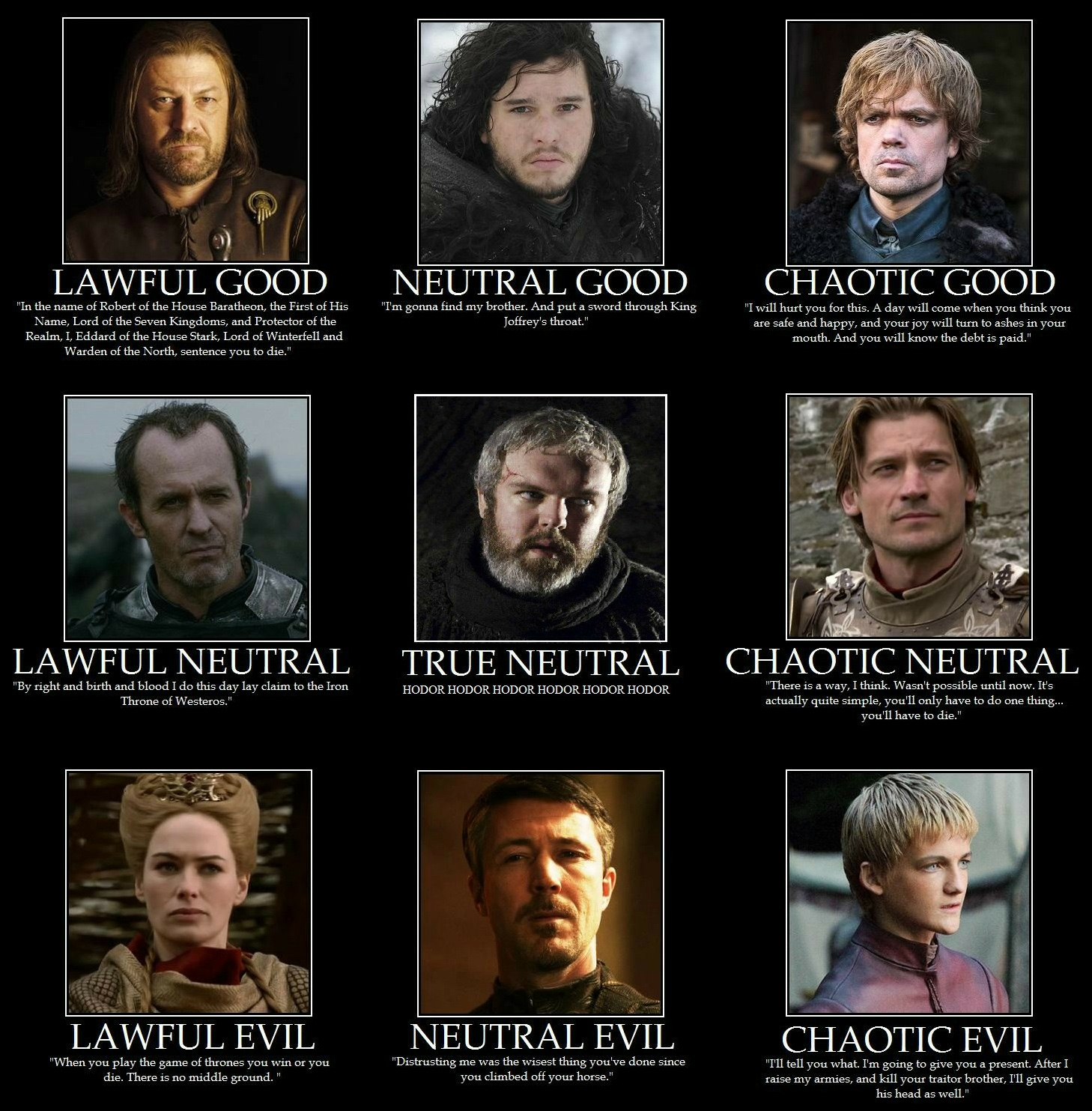
If you have been on social media for any length of time, you likely have seen a meme that looks something like this:

alignment

And half of them seem to use Game of Thrones character for whatever reason. (http://postitjournal.blogspot.com/2012/03/viewing-life-through-alignment-grids.html)

Long before these charts became “meme worthy”, players of RPGs like Dungeons and Dragons were familiar with building characters in a similar way, aligning their characters along a “moral and ethical axis”. A full (very handy) breakdown is available on TV Tropes, but it can basically be broken down into:

alignment_graph_3756

tvtropes.org

Now, these breakdowns don’t always work for fiction writers (as TV Tropes very smartly says, “remember that the vast majority of characters in fiction are not tabletop game characters, and therefore lack a canonical interpretation of alignment“) more and more I have found it helpful to think of characters who fit a “vague alignment”, both when it comes to writing and editing. Why? For the same reason the charts came into fashion for role playing games, I imagine. Because it is a handy way to develop just who your character is.

Personally, looking into alignments arose as part of writing my Broken Line Series. With each book following a different main character (and yet interlocking with each of the others) it became very important to develop each character as their own person, otherwise everything slowly began to get a little too wishy-washy with an ever-growing cast of characters. Thinking of a character in terms of a designation (along with plenty of other character building of course) it can be simpler to think just how they would react when thrown into a tough spot.

So, if dealing with a number of characters (or simply needing to flesh out a single character further) consider their alignments:

  • Lawful Good: Simply put, the Lawful Good believes that, well, the law is good. Being a good person (which they strongly wish to be) requires upholding the law. This character believes in truth, justice, and other ideals seen as virtuous, but such strong convictions may also prove their undoing (see poor Ned Stark up there). They are so committed to their ideals, they may struggle to uphold them even to their own (or other’s) detriment.
  • Neutral Good: For the Neutral Good, doing the right thing is very important, but the right thing doesn’t always mean the lawful thing. Following their personal morals, doing good is more important than upholding the law, but they also don’t see law as a bad thing. If they are able to do good by playing by the rules, they will.  If they have to break a few laws to save someone, however, they don’t find themselves in an ethical quandary. As TV Tropes puts it, “Just think ‘basically nice person’ and you’ve probably got it.”
  • Chaotic Good: Home to the rebels and free spirits, the Chaotic Good want to help people and do good, but they tend to believe that things like order and discipline get in the way. For all the Whovians out there, my personal favorite picture I’ve seen for Chaotic Good is The Doctor. The man always wants what is best for everyone, but isn’t about to let silly things like laws (even generally good ones) get in the way of achieving good.
  • Lawful Neutral: The Lawful Neutral is “the rule-abiding sort”. Good and evil are all well and good, but not something that keeps them up at night. Law and Order (not the show) are what drives the Lawful Neutral with “justice” not necessarily coming into play. As TV Tropes says, “They’ll arrest a robber or rapist, but may also kick a family out of their home for failing to pay rent” even if the family missed rent for a “good” reason. TV Tropes and I agree probably the best example here is Inspector Javert from Les Mis (stealing bread to feed your starving family is no better than stealing cigarettes to hock to school kids). Any other character who is the same staunch type of Legalist would be a Lawful Neutral (protagonist, antagonist, or anyone in between).
  • True Neutral: True Neutrals are either characters who want to “keep the balance” and thus not interfere (think the Elves staying out of things in Lord of the Rings) or characters that don’t care about just about anything for one reason or another (be it they’re too stupid to realize they should care, have a “calling” they see as above Earthly problems, or just simply want to be left alone).
  • Chaotic Neutral: The Chaotic Neutral is either “the ultimate free spirit” or someone who is just plainly crazy. Chaotic Neutrals don’t wish to harm, but neither do they want to help others. Freedom is their be-all end-all. As long as you don’t try to rein them in, they really couldn’t care less what happens to anyone else.
  • Lawful Evil: Heading into the villains and antiheroes, the Lawful Evil is the “sort of Evil that often ends up in charge.” Lawful Evil don’t care in the slightest about hurting people, but they care a lot of keeping order (whether because they believe it’s intrinsically important or because order is easier to exploit).
  • Neutral Evil: As TV  Tropes so gracefully puts it, “Sometimes known as the Asshole Alignment.” It doesn’t especially matter who gets hurt to the Neutral Evil, and it doesn’t especially matter to them if they play by the rules or not. If the rules suit their purposes, they’ll follow them. If not, they’ll break them. They are often considered more dangerous than the Lawful Evil or Chaotic Evil simply because you never quite know where they’re going to swing next. (For those who have read The Copper Witch/The Copper Rebellion,  this is where I would honestly place our anti-heroine).
  • Chaotic Evil: Just as interested in being a free spirit as the Chaotic Neutral, the Chaotic Evil is all about doing whatever they want, even if it hurts other (for some, especially if it hurts others). Rather than simply being willing to break rules if they don’t agree/they get in their way (like the other Chaotic alignments) Chaotic Evils often take great pleasure in destroying order/causing chaos. Batman’s The Joker is perhaps one of the best examples of Chaotic Evil.

(Need more information before you can place your characters? Read the full descriptions on TV Tropes or click any of the links above for more examples of the specific alignments).

Editing 101

As I head into edits for Book 2 of The Broken Line Series (The Porcelain Child, for those who are wondering), I have been asked for some editing tips for when you are taking a stab at going through the several thousand words of a rough draft.

Of course, there are no set rules anyone must follow when it comes to editing your own work. Much like writing, it’s about developing a style that works for you. To help take the first steps, however, I have included the “standard” advice I have heard when it comes to editing and my own thoughts on each.

1. Take a break after you have written it. Whether it’s a day or Stephen King’s suggested six weeks, the first piece of advice most writers hear when it comes to thinking of editing. In my own opinion, this isn’t bad advice, if you start right into editing the moment you write “the end” you will likely still be in writing mode and miss a lot of problems you might otherwise. Of course, if there are still large portions of the story you know you will have to rewrite, taking yourself out of this mindset might be detrimental.

Verdict: If you are ready for straight editing, take a break. Possibly even work on another project that will take your mind off things. If you need large swaths of rewrites/changes, go ahead and start right away. (Personal caveat–if you are writing a series and have a publisher waiting for books 2 and 3, it’s probably best to go right into edits so you can send that off before they yell at you…)

2. Just do a read through. After you have taken a break, the most common advice I’ve heard is to read through the manuscript without making any changes. While this is good if you need to put yourself in another mindset (if you need “editor” brain, rather than “writer” brain) I have never personally followed this advice. I never make big changes on the first read through (unless I was already rewriting a section, as mentioned in Step 1) but reworking wording here and there to fix problems will not make or break how you edit.

Verdict: It is a good idea not to start making sweeping changes on your first go through (otherwise you might find yourself causing more problems than you fix) but, unless you need “editor” brain to work, you can feel free to make changes as you go along on your first read through.

3. Don’t sweat the small stuff. Yes, grammar is important, but it is not the most important thing at the beginning stages of editing. If you realize after your first read through that a character simply isn’t working or there’s a plot hole that needs to be taken care of, deal with that before you work on the exact wording for one sentence and worry about if you should have subjunctive tense or not in another. If you end up reworking entire scenes, you’ll likely find new typos popping up anyway. Don’t worry about those until the big pieces have all fallen into place.

Verdict: Definitely good advice for an early go through. There’s a reason copy edits always come after content edits when working with a publisher. Grammar and spelling are important, but not until everything else is taken care of.

Note, “big pieces” generally include:

  • Plot holes
  • Characterization problems
  • Info dumps rather than interwoven back story
  • Inconsistent tone
  • Unnecessary/repetitive scenes
  • Missing scenes

Along with anything that will perhaps require substantial rewrites and/or added/deleted text.

4. Read it Out Loud. Once you’ve gotten the big things ironed out, one of the best ways to hear if a sentence is off is to read it out loud. I find this especially helps people who have trouble with dialogue. Dialogue is about capturing how people speak, so if seems stiff to say aloud, it’s probably too stiff for the page.

Verdict: If you are still developing your voice as a writer, or have a specific problem with clunky sentences/dialogue, reading aloud is a great way of fixing that. If you are more seasoned/can “hear” how it sounds in your head, it isn’t as necessary, though it can still be helpful.

5. Read it Backwards. Having moved on from the large problems, reading backwards is what I have often heard suggested for catching typos. Not caught up in the story, you are more likely to see that that “the” was supposed to be “they”. Since half of grammar to me is being able to pause over what doesn’t sound correct in a sentence, personally, I don’t find this as helpful a step as others, but the idea holds: Find some way to take yourself away from the story and focus on the words themselves.

Verdict: While the principle holds true, this might be more helpful in finding spelling mistakes than grammar if you “write by ear” like I do. (Personal note, I prefer running my stories through a text-to-speech program. While may miss a typo, since I know what I meant to say in a sentence, hearing a mechanical voice say “The walked down…” will let you catch the/they just as easily [if not more so] than reading backwards).

Once you have gone through a story this far (and are perhaps sick of reading it over and over again) it’s time to call in the beta readers–which means you’re done, until you get all their notes back and have to edit to fix those.

But that’s a post for another time.

————————————————————————

Want to carry this and other posts with you wherever you go? Download Write, Edit, Publish for free today.
Guest Post – Danielle E. Shipley: When Classic Tales are Your Inspiration

Today’s post comes from author Danielle E. Shipley, author of several novels–including new release Inspired. Find out more about Danielle below (or pop over to her site today to see my post about going from NaNoWriMo project to published novel).

BT

———————————————————————

When Classic Tales are Your Inspiration
by Danielle E. Shipley

A writer’s inspiration can come from many places. One of my own oft-used sources – and that of artists everywhere, in mediums across the board – is the good old-fashioned fairytale. A lot of us grow up surrounded by such tales, stories seen over and again in picture books and movies, stage shows and novels. Clearly, there are any number of ways to take a source tale and make it different. But how to make it uniquely yours?

…Oh, dear. You’re asking me, aren’t you? As if I ever consciously know what I’m doing. Like I didn’t just write and write my whole life long until I one day glanced up from my laptop and realized, what do you know, I’m a writer. I’m still trying to figure out how I got here; trying to retrace my steps to see what tricks I picked up simply by fooling around with imaginary people on the stage of the blank page. Now people are starting to look at me like I’m some kind of authority (I guess a few published books can give that impression), and I’m over here wondering if there’s any method to my madness I can share with inquiring minds.

I think there may be. After much introspection, I think I may know my unwittingly followed core piece of advice for reworking an old story into a brand new, “so you” one. And that advice is: Find what it is about the original story that inspires you.

What element of the story appeals to you? Excites you? Makes you wish, at the end, that the story had been even more about that? Locate, expand upon, and build around that, and your end result just may be a story you always wished you could have read.

In my own case, apart from the magical trimmings and trappings that make up the atmosphere of a classic fairytale world – you know, inconvenient enchantments and talking creatures/objects and other such shiny impossibilities – what I’ve always loved most is… well, love! Love at first sight, true love and its spell-breaking kiss, the love that drives the heroes and heroines to brave whatever it takes to ensure their happy ever after with the ones their hearts have chosen.

So when I set out to weave a collection of fairytales into my series of Wilderhark Tales novellas, that was my primary focus: The hearts of the characters. Turning them from the mere archetypes seen in the fairytales’ originals into individual people whose hearts beat with their own loves and hates and fears and desires and selves is what sets them and their stories apart from any other’s. It’s what makes the stories theirs, and what makes the stories mine.

I applied the same principle when tackling my take on the tales of Robin Hood. Sure, I love the thrill of fictional thievery, but at the core of it, I’m not in the stories for the outlaws’ adventures; I’m in it for their camaraderie. Their relationships, friendship, brotherhood within the band – that’s what makes me want to spend time in the Merry Men’s midst. So that became the heart of my developing Outlaws of Avalon trilogy.

Classic tales are a gold mine of inspiration. Find the nuggets that gleam brightest to you, and create away!


Inspired: 

For a muse like Lucianíel, one story’s end is another’s beginning.

In the wake of his author’s sudden death, Luc takes ownership of her surviving creations—four fantastical characters with tales yet to be told—saving them from unwritten lives crumbling around them and giving them a second chance at a literary future.

Luc finds that chance in the unsuspecting mind of Annabelle Iole Gray, a quirky teen with her head in the clouds, nose in a book, and imagination ripe for a brilliant muse’s inspiration.

Or so he hopes.

Neither Luc nor Annabelle, however, realize all they’ve undertaken. Even with a to-write list including accounts of a shape-shifting cat creature, gentle knight-in-training, vigilante skater girl, and a mystery boy smothering in unspoken fear, the most remarkable saga created between author and muse just may turn out to be one stranger than fiction.

Their own.


Buy now in Paperback or ebook from: Amazon             Barnes and Noble           Kobo Books


DanielleAbout the Author: Danielle E. Shipley’s first novelettes told the everyday misadventures of wacky kids like herself. …Or so she thought. Unbeknownst to them all, half of her characters were actually closeted elves, dwarves, fairies, or some combination thereof. When it all came to light, Danielle did the sensible thing: Packed up and moved to Fantasy Land, where daily rent is the low, low price of her heart, soul, blood, sweat, tears, firstborn child, sanity, and words; lots of them. She’s also been known to spend short bursts of time in the real-life Chicago area with the parents who homeschooled her and the two little sisters who keep her humble. When she’s not living the highs and lows of writing young adult novels, she’s probably blogging about it.

Personal Experiences and Author Inserts

Thank you to Emma Aveston for hosting my blog today on her site. Pop over to “in a thousand blades of grass” to see posts like this and Emma’s own writing.

Guest Post: Writing with Personal Experiences and Author Inserts

I think it is nearly impossible for writers to keep themselves out of their writing entirely. Personality, life experiences, even friends work their ways into stories—purposefully or not.

That said, I have done my very best to keep much of my own life out of my writing. I fully admit my first novel—now safely hidden away in the depths of my computer—included an author insert. Worse, a Mary Sue (an idealized author insert). Only being fifteen at the time, I do my best to be too ashamed of it, but it did teach me that it can be dangerous putting too much of yourself in a character. As much as it can be fun to put yourself into a world where you can control everything around you (or “your character”) that doesn’t make for especially good story.

Of course, just because I do my best to keep “me” characters out of my books, that doesn’t mean parts of me don’t make it in now and again. There are just a few rules I try to stick to:

1. Don’t change your world for a character
One of the major problems with Mary Sues is that the character is wish fulfillment, and thus the character is able to do things that wouldn’t happen for anybody else in the world you have built. Whether it’s an author insert, a …Read More

Making Your Characters Believable

Thank you to Quality Reads UK Book Club for hosting my post. Tips for making your characters more believable:

Making Your Characters Believable with @JessicaDall #WriteTip

When it comes to writing, I have always been a “character-driven” author. If you don’t have a good plot, of course it’s a problem, but I fully admit that it tends to be the characters that make me interested in writing a particular story rather than the plot (sometimes I’m not even entirely sure what the plot is going to be when I start out since I don’t tend to care for outlines).

Leaving the characters in charge of powering the story, however, makes building believable characters all the more important.  So how do you do that?

1.       Work out a backstory

No character exists in a vacuum. Just like you didn’t magically appear one day fully grown (I’m assuming…) your character has likely has some past that affects the person they are today. While you should certainly avoid info dumping (overwhelming your reader with a bunch of backstory that they may or may not need to know all or once) you, as the author, need to know what makes your character tick. Have they had a great sense of humor since they were a child? Did they learn it from a friend? Is it a reaction to having a very serious family? The answer may not matter to anyone else, but it will help you shape the little things about your character which turn them from ‘Character A’ to a real person.

2.       Use Character Questionnaires sparingly

All right, this comes down to if you find them helpful or not, but Character Questionnaires have only been passingly helpful for me in the past. They are great for getting the basics down, like what your character looks like or if they have siblings, but is thinking about what my character’s favorite ice cream flavor is really going to help make them real? If questionnaires work for you, go for it. You just might be better served working outside a form (I personally like writing in paragraphs when it comes to the basics) or using other character-building techniques. Like:

3.       Take your characters out of your story

Dialogue has always been my strength so I might be biased here, but one of the best ways I have found to develop a flat character is to take them out of the actual story, and throw them into a strange situation. How would Character A take it if she was suddenly stuck in an elevator with Character B. How would Character B act if he was out couch shopping with his mother? Without having to worry about where the story is going, the characters are free to talk to one another and generally interact with the world, which can give you some great insight into everything from their speech patterns to past relationships.

4.       Let your character lead

This one doesn’t happen to everyone, but sometimes well-developed characters get a little headstrong. If you find yourself writing and all of a sudden a character decides that they actually don’t really like a character you meant to make their best friend/significant other, let them make the change. It’s a good sign your character is developed enough to react to a situation as their own person—forcing them back to what you originally were planning will often suddenly shatter the little things that make them a “real”, believable person.

——————————————————————-

Want to carry this and other posts with you wherever you go? Download Write, Edit, Publish for free today.

Antagonist vs. Villain

And the big day is finally here. My new novel, The Copper Witch, has hit the shelves (or at least e-shelves, print comes out soon). You should totally go buy a copy. You know you want to.

See how pretty it is?

See how pretty it is?

With reviews trickling in (which I’m happy to say are generally positive) a common theme I have found is readers either loving or hating the main character. And honestly, I can’t say I’m too surprised. Adela Tilden, the protagonist of The Copper Witch, is a very strong personality–and honestly an anti-heroine. She was never meant to be particularly “likable” as much as she was meant to be interesting (whether that is a good or a bad interesting seems to be entirely up to the reader).

Antiheroes have been a trend for a while now. While there are still certainly stories with true “heroes” as their protagonists (Good vs. Evil as a literary staple has been around since Gilgamesh–I have to say I don’t see it going anywhere anytime soon) protagonists who lack the standard “heroic” traits (antiheroes) are no stranger to fiction these days either. They are written for any number of reason, but they do end up changing the traditional names that might be used when describing characters.

Yay, Antiheroes (who seem to be predominately men, looking at TV Tropes)

Yay, Antiheroes (who seem to be predominately men, looking at TV Tropes)

You see, while performing an author interview for another blog, I was asked a relatively simple question, “How important do you believe villains are in stories?”

This lead me to the answer that antagonists (someone your protagonist struggles against) are very important–or at least conflicts are. Without conflicts, there generally isn’t much of a plot. There has to be something that your character wants and something stopping them from getting that want, or what would your plot really be? That doesn’t, however, mean there has to be a “villain”. You see, thinking about who the villain in The Copper Witch (the character who tends to have a negative effect on other characters) would most likely also be our protagonist. That’s a bit what being an antihero seems to be–the name for a protagonist who would likely be the villain were situations different.

And that is why “villain” and “antagonist” can’t really be synonymous. Often time villains double as the antagonists of stories, but they don’t always. Even in stories with more traditional “heroes” (i.e. no antiheroes) there doesn’t always have to be a “villain” there simply has to be something that causes a struggle/obstacle. Not necessarily someone evil (e.g. if your story is about a student who wants to get the lead in a school play, the antagonist could be another student also up for the role…even if the other student is perfectly nice).

So, The Copper Witch doesn’t really have a villain, but it does have things for the protagonist to struggle against. And so, antagonist is truly the word to use for what is important in stories. Not villain.

———————————————————————————

The Copper Witch, now available electronically on:
Amazon         Smashwords         Barnes and Noble         All Romance

Print available soon

Outlining a Series

Thank you to Tony Jones at The Craft of Words for hosting my blog post: Outlining a Series.

Because plotter or pantser, you tend to need some kind of outline when you’re writing a series:

cropped-New-Logo-small

Outlining a series

While The Copper Witch is not my first novel, it is the first series I have ever written. As a pantser (someone who tends to ‘fly by the seat of their pants’ while writing) this has proven to be a special challenge—namely because I have a hard, hard time sticking to outlines. While this isn’t a big deal when it comes to writing one book, sticking to some sort of outline becomes more important when the ending of one book affects the plot of the next one.

So how do you stick to an outline when you aren’t the type of writer who likes them?

1. Outline only the Major Plot Points

One of the major problems I have with outlining comes from the fact that once I have written things down, I lose interest in the story—it’s already written down, more or less, so why should I take the time to write it again? I actually write best when I don’t know the end of the story and want to see what happens. Since that’s not entirely a possibility with a series, I’ve managed to come to a happy medium with knowing the ending, but only vaguely. My main character has to end up in X city with Y person, but how exactly she gets there, doesn’t matter so much.

Only writing down the parts that absolutely have to happen for Book 2 to still be on track allows for some creativity in the actual writing process while not completely writing yourself into a corner when it comes to move on.

2. Work in Paragraphs

Or at least don’t feel like you need to follow any certain outlining structure. When I first started trying to outline, I went straight to the letter and Roman numeral structure I was taught to use in high school outlining papers. The problem? All of a sudden what had been fun (figuring out where a story was going to go) started to feel like school-work. By simply…. Read More

Character Flaws

With the term “Mary Sue” becoming more and more common amongst writers, one question I get asked more and more is how to give characters flaws. After all, one of the major reasons Mary Sues are so annoying are that they’re perfect, and perfect characters are boring at best, unbearable at worst.

The problem with thinking of weaknesses as something you have to throw in to balance out strengths, however, is that it is entirely missing the point. Giving a character weaknesses isn’t about balancing some cosmic Mary Sue scale (Good singer +3 Sue, Clumsy -1) it’s about making your character seem real

And so, if your character seems annoying perfect, throwing in a few “weaknesses” isn’t going to help all that much. A saintly character who is sweet, and smart, and entirely angelic is not going to become any more interesting because sometimes she’s a little absentminded or naive.

When trying to flesh out characters, don’t worry about the strengths and weaknesses lists, worry about building a believable character. While a lack of weaknesses is a warning sign for Mary Sues, the bigger problem is they simply aren’t believable. They’re perfect and special and the world around them changes to accommodate them because they are so perfect and special. Any amount of random weaknesses isn’t going to change that.

So, how do you build a believable character:

1. Separate yourself from your character.

Every author puts a little bit of themselves into their characters. One character might like the music you like. Another might have your sarcasm. That isn’t a problem.  What you don’t want to do is make a character your wish-fulfillment. A character that is you as you wish you could be isn’t going to be realistic. Even a character you just really, really care about might not be. Caring about your characters is fine, just don’t let your love for them cloud your judgment when it comes to building their personalities.

2. Think of personality as more than just a pro/con list.

As stated above, it isn’t possible to balance out a Mary Sue by countering their +3 awesomeness with -2 clumsiness. Instead of coming up with a list of all that is good about your character and then trying to think of an equal number of weaknesses, come up with traits. People are a balance of good and bad traits in real life, but many times what is positive and what is negative come from the same trait. Being outgoing, for example, is generally a good thing. It can become negative, however, if the character doesn’t know when to keep quiet or can’t keep secrets simply because they love to talk to people. Again, being a straight-A student would likely go on the “strength” side of the list, but what comes with that as far as weaknesses go? Perhaps they’re stressed, feeling they need to be perfect. Maybe they’re overly competitive or think school is the only thing that’s important. Consider each trait and what it means for your character’s personality, not just if it goes in the strengths or weaknesses category.

3. Change your character based on your world, don’t change your world for your character.

Everyone has a past. Whether you drop in when your character is 5, 15, or 50, it doesn’t matter. They have things that have happened that have shaped who they are. While the reader doesn’t necessarily need to know everyone’s back story, it’s important for the author to, and to think about how growing up as the character did affected them. Someone who grows up dirt poor in rural New Mexico. is going to be a different person than someone who grew up being groomed for the galactic senate. Don’t change the world you have built to suit your character (the real world doesn’t change to suit us), figure out how your character fits into the world you have built.

——————————————————————-

Want to carry this and other posts with you wherever you go? Download Write, Edit, Publish for free today.